For decades, the most dangerous seat in Hollywood wasn’t the director’s chair or the leading lady’s trailer; it was the cushion directly to the left of Johnny Carson. While the world watched the King of Late Night, a revolving door of famous tonight show guest hosts stepped into the spotlight, knowing that a single monologue could launch a career or ignite a lifelong feud. These weren’t just substitutes; they were the architects of a high-stakes audition process that captivated millions while the primary star was away.
You likely remember these faces as mere placeholders, a necessary convenience for when the star needed a vacation. It’s easy to view the guest host role as a footnote in television history, yet the reality was a complex web of professional hierarchies and unspoken rules. This article promises to reveal the high-stakes history of the stand-ins who defined late-night television, from Joey Bishop’s record-breaking run to the infamous ban of Joan Rivers. You’ll gain an insider’s perspective on the drama that occurred when the cameras stopped rolling.
We’ll explore the evolution of the guest host role, examine the records held by industry legends, and finally settle the myths surrounding the most controversial transitions in broadcasting history. This is the story behind the desk, where the stakes were always higher than they appeared.
Key Takeaways
- Trace the evolution of late-night television from its grueling live origins to the innovative split-hosting solutions of Steve Allen and Ernie Kovacs.
- Explore the legendary tenure of Joey Bishop, who defined the “Permanent Guest Host” title through a record-breaking run of 177 appearances.
- Examine the complex legacy of Joan Rivers, detailing her groundbreaking rise and the professional drama that led to her infamous ban from the show.
- Discover how famous tonight show guest hosts like Harry Belafonte and Sammy Davis Jr. used their time behind the desk to break racial and political barriers.
- Learn how the guest host chair served as the ultimate industry audition, launching the careers of next-generation icons like David Letterman and Jay Leno.
The Necessity of the Stand-In: How Guest Hosting Saved the Tonight Show
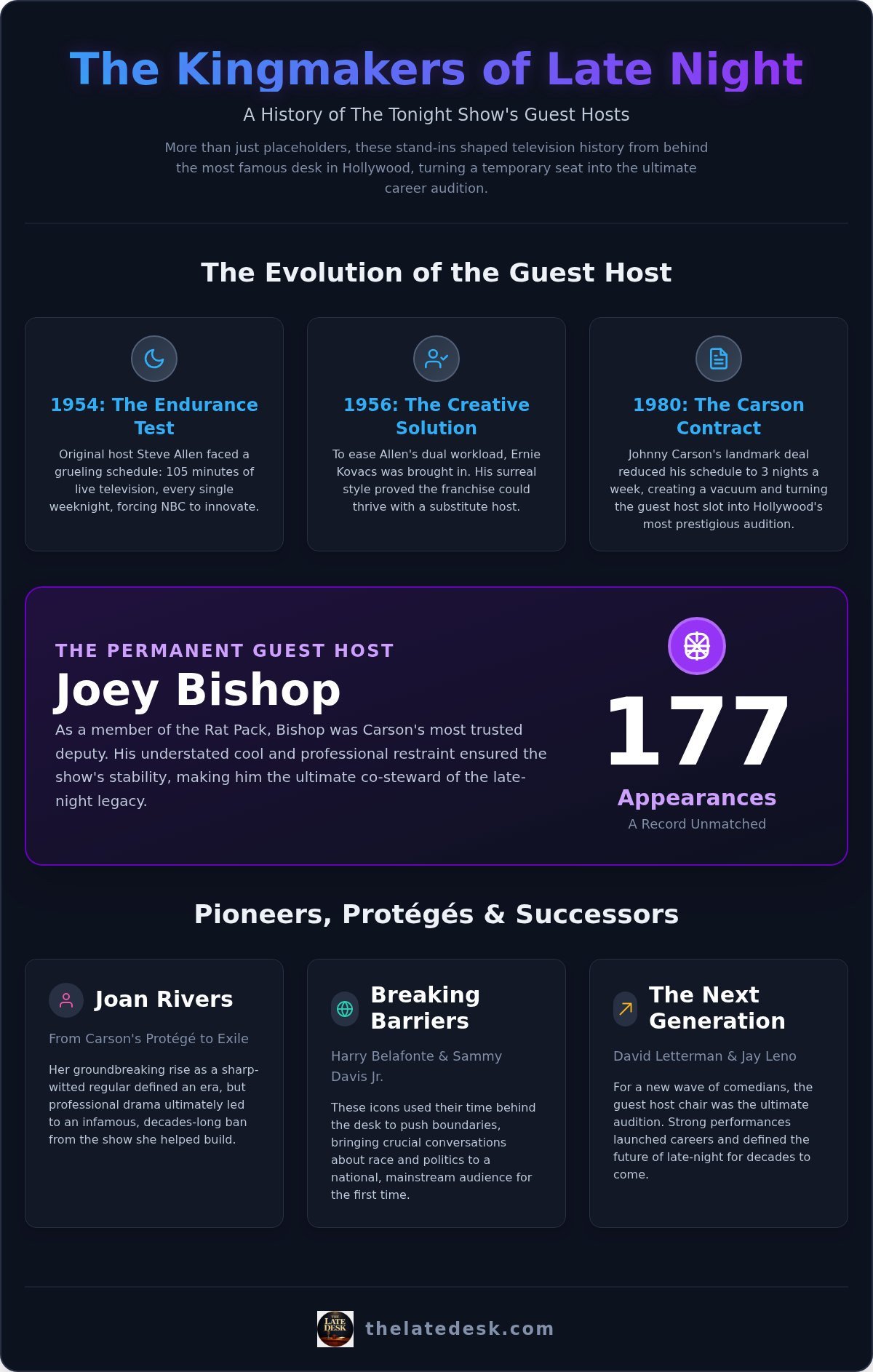
Before it became an American institution, the Tonight Show was a grueling endurance test. In 1954, Steve Allen faced a schedule that would break a modern performer. He was responsible for 105 minutes of live television, every single weeknight. The sheer volume of material required was staggering, and the toll on the host was visible. This pressure cooker environment forced NBC to innovate, creating a role that would eventually be filled by some of the most famous tonight show guest hosts in history.
Steve Allen and the Dual-Workload Dilemma
By 1956, Allen’s immense popularity led NBC to grant him a high-stakes Sunday night variety show. Suddenly, he was expected to compete with Ed Sullivan while still anchoring the late-night slot. The network’s solution was the Monday/Tuesday split. This arrangement introduced Ernie Kovacs to the desk, a man who didn’t just fill time; he dismantled the format. Kovacs brought a surrealist visual style that proved the franchise could survive, and even thrive, without its primary star. This era established that the guest host wasn’t just a placeholder, but a vital creative partner in the show’s survival.
The Carson Era: From 5 Nights to 3
When Johnny Carson took the reins in 1962, he initially maintained the heavy schedule of his predecessors. However, as his cultural leverage grew, so did his demand for a more sustainable pace. His landmark 1980 contract negotiation changed the industry forever. He traded screen time for professional longevity, reducing his mandatory appearances to just three nights a week. This created a massive vacuum in the schedule that NBC desperately needed to fill to maintain its advertising revenue.
The desk became a sacred space, and the invitation to sit behind it was the ultimate industry vetting. During this period, the role of famous tonight show guest hosts shifted from a desperate measure to the most prestigious audition in Hollywood. The transition was calculated and cold. If a performer could command the monologue and the couch while the King was away, they were essentially being groomed for the future of the medium. The guest host was no longer just a substitute; they were a protected asset in a multi-million dollar broadcasting empire.
This evolution turned the Tonight Show into a kingmaker. It wasn’t just about keeping the seat warm. It was about finding the few individuals who possessed the rare combination of wit, timing, and authority required to hold the attention of a nation that was just beginning to discover the power of late-night television. Yet the broader history of the midnight hour extends well beyond this single franchise, as forgotten late night tv hosts who shaped the genre were simultaneously taking risks and introducing innovations that the established giants were too comfortable to attempt.
The Permanent Guest Host: Joey Bishop and the Art of the 177-Show Marathon
While many celebrities enjoyed a single night in the spotlight, a few individuals earned a title that carried almost as much weight as the host’s own: the Permanent Guest Host. This wasn’t a casual designation; it signaled to the industry that the performer had the stamina to carry a multi-million dollar franchise for weeks at a time. Among the elite circle of famous tonight show guest hosts, Joey Bishop stood as the unrivaled champion of this grueling format, bridging the gap between a mere substitute and a co-steward of the late-night legacy.
Bishop brought a specific, understated cool to the desk. As a member of the Rat Pack, he possessed an effortless charisma that didn’t need to scream for attention. He was Carson’s most trusted deputy because he understood the delicate balance of the late-night ecosystem. He kept the seats filled and the laughter consistent without ever attempting to outshine the King himself. This professional restraint was his greatest asset, ensuring the audience felt they were in capable hands while they waited for Johnny’s return.
The Joey Bishop Record
His dry, almost melancholic wit resonated with an audience that appreciated subtle irony over loud slapstick. Carson and Bishop shared a mutual respect rooted in their shared understanding of comedic timing and professional boundaries. The Joey Bishop era of guest hosting was defined by his staggering record of 177 appearances, a milestone that remains a testament to his reliability and appeal. To understand more about the golden age of broadcasting, you can explore our historical television articles.
The Rivalry of the Stand-ins: John Davidson and Bob Newhart
Competition for the desk was fierce, often pitting vastly different styles against one another in a battle for ratings and network favor. John Davidson offered a “safe” musical-variety alternative, providing a polished, high-energy contrast to Carson’s sharp-edged monologues. In stark opposition stood Bob Newhart, who brought a deadpan brilliance that felt like a masterclass in psychological comedy. These weren’t just nightly ratings wins; guest host rankings became a primary metric for network executives, often serving as the foundation for future development deals and solo series.
The role of the guest host had become a high-stakes proving ground. It wasn’t merely about filling time anymore. It was about demonstrating a specific kind of television literacy that could sustain a career for decades. For performers like Bishop, Davidson, and Newhart, the Tonight Show desk was the ultimate platform to prove they were more than just entertainers; they were masters of the medium.
The Joan Rivers Era: From Carson’s Protégé to Late-Night Exile
In the early 1980s, the late-night landscape was a strictly guarded fraternity. While several famous tonight show guest hosts had successfully kept the seat warm, none had disrupted the status quo quite like Joan Rivers. With a razor-sharp wit that could dismantle a star’s ego in seconds, she became more than a substitute; she was a phenomenon. In 1983, NBC formalized this relationship by officially naming her the “Permanent Guest Host,” a title that signaled her as the undisputed successor to the throne.
The Rise of the First Lady of Late Night
Rivers possessed a singular ability to weaponize self-deprecation while simultaneously skewering the Hollywood elite. This duality resonated deeply with audiences, leading to a significant ratings surge whenever she commanded the desk. She didn’t just maintain the format; she energized it, proving that a woman could thrive in the high-pressure environment of the “Boys Club.” For a deeper look into the industry shifts of this era, read The Joan Rivers Tonight Show Ban: A Detailed Analysis. Her presence was a calculated risk that paid off handsomely for the network, at least initially.
The Fallout: A Professional Divorce
The transition from protégé to pariah happened with startling speed. In 1986, Rivers accepted an offer from the fledgling Fox network to host her own show, a move that would directly compete with Carson. The betrayal wasn’t the move itself, but the perceived breach of etiquette. Carson, a man who valued a specific code of loyalty, claimed he was never given the courtesy of a phone call before the news broke. He never spoke to her again.
This professional divorce had immediate and lasting consequences. Rivers was effectively erased from the show’s history, beginning a 26-year ban that would only be lifted long after Carson had passed. Her departure forced NBC to reconsider the “Permanent Guest Host” model, shifting away from grooming a single successor toward a more fragmented rotation of talent. The legacy of her exile cast a long shadow over the industry, illustrating the cold reality of power dynamics in the golden age of television. It remains a cautionary tale of how quickly a rising star can be cast into the wilderness when they challenge the existing hierarchy.
Breaking Barriers and Boundaries: Iconic One-Offs from Kermit to Belafonte
While the permanent guest hosts provided the show with its nightly rhythm, the “one-off” appearances often delivered its most profound cultural statements. In 1965, Sammy Davis Jr. stepped behind the desk as the first African-American host in the show’s history. It was a quiet revolution. He didn’t just fill time; he signaled to a divided nation that the most prestigious seat in television was no longer a segregated space. This was the beginning of the desk serving as a barometer for social change, proving that the role could be used for more than just keeping the seat warm.
Political Gravitas: The Harry Belafonte Week
In February 1968, the show took an unprecedented turn toward the serious. Harry Belafonte took over for a full week, but he didn’t rely on the standard parade of starlets and comedians. Instead, he invited Dr. Martin Luther King Jr. and Robert F. Kennedy to discuss the soul of the country. The 1968 Belafonte residency stands as a pivotal moment in media history, transforming a comedy institution into a vital forum for national conscience just months before both guests were tragically assassinated. He demonstrated that famous tonight show guest hosts could wield the monologue as a tool for activism, forcing a suburban audience to confront the realities of the Civil Rights movement.
The Novelty Hosts: Muppets and Movie Stars
Not every boundary-breaking moment was somber. In 1979, the production team faced a unique logistical nightmare: how to seat a puppet behind a desk designed for men in suits. Kermit the Frog’s hosting gig was a technical marvel that required a hollowed-out floor and a specialized desk, yet the audience accepted the Muppet as a legitimate interviewer. This absurdity kept the format from calcifying into a predictable routine, showing that the franchise could survive even the most surreal experiments.
Other stars brought a different kind of disruption. Burt Reynolds famously abandoned the script during his residency, leading to the infamous “shaving cream” incident that left the set in shambles. Even Don Rickles made history by proxy when he broke Carson’s wooden cigarette box while guest-hosting, a minor act of vandalism that led to one of the most celebrated unscripted segments in television history when Carson returned the next night. These moments of unpredictability were the lifeblood of the franchise. To dive deeper into these archival gems, visit our collection of historical television articles. They remind us that the Tonight Show was at its best when it allowed the guests to truly run the asylum.
The Audition of a Lifetime: How Guest Hosting Defined the Next Generation
By the mid-1980s, the Tonight Show desk had evolved from a nightly convenience into the most coveted real estate in American broadcasting. While the era of famous tonight show guest hosts had once been defined by reliable deputies like Joey Bishop, the new guard viewed the role through the lens of corporate succession. It was no longer about keeping the seat warm for Johnny; it was about proving that the seat belonged to them. This shift turned every monologue into a high-stakes referendum on the future of the network. The same hunger for recognition drove many forgotten late night tv hosts across the broader television landscape to take bold creative risks that the dominant franchises were unwilling to explore.
The Letterman vs. Leno Guest Hosting War
David Letterman’s 51 appearances introduced a revolutionary irony that challenged the very foundations of the talk show format. He was the cerebral alternative, a host who wasn’t afraid to let the audience in on the joke. Jay Leno, however, countered with a relentless touring schedule and a polished, professional reliability that NBC executives found irresistible. The tension reached a breaking point in 1987 when Leno was appointed as the exclusive guest host, a move that effectively ended the open rotation system. They weren’t just choosing a substitute; they were crowning a successor. This decision turned the guest host chair into a battleground, forever altering The Lineage of Laughter: A Definitive History of Tonight Show Hosts.
The End of an Era
The modern era has seen this once-vital institution wither into obscurity. In a media environment driven by viral clips and personal branding, current hosts like Jimmy Fallon or Stephen Colbert rarely risk their platform by handing the reins to a potential rival. The preference for re-runs and “best-of” highlights over live stand-ins has robbed the industry of its most effective proving ground. It’s a loss that felt deeply by those who remember the desk as a place of discovery and danger.
We’ve moved away from the “story behind the story” that occurred when a guest host would unexpectedly capture the nation’s imagination. The famous tonight show guest hosts of the past were more than just placeholders; they were the architects of a transition that defined the golden age. Today, the absence of the permanent guest host marks a shift toward a more controlled, less spontaneous form of entertainment. The Tonight Show stand-in was once a cultural barometer, a high-stakes gamble that proved late-night television was a living, breathing entity rather than a curated loop of digital highlights.
The Legacy of the Late-Night Stand-In
The history of late-night television is written in the moments when the primary star stepped away. From the endurance-saving rotations of the 1950s to the high-stakes succession battles of the 1980s, the role of the guest host transformed from a simple necessity into a cultural kingmaker. While the modern era has largely moved toward a more controlled and predictable format, the stories of these famous tonight show guest hosts remind us that the medium was once a place of genuine discovery and professional danger.
We’ve explored how icons like Joey Bishop and Joan Rivers navigated the delicate power dynamics of the industry, proving that the seat to the left of the host was often the most influential spot in Hollywood. Understanding these hidden layers allows us to appreciate the golden age not just for its laughter, but for the complex human dramas that unfolded behind the scenes. If you are a fan of nostalgic storytelling and expert commentary on classic television, explore the full archives of Late Night TV History at The Late Desk. Our in-depth historical analysis invites you to rediscover the moments that defined a generation. Lean in and discover the story behind the desk; there’s always more to learn about the legends who kept the lights on.
Frequently Asked Questions
Who guest hosted The Tonight Show the most times?
Joey Bishop holds the definitive record with 177 appearances behind the desk. He was the most prolific of all the famous tonight show guest hosts, serving as Johnny Carson’s most reliable substitute throughout the 1960s and 1970s. His dry wit and professional restraint made him a favorite of both the network and the audience. This record remains a staggering milestone in the history of late-night television broadcasting.
Why did Johnny Carson stop using guest hosts toward the end of his career?
Carson shifted toward using an exclusive guest host to stabilize the show’s succession plan. In 1987, Jay Leno was appointed as the sole guest host, effectively ending the era of a revolving door of performers. This move was largely a corporate decision by NBC to groom a clear successor and prevent the fragmented ratings that occurred with a rotating cast. It marked the end of the traditional guest-hosting format.
Who was the first woman to guest host The Tonight Show?
Arlene Francis became the first woman to host the program on February 1, 1956, during the Steve Allen era. While Joan Rivers is more famous for her “Permanent Guest Host” title, Francis broke the gender barrier nearly three decades earlier. Her appearance was a rare exception in the male-dominated world of early broadcasting. It paved the way for future female entertainers to command the desk during the golden age.
Was David Letterman ever a guest host for Johnny Carson?
David Letterman was a frequent guest host, appearing behind the desk 51 times between 1978 and 1982. His innovative and often ironic style made him a favorite of Carson, who eventually helped him secure his own show, Late Night with David Letterman. These appearances served as a critical audition for his future career. They established him as one of the most influential figures in the history of the medium.
Why was Joan Rivers banned from The Tonight Show?
Joan Rivers was banned after she accepted an offer to host her own competing show on the Fox network in 1986. Carson felt deeply betrayed because she didn’t call him personally to discuss the move before it was announced. This perceived breach of loyalty resulted in a 26-year exile from the program. She didn’t return to the NBC desk until 2014, long after Carson’s retirement and death.
Who was the first African-American to host The Tonight Show?
Sammy Davis Jr. made history as the first African-American guest host on April 2, 1965. His appearance was a landmark moment for the franchise, breaking racial barriers in an era when late-night television was almost exclusively white. This opened the door for other famous tonight show guest hosts like Harry Belafonte and Bill Cosby to bring their unique perspectives and social activism to the national stage.
Did Kermit the Frog really host The Tonight Show?
Kermit the Frog hosted the show on April 2, 1979, in one of the most memorable novelty episodes ever produced. The production required significant technical adjustments, including a specialized desk and a hollowed-out stage floor for the Muppet performers. Despite the absurdity of a puppet interviewing celebrities like Vincent Price, the episode was a ratings success. It remains a legendary archival moment that proved the format’s versatility.
Who were the “permanent” guest hosts of the Carson era?
The title of “Permanent Guest Host” was officially held by only a select few, most notably Joey Bishop and Joan Rivers. These individuals weren’t just one-off substitutes; they had contracts that guaranteed them regular weeks behind the desk. Other frequent regulars included John Davidson and Bob Newhart before Jay Leno took over the role exclusively. This position was a distinct professional rank that signaled a host’s elite status within the NBC hierarchy.