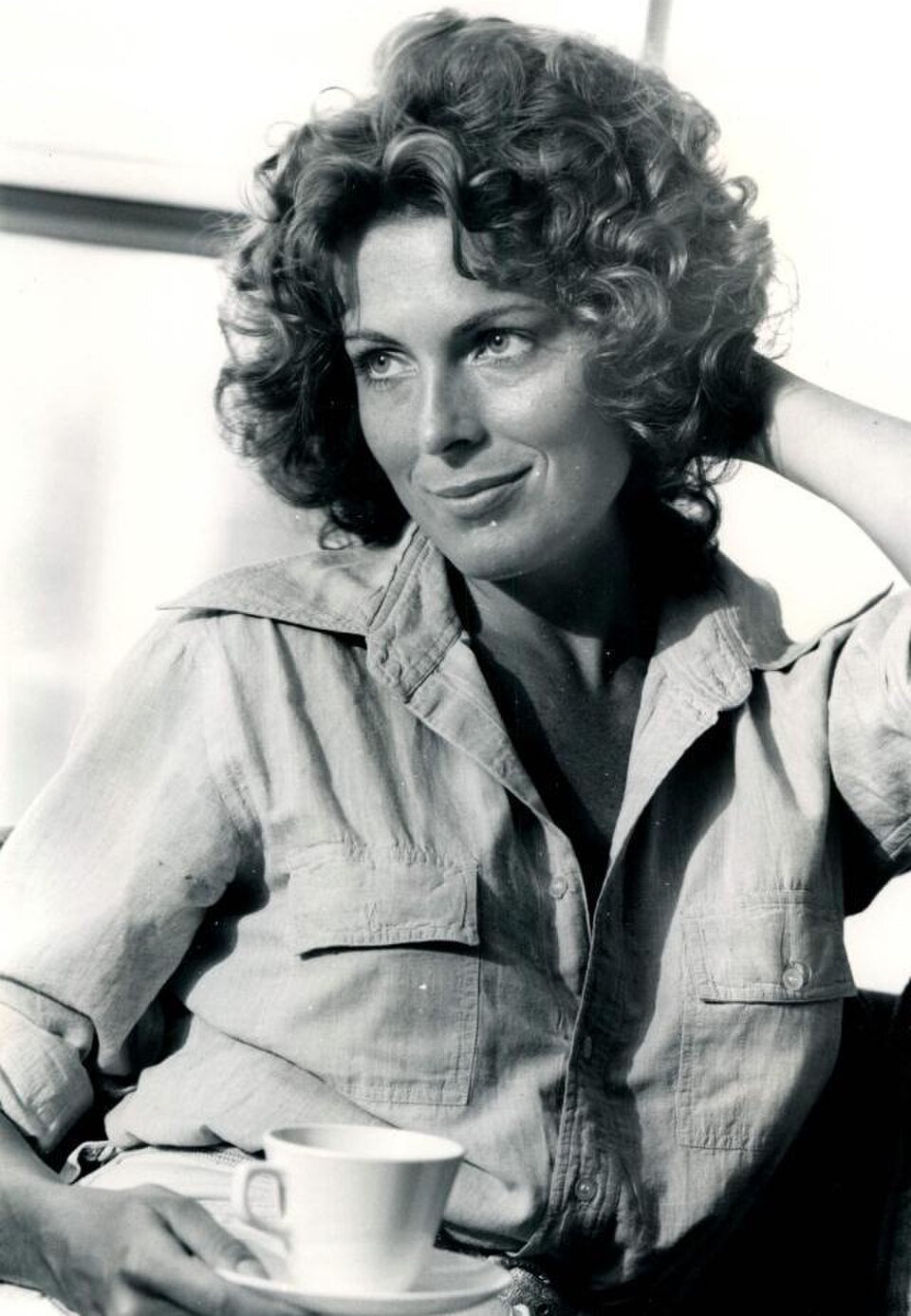
In January of 1974, a tall redhead walked out onto Johnny’s stage – a name most of the country hadn’t caught yet; and sat down like she’d wandered in from someplace more interesting than a television studio.
She wasn’t nervous. She just didn’t seem to know the rules — or she knew them and didn’t much follow them. Johnny would set up an ordinary question and she’d come at it sideways, plainspoken, like the two of them were talking over the back fence instead of sitting under the lights on the biggest show on national television.
Johnny asked where she was living these days, and she told him about the treehouse. Not a figure of speech. An actual tree, with an actual platform, that she’d actually climbed up into and called home.
By then Johnny had been behind that desk a dozen years, and he’d seen almost every kind of guest there was. This was one he couldn’t read.
Her name was Joanna Cassidy. Over the next four years she’d be back on that couch three more times, and each time she’d hand him something he didn’t expect.
Maybe the name doesn’t ring a bell right off — but stay with me, because there’s a raincoat in this story too, a clear plastic one she held onto for twenty-five years, and by the end I think you’ll remember the face.
The woman nobody could file away
Here’s what the couch couldn’t see.
The tall redhead swapping stories about treehouses was, by that January night, pushing thirty — a mother of two who’d just come out the far side of a ten-year marriage. She’d grown up in Haddonfield, New Jersey, the daughter and granddaughter of painters, and she’d gone to Syracuse to study art, not acting.
Somewhere in there she married a doctor, followed him to San Francisco while he built a psychiatric practice, and modeled to help pay for it. Two kids came. Then the marriage came apart. And she looked at her life at the edge of thirty and decided to drive to Los Angeles and see if she could act.
That’s a lot of living to walk onto a stage with. Most guests hid it. She didn’t hide anything.
So when Johnny asked the ordinary questions, he kept hitting the parts other people would have smoothed over. Where are you living? A treehouse. What do you do at night? Wear socks to bed, always.
Joanna said it the way you’d mention you take your coffee black — no apology, no wink, no sense that she’d handed him anything unusual. He’d been sitting across from beautiful, careful guests for a dozen years, women who’d been coached on what to say and how to say it. Here was one who’d apparently never gotten the memo, or had read it and thrown it out.
And you could feel him enjoying it. Not laughing at her — leaning in. There’s a difference, and the audience heard it, because they leaned in too.
Everything that almost happened
She was not an overnight anything.
Look at what came after that first Carson appearance and you’d think you were reading the résumé of a woman on her way up. The Outfit, opposite Robert Duvall. Bank Shot, her first real co-star billing, next to George C. Scott. Guest spots on everything with a camera – Dallas, Taxi, Starsky and Hutch, Charlie’s Angels. She worked constantly. That’s the part people miss about her: she was never not working.
And yet the big thing kept not happening.
In 1975, she read for the lead in a new show about a superhero in star-spangled shorts. By some accounts she won it — the title role in Wonder Woman — before the part went to Lynda Carter and turned Carter into a household name for a generation.
Joanna Cassidy went back to the guest spots. She’d get a series of her own, and it would die. She’d get another, and it would die too. Over about a decade she headlined show after show that the networks aired for a few weeks and quietly buried.
Here’s the thing worth sitting with. A lot of careers would’ve bent under that you start shaving off the odd corners, saying the coached thing, trying to become the version they keep almost buying. As far as anyone could tell, Joanna never did. She kept showing up as exactly herself, treehouse and all. And she kept coming back to Johnny’s couch, where being exactly herself was the whole point.
Seventeen days
The fourth and last time she sat with Johnny was April of 1978, and she came in on roller skates.
That wasn’t a stunt for the show. Skating was just something she did : an old bio from those years lists it right alongside needlepoint and pen-and-ink drawing, the ordinary hobbies of a working actress.
So Joanna Cassidy rolled out onto his stage, and the band picked up a tune, and for a minute the biggest show on television belonged entirely to a woman going in easy circles on wheels, laughing that big laugh of hers. If you were watching that spring night, you saw it live, Johnny half-delighted, half-worried she’d go down, and the audience with him.
She had good reason to be glowing. She was there to plug a brand-new NBC series, her own, premiering in three weeks. A show built around her.
It was called Rollergirls. NBC put the first episode on the air on April 24th. Then it moved the night. Then it aired a couple more, out of order, into the spaces where nothing else was scheduled.
By the tenth of May the last of the four filmed episodes had burned off, and on the sixteenth the network announced there would be no more. Seventeen days, start to finish. Joanna had skated onto Johnny’s couch selling a show that was cancelled before the calendar page turned.
Her shows kept dying. She didn’t.
The snake knew

Joanna Cassidy at the 2007 Jules Verne Adventure Film Special Awards Presentation, credit to lukeford.net
Now here’s where the whole thing turns around on you.
Those roller skates weren’t just a hobby she happened to mention. Joanna Cassidy used to skate the Venice boardwalk with one of her pet snakes draped around her shoulders – she kept several over the years, a whole houseful at one point, including a Burmese python named Darling.
Picture that. The woman Hollywood couldn’t quite figure out how to package, gliding down the boardwalk with a python around her neck, in no hurry to be anybody but herself.
And that – that exact quality is what finally made her permanent.
In 1982, Ridley Scott was casting a strange, rainy science-fiction picture called Blade Runner, and he needed a woman who could play a killer built to look human. Also, he needed someone who seemed genuinely dangerous, genuinely other.
Joanna Cassidy walked in and, the story goes, mentioned she owned her own snake. And she got the part. Darling went into the movie as the serpent her character carries. She’s on screen barely ten minutes, as a replicant named Zhora, and yet that death – the woman in the clear plastic raincoat, crashing through glass is one of the images the whole genre never let go of.
Everything the couch couldn’t smooth down, everything the networks couldn’t sell, Ridley Scott put in front of a camera and called exactly right.
Which brings us back to the raincoat. It never sat right with her, how they’d shot her death – a stunt double in a bad wig taking the fall while the real Cassidy watched from the side. It stuck with her for twenty-five years. “What I did obsess over,” she said later, “was the stunt double going through the glass with a bad wig.”
So in 2007, when they were remastering the film, she talked them into letting her fix it. Pulled out the old coat, found it still fit, and went through the glass herself, at last. A few years after that, past sixty-five, she staged the one big scene the movie had cut for money back in ’82 — a snake dance she’d never gotten to do — filmed it on her own terms, and put it out into the world. Two trips back. Two things other people had left unfinished on her, finished.
Somewhere in the middle of all that, in 1984, she won a Golden Globe – for a sharp little NBC comedy called Buffalo Bill that the network cancelled anyway, after two seasons. Of course they did. By then it would’ve been strange if one of her shows had lived.
What we can’t quite pin down
A few things about her don’t sit still, and it’s only fair to say so. The record can’t quite agree on when she was born; some sources say 1944, some say 1945, which means she was either twenty-eight or twenty-nine that first night, and is either eighty or eighty-one as you read this.
The Wonder Woman story comes down to us secondhand; that she was in the running seems clear, that she was actually cast and then replaced is the kind of thing that hardens into legend whether or not it happened exactly that way.
And the tidy dates of her middle two Carson visits are fuzzier than I’d like. None of it changes the shape of the thing. It just means some of the edges are honestly blurred.
The one nobody filmed
Picture her one more time, but this time not on Johnny’s couch, not on the Blade Runner set, but on the Venice boardwalk on an ordinary afternoon. Roller skates. A python across her shoulders. Nobody filming, nobody she’s trying to impress, no version of herself she’s performing for the cameras.
Just a tall redhead rolling down the boards in the sun, being precisely, unfixably who she was. That’s the one nobody thought to point a camera at. It’s also the one you’ll remember.