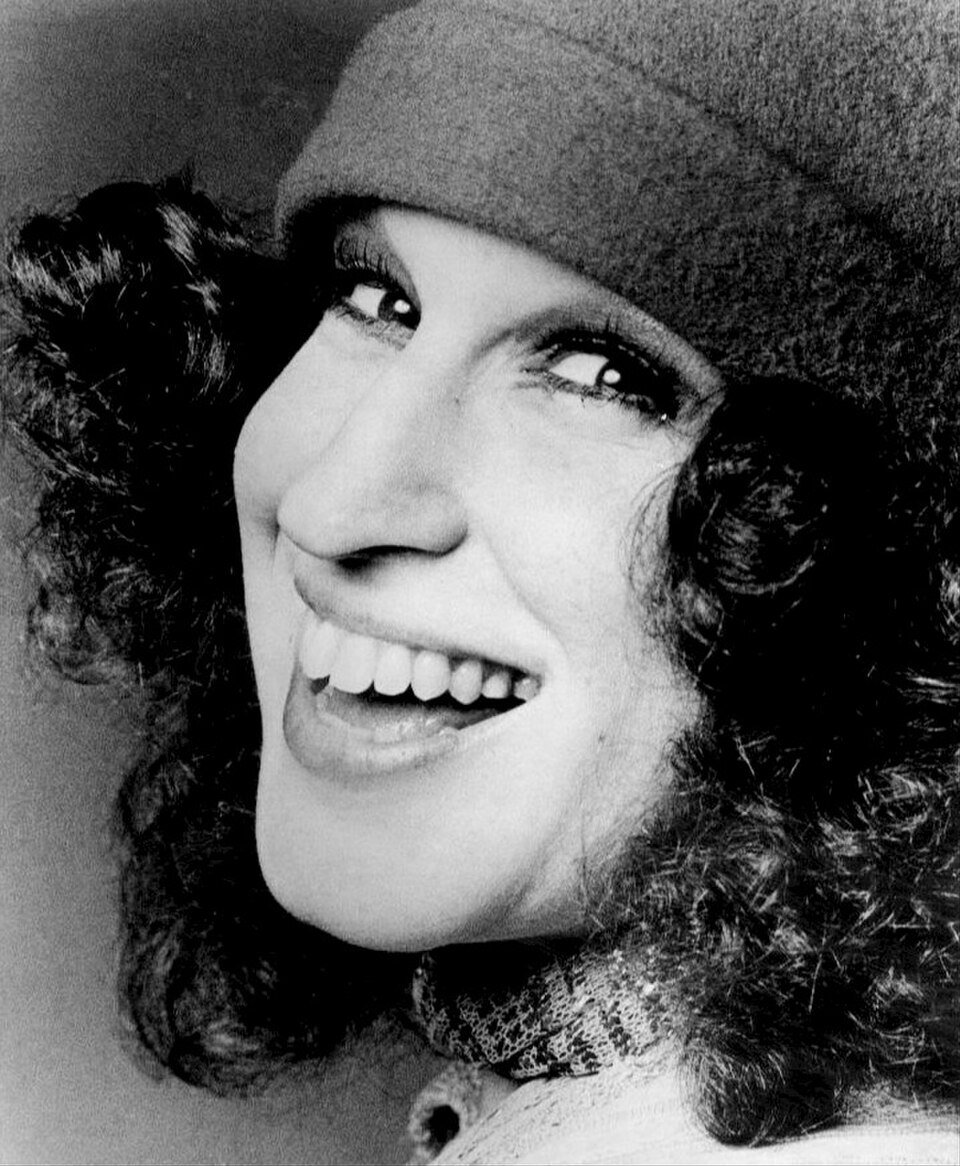
Photo of Bette Midler by Francesco Scavullo
In 1970, Bette Midler was singing in a bathhouse. Not a metaphor. An actual gay bathhouse on the Upper West Side, a place called the Continental, where the crowd sat around the pool in towels while she stood up front and belted out old songs. She had no record deal and no movie, and hardly anyone outside New York knew her name.
That same year, she got herself booked on the biggest show in America.
Twenty-two years later, when Johnny Carson could have picked anyone alive to sit beside him on his way out the door, he picked her. Bette Midler was his last guest, and the reason why goes back to that first night in New York – a night nobody can watch anymore.
The tape got thrown out years ago. He’d put her in front of the whole country before she had a record to sell, and she never let him forget he was the first.
This is the story around those famous clips. Who she was before the couch. What Johnny’s belief actually bought her. And why, on his second-to-last night on the air, she left the coolest man on television in tears.
The clips are all below, twenty years of them. This is what was happening around them.
Before the world knew her
She grew up the odd one out. Born in Honolulu in 1945, raised in a working-class stretch of Aiea, the daughter of a house painter, and the only Jewish family for miles in a mostly Polynesian neighborhood. She once brought a note to school explaining she’d been out for Yom Kippur, and the teacher told her there was no such holiday.
Money was thin. She couldn’t afford new records, so she sang along to the family’s old ones, the 78s from the twenties and thirties, until she wore the grooves flat. She’s described herself back then as “the white girl, the only one for miles around.” She was also class valedictorian. Both things were true.
She got out the first chance she had. A bit part as a seasick passenger in the film Hawaii paid for a one-way trip east. By 1965 she was in New York with about a thousand dollars and a room at the Broadway Central Hotel. “I came to New York because I had to,” she told Interview. “I just had to.”
She kept the lights on with a filing job and a glove counter, whatever paid the rent. Then she landed in the chorus of Fiddler on the Roof, and by the end of a three-year run she’d worked her way up to Tzeitel.
Then she found the room that changed everything.
In 1970 she took a weekend gig at the Continental Baths, in the basement of the Ansonia. The setup was exactly as strange as it sounds. She’d stand near the pool in a slip and heels, a young piano player named Barry Manilow beside her. She sang to a room of men in towels who’d come for the baths and stayed for her.
That’s where the Divine Miss M got built: the brassy patter between songs, and the old Andrews Sisters numbers sung like she’d written them herself. Word traveled fast. Within months she was the most talked-about new act in gay New York, and then in New York, period.
The head of Atlantic Records came down to see her and wanted to put the bathhouse act straight onto a record. She turned him down. By his account, she didn’t want to be known as “the girl who sings at the Turkish baths.”
The man who put her on television
Bette’s booking on the show that mattered came through her first manager, Budd Friedman, who ran the Improv and had watched plenty of young acts get their first real break.
So in 1970, before the album, before the Grammy, before most of the country had the faintest idea who she was – Bette Midler walked out onto The Tonight Show.
Understand what a gamble that was. The show was still in New York then, at 30 Rockefeller Plaza, two years shy of the move to California. The crowd Midler had built was downtown and gay; Carson’s audience was the entire country, Nebraska to Florida, sitting up in bed. Putting one in front of the other was not an obvious thing to do in 1970.
He did it anyway. It worked the way a Carson booking always worked back then: you went on his show, and the next morning you existed to all of America. She became a regular and kept coming back. For a stretch she even opened for his stand-up act out in Las Vegas.
Here’s the strange part. That first appearance – the one that launched her nationally – you can’t watch it. Nobody can. NBC held onto Carson’s early tapes for a while, then threw them out to clear storage after the show moved to Burbank in 1972. Only thirty-three complete episodes from before that move are known to survive; even Carson’s own first night as host is gone.
When he later found out the network had wiped the archive, he was furious. So the single most important booking of Midler’s early career, the night the country met her, lives now only in the memory of whoever happened to be watching. The tape went in the trash.
She kept walking back through that curtain for twenty years, and every time, she carried the same thing with her: he’d been the first to bet on her. Not every performer Carson lifted up stayed close to him. The comic he later made his permanent guest host, Joan Rivers, left his good graces for good, and that ended very differently. Midler never did. She just kept coming home to his stage. Then came the last time.
The last guest
May 21, 1992. Carson was three decades into the job and one night from leaving it forever.
He’d hand-picked his final two guests: Robin Williams, and Bette Midler. (People remember it as the last show, but it was the second-to-last.) The actual finale, the next night, had no guests at all. Still, he called Midler his last guest, and so does she.)
There’s a symmetry to it. The man who put her on national television before anyone else wanted her in the chair beside him when he said goodbye.
What the audience didn’t see was the work behind it. She’d called in Marc Shaiman, her musical director, to help her build the night. The two of them, with the writer Bruce Vilanch, started by rewriting an old Judy Garland number called “You Made Me Love You.”
They turned it into a loving roast of the man himself, teasing him about his marriages and the whole Carson legend. She made him laugh until he could barely sit up.
Then came the song everyone remembers, and it was Shaiman’s idea. It hit him in the shower, and he called her dripping wet to say he’d found the one. “One for My Baby,” the old last-call ballad.
Bette balked. “I can’t sing that song,” she told him. “I’ll be too nervous to hit those notes.” He talked her into it once they found the right key. Then he did a bold thing: he rewrote a single line of a Johnny Mercer lyric so the song spoke straight to Johnny.
Carson came to the rehearsal himself. He was a longtime fan, and Vilanch, watching him, thought he was afraid he’d break down on the air. He thanked her for doing the show at all, in the driest way he had. “You need this,” he told her, “like a root canal.”
And then the thing everyone remembers happened. Carson started to cry. This was the man who’d spent thirty years never letting the country see him feel much of anything, and there he was with his head propped on one hand, watching her from the desk. She’d also pulled him into a duet on “Here’s That Rainy Day,” a song he’d once called his favorite.
The performances are all in the video above; watch his face. She won an Emmy for those few minutes.
The next night, alone on his final show, Carson pulled up a stool and looked back over thirty years. He said there were early moments he wished he could show the audience and never could, because the tape no longer existed.
One of the ones he named was the first time Bette Midler ever walked out on his stage. Twenty-two years after he put her on television, he was still thinking about the night it started. That night was gone.
What we can’t nail down
A couple of honest gaps. The exact date of that first appearance isn’t settled. Every reliable account puts it in 1970, in New York, about two years before the album made her a household name.
One detailed Midler archive lists August 12, though the precise day isn’t nailed down anywhere solid. What’s certain is the shape of it: 1970, before she was anyone, and the footage destroyed.
Some of what passed between them on the air, the lines he handed her and the things she fired back, survives only in the clips now. There’s no dependable transcript. Where the exact words matter, they’re in the video, not here.
A little bit of devil, a whole lot of angel
She’d been telling people for twenty-two years that he saw it first. When he died in 2005, she said the rest of it. Behind the private face, she wrote, he was a deeply generous man, and a whole generation in show business owed him their careers.
Being his last guest had been one of the most moving nights of her life. Then, the way only she could, she summed the man up: “a little bit of devil, a whole lot of angel.”
Miss the kind of television where a moment like that could just happen, live, with nobody sure how it would land? That’s what this channel is for. Subscribe — there’s a new story every week.