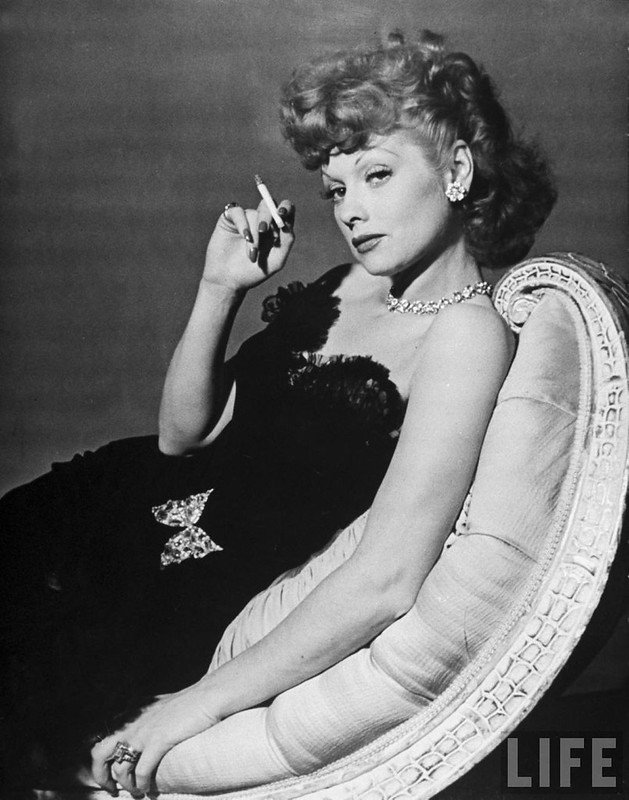
On the night of March 22, 1974, the first guest on The Tonight Show had already played that Burbank stage more than a dozen times, and everyone in the building knew what her visits usually meant. When Lucille Ball came on, sooner or later Johnny lost the wheel of his own program, and that night she started early, running things from behind the curtain before he’d even gotten her name out.
What none of it showed was the month she’d just come through. Four days earlier, the last episode of her weekly series had quietly aired, closing out twenty-three unbroken years of Lucy on television every week.
Two weeks before that, her big movie musical had opened in New York to reviews that came after her by name, the worst of her career. Two of the biggest things in her working life, both gone inside a single fortnight, and here she was at sixty-two, walking out under the lights to make a room full of strangers laugh.
That’s the woman who sat down and took Johnny’s whole show away from him. Though “guest” was always the wrong word for her. The woman crossing his stage had run her own Hollywood studio, and owned more of television than he ever would.
This is the story around those four famous nights on The Tonight Show – the empire Lucille Ball built before she ever sat in Johnny’s chair, what was falling apart off camera while she was winning on it, and how the guest who kept hijacking Carson’s program ended up, six years later, making him the guest on hers.
How Lucille Ball Built the Desilu Studios Empire
Start with the thing the applause never mentioned. By the time Lucy walked onto that stage, she wasn’t just a comedian who visited television. She had owned a piece of it outright.
Inventing the Television Rerun
Back in 1950, when the networks wanted her radio show turned into a TV series, she and Desi Arnaz put up five thousand dollars of their own money to shoot the pilot, and they held onto the rights. They insisted the show be shot on 35mm film in front of a live audience, using three cameras, an argument they had to win against the network. Because it was on film, it could be run again.
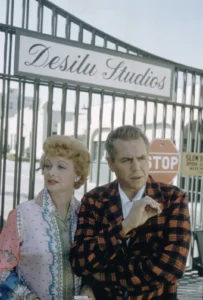
Ball and Arnaz outside Desilu Studios. Source: Reddit
Here is the piece that mattered most, and it was pure business. Shooting on film cost more, and the network balked at paying for it. So the couple made a trade: they would take a cut in their own salary to cover the difference, in exchange for owning the finished films outright.
The network said yes, thinking it had saved money. What it had actually done was hand two performers the negatives to a show that would run somewhere in the world, more or less, forever. They had invented the rerun and kept the keys to it. The residuals from that one arrangement made them the first millionaires television ever produced.
Buying the RKO Studio Lot
The money went back into the company. In 1957 they bought RKO, the very studio that had once kept Lucy under contract as a decorative extra, and turned Desilu into the largest independent television operation in the country. It was a real lot with real acreage, and it wasn’t only Lucy’s own comedies coming off it. F
For a while, Desilu was the production home for a startling run of shows people remember without ever knowing who made them: The Untouchables, plus the lot that housed The Andy Griffith Show and The Dick Van Dyke Show.
The First Woman to Run a Major Studio
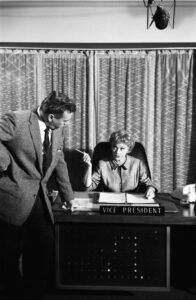
Lucille Ball as Vice President. Source: Reddit
Then the marriage came apart, the way the show it inspired never did. And in 1962, Lucy bought out Desi’s half and ran the whole thing herself — the first woman ever to head a major Hollywood studio.
She never wanted to be a businesswoman, by her own account, and she ran it anyway. Here is what running it meant. A script for a science-fiction show landed on her desk that the men around her thought was strange, expensive, and doomed; one executive told her flatly it could sink the studio. She put the studio’s money behind it. That show was Star Trek. The same office greenlit Mission: Impossible.
For a stretch in the 1960s, the woman who would later reach into a purse and make Johnny Carson fall apart on camera was the person deciding what a large part of America got to watch.
So when Ed McMahon read her name and she came through that curtain, the live audience saw the funniest woman in America. What they were also looking at was the boss.
March 1974: The Month Everything Ended
Now put that woman inside March of 1974, because the timing is the part almost nobody talks about.
Fifteen days before the appearance, her movie had opened in New York. It was the film version of a hit Broadway musical, and she had wanted the part badly enough to help bankroll the picture herself, roughly twelve million dollars riding on it. The critics did not merely dislike it. Time magazine, reviewing the thing, said she had been turned over the years into a “national monument” and now performed like one. The picture took back about half its cost. She never made another movie as long as she lived — not because the offers dried up slowly, but because she decided, right there, that she was done with film.
Leaving Weekly Television
Four days before the appearance, the other shoe. The final episode of her weekly series aired on March 18, ending a run that stretched all the way back to 1951. Twenty-three years. Every week, one network, one woman.
Lucy had been a Monday-night fixture on CBS for more than two decades, a name the network built whole evenings around, and as of that Monday she was off the air. Her contemporaries from television’s first age were nearly all gone from weekly series by then; she had outlasted the entire generation she started with, and now she’d stepped off too.
If you were home watching Carson that night, you saw none of it. You saw her skip out in a purple suit, hug him, swat his hand away when he reached to feel the fabric, and take the room apart. What you could not see was that she had walked into the studio carrying the worst reviews of her career in one hand and the end of her television life in the other, and had decided the audience would get the best of her anyway.
That was the discipline of the thing. The wreckage stayed off camera. The performance did not know it was standing on it.
Why the Tonight Show Was the One Stage She Couldn’t Script
Here is the detail that makes those Tonight Show nights stranger the longer you look at them.
Lucille Ball did not improvise. On her own shows, everything was written, rehearsed, and nailed down before a camera ever rolled. When reporters asked her about it late in her life, she was blunt about the method: they knew the characters cold, there was “no ad-libbing,” they read what the writers gave them and did the work. Colleagues who worked on her series described the same thing from the inside: a set run with total control, a star who treated a half-hour comedy like an operation. Off camera she was famously all business, the chairman of the board.
Carson’s Unscripted Stage
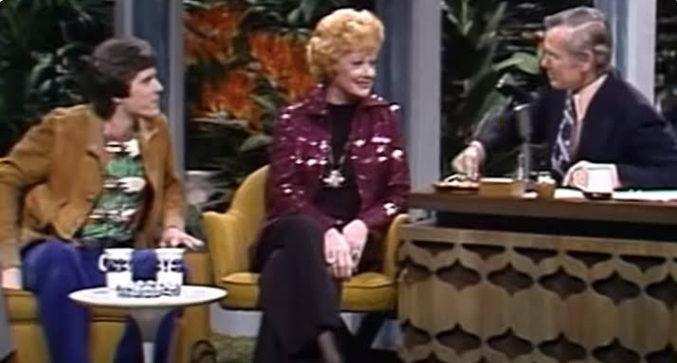
Which is what makes the couch so odd. Carson’s show was the one major stage in America with no script at all. No second take, no rehearsal, no writers’ room to catch a line before it went out to millions of people. It was the exact opposite of every environment she had ever chosen to work in.
And yet the free fall was the point. Watch the tapes and you can find the tell. She said it out loud to him more than once, some version of asking why she still got so nervous coming out to see him after all these years.
A woman who had commanded studios, who staged her own comedy down to the inch, sat across from Johnny Carson without a net and let the whole thing be unrehearsed. Lucy brought a Cosmopolitan quiz to run on him. She brought a set of false teeth. She brought a box of live earthworms. She turned up prepared to be spontaneous, which is its own kind of paradox, and the preparation was the gift she gave a man whose entire show ran on not knowing what came next.
He, of all people, understood exactly what that was worth. The most improvisational host in television had, as his favorite recurring guest, the most controlled performer in it – willing to hand him the wheel precisely because she trusted where he’d steer.
How the Guest Became the Host: The Fred Silverman Connection
There is one more figure standing behind this whole story, and most people watching never knew his name. Fred Silverman.
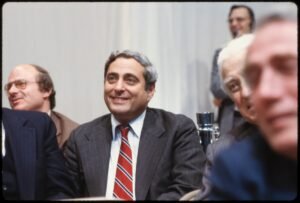
In the early 1970s, Silverman ran programming at CBS, head of the department, the man deciding the schedule, and he was busy clearing out the network’s old guard. The rural comedies, the family shows, the classic-era holdovers all went, replaced by a harder, newer lineup: the shows about divorced women and army surgeons that defined the decade.
Lucy’s brand of comedy was exactly the kind he was phasing out. Yet when she moved to end her series after five seasons, it was Silverman who talked her into one more year, because a name like hers was too valuable to simply let walk out the door. He was, a Time cover story would later call him, the man with the “golden gut” for what America would watch.
Ending the weekly series didn’t end the relationship. She stayed under contract to CBS, and across the next few years she turned out a string of specials for them. She was still, on paper, a CBS asset, the network’s grand old name, more than two decades after she’d first signed on. That contract history is what gives the next turn its weight.
The NBC Reversal
Follow Silverman forward and the story bends into something almost too neat to be real. He left CBS, spent three years running ABC, and by 1978 had taken over as president of NBC — Johnny Carson’s network. In February 1980, NBC aired a special built on precisely that fact: a comedy about Fred Silverman coaxing Lucille Ball out of retirement and away from CBS, the network that had been her home since 1951. She played herself. The premise was the business she had actually lived.
Carson agreed to appear in it. And here is the reversal the whole arc had been building toward. When he walked onto the set: her set, her production, her name on the special – the scene had him gravely handing her a stack of pages: a guide to how one ought to run a television show. The gag only lands because everyone involved knew the truth underneath it. She had been running television, for real, since before he had a desk at NBC.
Letting a guest take over your program, night after night, is not something the King of Late Night did casually. When another performer eventually sat in that chair as a regular guest host and then built a rival late-night show of her own, it detonated one of the most famous friendships in Carson’s life, though that ending belongs to Joan Rivers, and it’s a very different story. With Lucy, there was never a throne to defend. She’d owned a bigger one first, and he knew it.
The Last Years and the Final Verdict
They kept turning up in each other’s frames for years: tributes, specials, award shows, the easy shorthand of two people who no longer had anything to prove to one another.
The last time they were on camera together came on January 23, 1989, at the Television Academy Hall of Fame, where she inducted her friend Red Buttons. Both of them had already been enshrined there themselves. Three months later, on April 26, 1989, Lucille Ball died. She was seventy-seven.
The Greatest Television Icons
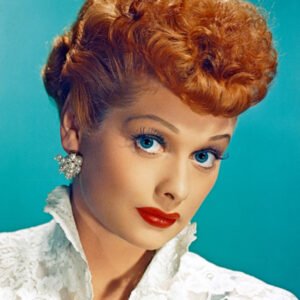
Then there is the coda, and it is a strange, telling one. In 2007, TV Land and Entertainment Weekly assembled a list of the fifty greatest television icons of all time. Their panel of experts put Johnny Carson at number one and Lucille Ball at number two.
A tidy verdict – the King of Late Night, and the Queen of Comedy just behind him. The people who actually cast votes are said to have flipped the order, and reasonable accounts of the ranking disagree on the details of that public tally. The record leaves it split: officially second, popularly first, depending on whom you asked.
A word on what’s disputed, because this reader deserves the honest version. It was widely reported at the time that Ball herself chose to end her weekly series in 1974 to chase other work. A number of accounts since have argued the network had cooled on her, with ratings slipping in the final season, and that the decision wasn’t entirely hers to make. Both versions have been told by people who were there, and both are still standing.
What isn’t disputed is the picture we started with. A woman walks onto a stage during the worst month of her professional life, having lost her movie and her show inside two weeks, and takes the room anyway – because taking rooms was the smallest thing she knew how to do.
Six years later, the most powerful man in late-night television stood on her set and handed her the instructions for a job she’d been doing, brilliantly, since before he owned a chair to sit in.
If you love television the way it used to be, subscribe to Late Desk on YouTube. We bring you one more of these stories every week.