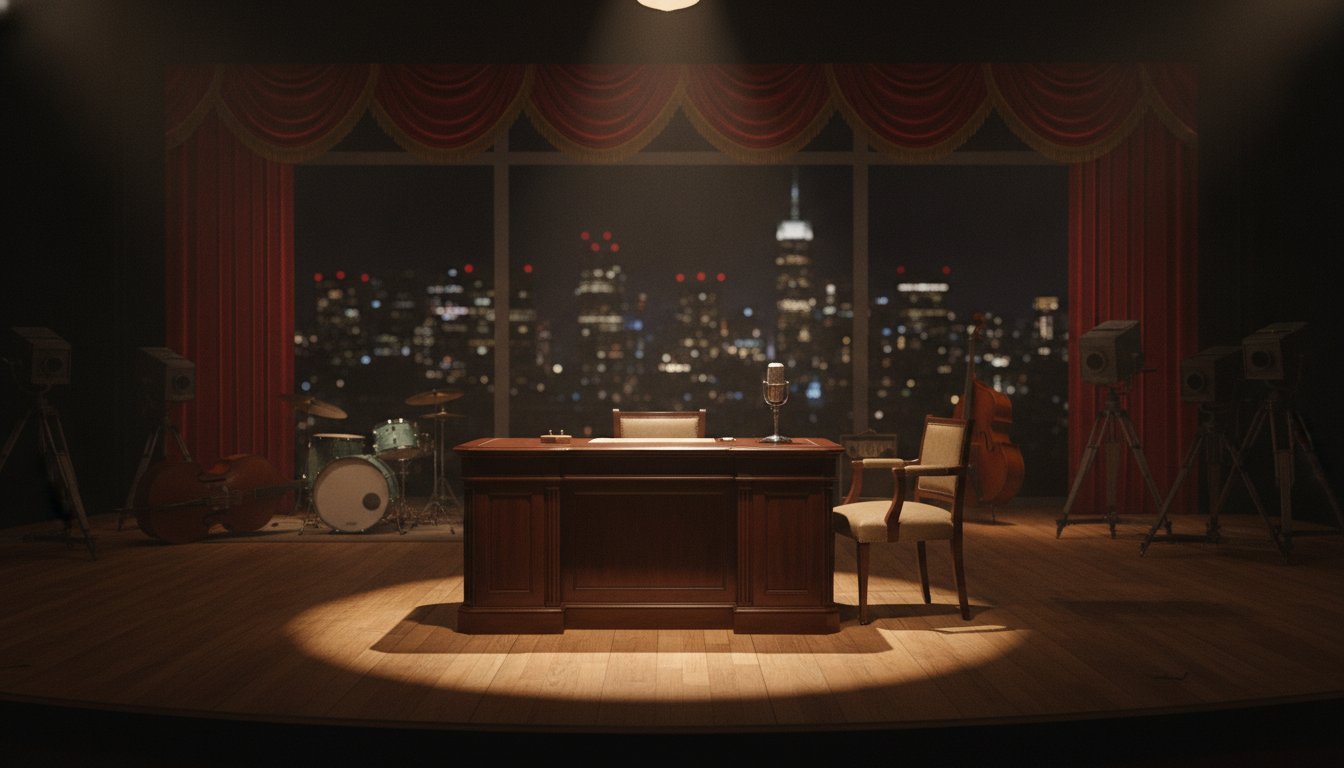
What if the most influential seat in American culture wasn’t located in a legislative chamber, but behind a mahogany desk in Midtown Manhattan? Before it became a billion-dollar industry, the history of late night television began as a quiet gamble to keep the transmitters humming after the local news ended. You probably feel a sense of nostalgic comfort when you hear the brassy swell of a late-night orchestra, recognizing it as the signal that the day’s chaos is finally being processed and packaged for your entertainment.
It’s easy to view these programs as mere variety shows, yet they functioned as a carefully curated theatre of power where the desk served as a throne. This article promises to reveal the legendary rivalries and industry politics that shaped the medium, offering a deep dive into the influence of pioneers like Steve Allen and the untouchable legacy of Johnny Carson. We’ll examine the technical and social shifts of the golden age, showing how a format born from radio roots evolved into the sophisticated, narrative-driven institution we recognize today. From the first broadcast in 1954 to the high-stakes ratings wars of the modern era, you’ll discover the story behind the stories that defined a nation.
Key Takeaways
- Trace the transformation of the midnight hour from a radio experiment into a televised variety format that prioritized spontaneity and live energy.
- Explore the unmatched cultural sovereignty of Johnny Carson and learn how his approval became the ultimate currency for aspiring entertainers.
- Examine the high-stakes politics and legendary betrayals within the history of late night television, including the definitive account of the Joan Rivers ban.
- Decode the evolution of the monologue and sketch comedy as they shifted from lighthearted entertainment to essential tools for social commentary.
- Discover how archival research unearths the intimate, behind-the-scenes interactions that contemporary headlines often missed.
The Midnight Experiment: Steve Allen and the Genesis of the Late Night Format
In the early 1950s, the hours following the local news were known as the “Land of Nod.” It was a vast, unprofitable silence where the only sound was the hum of a static-filled transmitter. This changed in 1954 when NBC launched a bold experiment to capture the post-news void. Steve Allen didn’t just fill this time; he invented a rhythm that would define the history of late-night television for decades to come. Late night television is a unique cultural hybrid, blending the spectacle of variety theater with the urgency of news and the quiet intimacy of late-night conversation.
Allen brought a specific, frantic energy from his radio days. In the radio booth, spontaneity was a survival skill. He translated this to the small screen by treating the studio as a laboratory for creative chaos. He’d dive into the audience, conduct improvised interviews with strangers, and lean into the technical glitches of early broadcasting. This “anything can happen” energy transformed a low-budget filler slot into an appointment for millions of insomniacs, proving that the midnight hour was ripe for discovery.
From Radio Waves to the Small Screen
The architecture of the talk show owes a massive debt to 1940s radio variety hours. Radio hosts often interacted with live studio audiences to create a sense of scale for listeners at home. When TV arrived, Allen visualized these “invisible” listeners by making the studio audience part of the gag. Early technical limitations also played a role in the format’s evolution. Bulky cameras and short microphone cables forced hosts into a stationary, close-up interview style. Understanding the history of late night television requires looking at how these physical constraints created a sense of forced intimacy that felt revolutionary to a public used to the distant glamour of cinema.
The First Desk: Setting the Stage for Power
The desk became the central anchor of the late-night aesthetic by accident, but it remained by design. It provided a physical barrier that established the host’s sovereignty over the room. While the guest sat on a low, soft sofa, the host remained elevated behind a heavy wooden barricade. This psychological dynamic reinforced the host as the arbiter of taste and the gatekeeper of the conversation. Early set designs mirrored a high-end living room, complete with heavy curtains and coffee tables. This helped the viewer feel like they were part of an exclusive, after-hours salon, turning a broadcast into a private, intimate gathering. The late night tv power dynamics embedded in this simple piece of furniture would shape the industry’s hierarchy for generations to come. To understand just how deliberately this prop was engineered as a tool of authority, the history of the late night talk show desk reveals the calculated psychology behind every design choice made from the earliest broadcasts onward.
The King of Late Night: How Johnny Carson Defined the Golden Age
Johnny Carson didn’t just host a show; he became the nation’s silent partner in the dark. For 30 years, a boy from Nebraska held the attention of a fractured country, transforming from a simple broadcaster into The King of Late Night. His reign from 1962 to 1992 serves as the definitive chapter in the history of late night television, a period where the monologue evolved from a string of jokes into a daily barometer of the American psyche. If you want to understand the modern media landscape, you must first understand the shadow Carson cast over the desk.
The desk was more than furniture. It was a throne. A single gesture from Carson, such as a subtle “OK” sign or a wave to the sofa, could instantly elevate a struggling comedian to a household name. This gatekeeping power was solidified in 1972 when the production moved from the cramped studios of New York to the sprawling sets of Los Angeles. Suddenly, late-night wasn’t just a variety show; it was the primary gateway to Hollywood stardom. This move changed the industry’s gravity, pulling talent toward the West Coast and cementing the talk show as the ultimate promotional vehicle. The full scope of how Carson built and maintained this authority is explored in the comprehensive account of The Tonight Show with Johnny Carson and his 30-year reign over late night.
The Art of the Interview
Carson’s brilliance lay in his silence. Unlike many modern hosts who compete for the punchline, he was the ultimate straight man. He mastered the “listening” technique, allowing guests like Lucille Ball to command the stage while he reacted with perfectly timed facial expressions. This dynamic was bolstered by Ed McMahon, whose booming “Heeere’s Johnny” and supportive laughter invented the “second chair” sidekick role that remains a staple of the format today. Together, they created a rhythmic safety net that allowed guests to take risks, knowing the host would always be there to catch them.
The Business of the Tonight Show Archive
Behind the scenes, Carson was equally revolutionary regarding his professional legacy. He was one of the first hosts to recognize the value of his own content, eventually taking ownership of his show’s master tapes. This savvy business move preserved the 1962-1992 era for future media scholars, ensuring that the “story behind the story” wouldn’t be lost to time. At The Late Desk, we specialize in exploring these archival media narratives, bringing a biographer’s eye to the moments that shaped the history of late night television. These archives aren’t just tapes; they’re the collective memory of a golden age that still dictates the rules of the entertainment game today.
The Network Wars: Rivalries and the Battle for 11:30
Late-night television was never just about the jokes; it was a blood sport played out in executive boardrooms and through whispered phone calls at 2:00 AM. While the history of late night television often highlights the laughter, the reality is a series of high-stakes chess moves designed to capture the lucrative 11:30 PM timeslot. The first crack in the polite facade of broadcasting occurred in 1960 when Jack Paar walked off his own set mid-broadcast. This wasn’t a scripted bit. It was a raw, public conflict with network censors that proved the late-night desk was a site of genuine cultural friction. This moment established a template for the host as a figure who could challenge the very institution that employed them.
As the medium matured, The Tonight Show became the crown jewel of the NBC empire. Controlling this franchise meant controlling the national conversation, and the battles for succession turned former allies into bitter rivals. These conflicts didn’t just change hosts; they created the modern media franchise model where a show’s brand is as valuable as the person behind the desk. The stakes were no longer just about ratings. They were about the legacy of the network itself.
The Joan Rivers Ban: A Detailed Analysis
The professional hierarchy of the “permanent guest host” was a delicate ecosystem. Joan Rivers, once Carson’s hand-picked successor, shattered this status quo when she accepted an offer to host her own show on the fledgling Fox network without telling Johnny first. The fallout was immediate and absolute. Carson never spoke to her again, and the resulting ban lasted for over two decades. This era reveals the rigid late night tv power dynamics of the “Golden Age” networks, where loyalty to the host was the only currency that mattered. It wasn’t just a personal snub; it was a warning to anyone who dared to challenge the established network throne.
Letterman vs. Leno: The 1990s Succession Crisis
When Carson finally stepped down, the battle for his chair became a public spectacle. David Letterman, the eccentric heir apparent, was passed over for the more “network-friendly” Jay Leno. This decision led to the creation of The Late Show franchise at CBS, permanently splitting the late-night audience into distinct demographics. Dave captured the urban, ironic youth, while Jay held the broad, suburban middle. This rivalry was the final evolution in the history of late night television, proving that the genre could support multiple kings, provided they each ruled their own specific kingdom. It turned the late-night landscape into a fragmented map of competing loyalties.

The Evolving Format: Monologues, Sketches, and the Sidekick Legacy
The late-night format isn’t a static relic; it’s a living organism that adapts to the cultural climate of the hour. While early broadcasts relied on broad vaudeville tropes, the history of late night television shows a steady migration toward a more structured, yet subversive, nightly ritual. Central to this ritual is the house band. Leaders like Doc Severinsen or Paul Shaffer weren’t just musicians; they were characters who provided the host with a rhythmic foil and an immediate social circle. The sidekick underwent a similar transformation. What began as a laugh-track in human form with Ed McMahon eventually evolved into a complex comedic partnership where the second chair could challenge the host’s authority. This shift turned the program from a solo performance into a communal experience, one that speaks to the broader cultural impact of late night tv as a shared national ritual that united millions of households each evening.
This shift from passive viewing to a shared experience continues in the digital age; for instance, you can learn more about Gameznights and how they provide software for hosting interactive party games digitally.
The Anatomy of a Monologue
Writing rooms became the engine rooms of American comedy, operating under a relentless daily grind that changed television forever. These rooms had to process the day’s events and find the irony before the 11:30 PM curtain. The monologue serves as the essential bridge between the hard news of the evening and the escapist entertainment of the night. Carson perfected the use of recurring characters, such as the mystical “Carnac the Magnificent,” to give the audience a sense of familiarity amidst the daily churn of topical jokes. This structure allowed hosts to deliver sharp social commentary under the guise of lighthearted character work, a technique that remains vital for modern hosts navigating the political shifts of 2026.
Beyond the Desk: Stunts and Participation
Steve Allen pioneered the “remote” segment by leaving the studio to submerge himself in a giant oatmeal vat, proving that the city itself could be a prop. This willingness to break the fourth wall created a sense of chaotic possibility. By the 1980s, David Letterman refined this into a high-art form of irony with segments like “Stupid Pet Tricks.” He didn’t just interview celebrities; he invited the absurdity of the real world into the studio. These segments broke the traditional variety show mold. They paved the way for the digital-first, viral-ready content that dominates the industry today. To dive deeper into the specific scripts and sketches that defined these eras, read our historical television articles for an insider’s look at the archives. Understanding these format shifts is key to appreciating how a midnight experiment became a national institution.
The Late Desk Perspective: Preserving the History of Late Night
Understanding the current media landscape requires more than a look at last night’s ratings. To truly grasp why certain formats endure while others fade, we must treat the history of late night television as a living record rather than a closed book. These archives function as a definitive mirror of American life, capturing the cultural shifts and power dynamics that shaped the nation’s bedtime rituals. At The Late Desk, we view ourselves as seasoned cultural archivists, dedicated to interpreting the interpersonal relationships and professional legacies that defined the golden age. We don’t just report the facts. We curate the collective memory of an industry built on the “story behind the story.”
As we move into the digital-first era of 2026, the role of the archive has never been more vital. Modern audiences often consume late-night content in fragmented, viral clips, losing the broader context of the broadcast’s narrative arc. Preserving the full history of late night television ensures that the technical innovations and social risks taken by early pioneers aren’t reduced to mere trivia. It allows us to see the evolution of the talk show as a cinematic journey, one that continues to influence how we process news and entertainment in a single, sophisticated package.
Researching Classic Television
The quest for historical accuracy is often a race against time. Many early broadcasts from the NBC and CBS years are considered “lost” media, victims of a time when networks frequently wiped and reused expensive magnetic tapes to save costs. Finding these fragments requires a detective’s patience and a biographer’s curiosity. Scholars and fans must look beyond the screen, utilizing trade publications, internal network memos, and specialized Media History Archives: Researching Classic Television to reconstruct the past. This archival research is the only way to uncover the intimate, confidential interactions that took place when the cameras stopped rolling; similarly, for those interested in how modern video archives document fashion and style trends, Lingerie Lowdown provides a comprehensive look at the evolution of intimate apparel through expert reviews.
The Lasting Legacy of the Golden Age
The shadows of Carson, Allen, and Rivers still loom large over every modern studio. Every time a host walks to the edge of the stage or leans across a mahogany desk, they are participating in a tradition established decades ago. This enduring appeal lies in the human drama behind the professional hierarchies. We invite you to join The Late Desk as we continue to uncover the archives of late-night history, bringing a polished authority to the stories that contemporary headlines missed. By studying these legacies, we don’t just honor the past; we gain the perspective needed to navigate the future of entertainment.
Rediscovering the Shadows of the Small Screen
The journey from Steve Allen’s frantic midnight experiments to the calculated corporate maneuvers of the modern era reveals a medium that has always been more than just talk. By examining the history of late night television, you’ve seen how a simple mahogany desk became a cultural throne and how network rivalries dictated the very rhythm of American sleep. These stories of betrayal, innovation, and comedic genius don’t just belong to the past; they continue to inform the digital-first landscape we navigate today.
Preserving these narratives requires more than a casual glance at old clips. It demands a specialized media history archive and the patience to sift through in-depth investigative narratives that reveal the true power dynamics of the golden age. At The Late Desk, we provide expert-curated television bibliographies to help you peel back the layers of broadcasting history. We invite you to Explore the Lost Archives of Late Night at The Late Desk and discover the secrets that never made it to the monologue. The golden age is waiting to be rediscovered, one broadcast at a time.
Frequently Asked Questions
Who was the first host of The Tonight Show?
Steve Allen was the first host of The Tonight Show, making his historic debut on September 27, 1954. He transitioned the program from a local New York experiment into a national phenomenon by infusing it with his background in radio variety. His tenure established the “anything can happen” energy that remains a hallmark of the genre, proving that the midnight hour was ripe for creative discovery.
How long was Johnny Carson the host of The Tonight Show?
Johnny Carson hosted The Tonight Show for exactly 30 years, reigning from October 1, 1962, until his retirement on May 22, 1992. During these three decades, he became a fixture of American life and transformed the late-night slot into the most influential platform in entertainment. His tenure is widely considered the definitive benchmark for success in the history of late night television.
Why did Johnny Carson ban Joan Rivers?
Johnny Carson banned Joan Rivers after she accepted an offer to host her own late-night program on the Fox network in 1986 without informing him first. Carson viewed this move as a profound personal and professional betrayal, especially since Rivers had been his regular guest host for years. The two never spoke again, and the ban persisted at NBC for over two decades until 2014.
What is the ‘Golden Age’ of late-night television?
The “Golden Age” typically refers to the era between the early 1960s and the early 1990s, when a single host could command the attention of the entire nation. This period was defined by the sophisticated, theater-like atmosphere of the studio and the absolute cultural sovereignty of Johnny Carson. It was a time before audience fragmentation, where the late-night monologue functioned as the definitive social barometer for millions of viewers.
Who were the most influential guests in late-night history?
Influential guests ranged from comedy royalty like Lucille Ball and Richard Pryor to cultural icons like Frank Sinatra and Muhammad Ali. A guest appearance was often a calculated career move, as a successful set or interview could lead to immediate stardom. These interactions were carefully curated narratives that allowed the public to see a more intimate, unscripted side of their favorite celebrities in an era of guarded public personas.
What happened to the missing episodes of early late-night shows?
Many early episodes were lost because networks frequently wiped and reused magnetic tapes to save on production costs during the 1950s and 1960s. This practice led to the permanent disappearance of thousands of hours of cultural history, including much of Jack Paar’s tenure and early Carson broadcasts. Modern archival efforts now work to piece together these lost narratives through surviving fragments, audio recordings, and secondary industry records.
How did the late-night format change from the 1950s to the 1990s?
The format evolved from the loose, improvisational variety sketches of the 1950s into the highly structured, monologue-driven franchise model of the 1990s. While Steve Allen prioritized spontaneity and audience stunts, the history of late night television shows a gradual shift toward a more polished nightly ritual. By the time of the Letterman and Leno era, the show had become a sophisticated machine designed to capture specific demographics through irony and sharp social commentary.
Why is the desk so important in late-night talk shows?
The desk serves as a psychological anchor that establishes the host’s authority and provides a physical barrier between them and the guest. It functions as a symbol of sovereignty, effectively turning the studio into a private chamber where the host remains the gatekeeper. This set design creates a hierarchy that allows the host to guide the conversation from a position of power while maintaining a sense of professional distance from the sofa. For a deeper examination of how this single prop evolved into broadcasting’s most powerful symbol of authority, explore the complete history of the late night talk show desk and the deliberate design decisions that shaped it across seven decades.