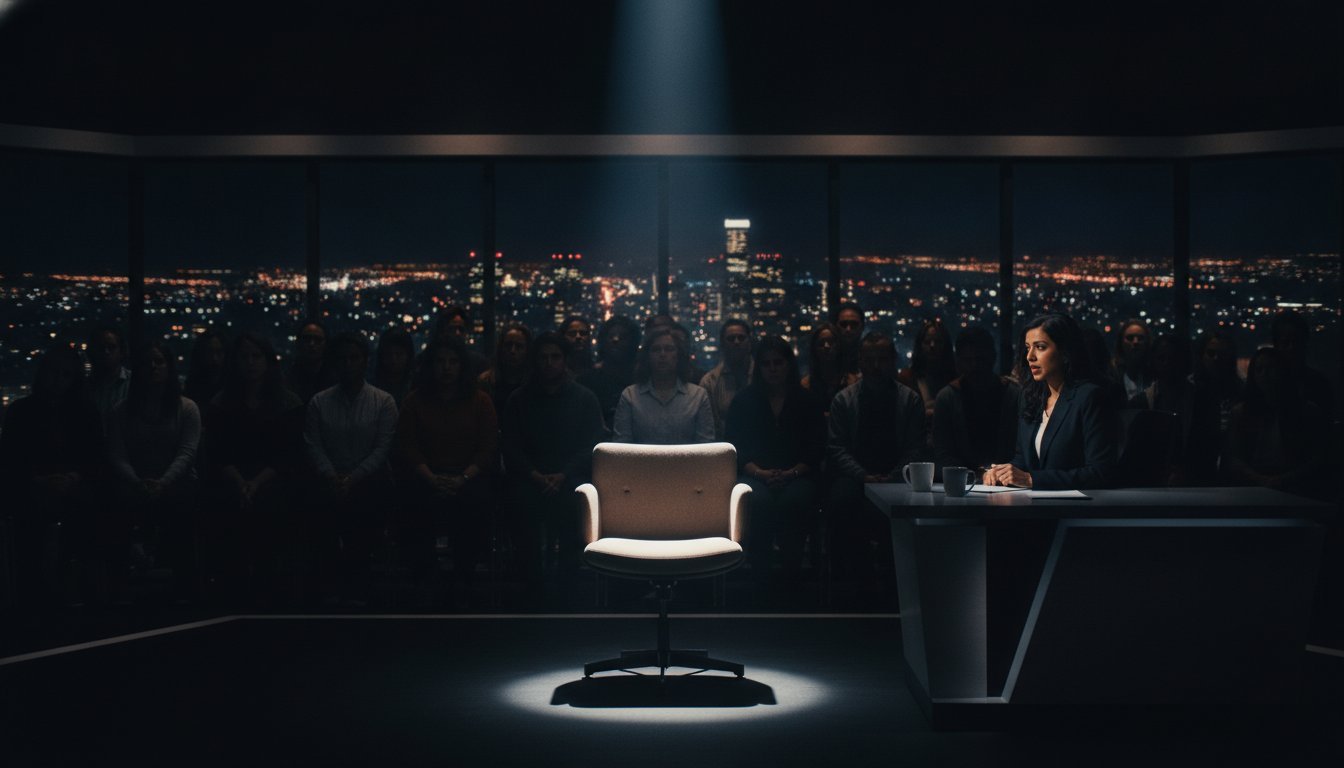
On February 11, 1960, a visible tremor of disbelief rippled through the NBC studio as Jack Paar, the host of The Tonight Show, announced his resignation on air and walked off the set. He left a stunned audience and a vacant chair, proving that the flickering glow of the television screen could barely contain the raw, human volatile energy of a live broadcast. These late night television guest scandals aren’t just moments of awkward silence or spilled water. They are the definitive battlegrounds where host authority and celebrity ego collide, often reshaping the entire industry in their wake.
It’s easy to feel frustrated by modern lists that only focus on viral clips from the last decade, ignoring the rich, complex history of the medium. You likely sense that there’s more to these stories than just a guest behaving badly for the cameras. This article promises to take you behind the curtain to discover the high-stakes power plays and unscripted chaos that transformed polite conversation into cultural firestorms. We will explore the evolution of talk show conflict from the Carson and Paar eras to the present, uncover the legendary “banned” lists kept by major hosts, and examine how these explosive moments directly fueled network ratings.
Key Takeaways
- Uncover the unspoken “host-guest contract” and why the live-to-tape format provides the perfect environment for high-stakes professional tension.
- Explore historical late night television guest scandals, from the unscripted walk-offs of the 1960s to the unpredictable appearances that challenged Johnny Carson’s composure.
- Gain an insider perspective on the industry’s “banned lists,” including the complex 26-year silence between the Tonight Show desk and Joan Rivers.
- Analyze how modern hosts control the narrative during controversies, shifting from spontaneous chaos to the calculated management of viral political moments.
- Discover the vital role of media archives in preserving the “story behind the story” and correcting the public record of these iconic television milestones.
Defining the Late Night Television Guest Scandal
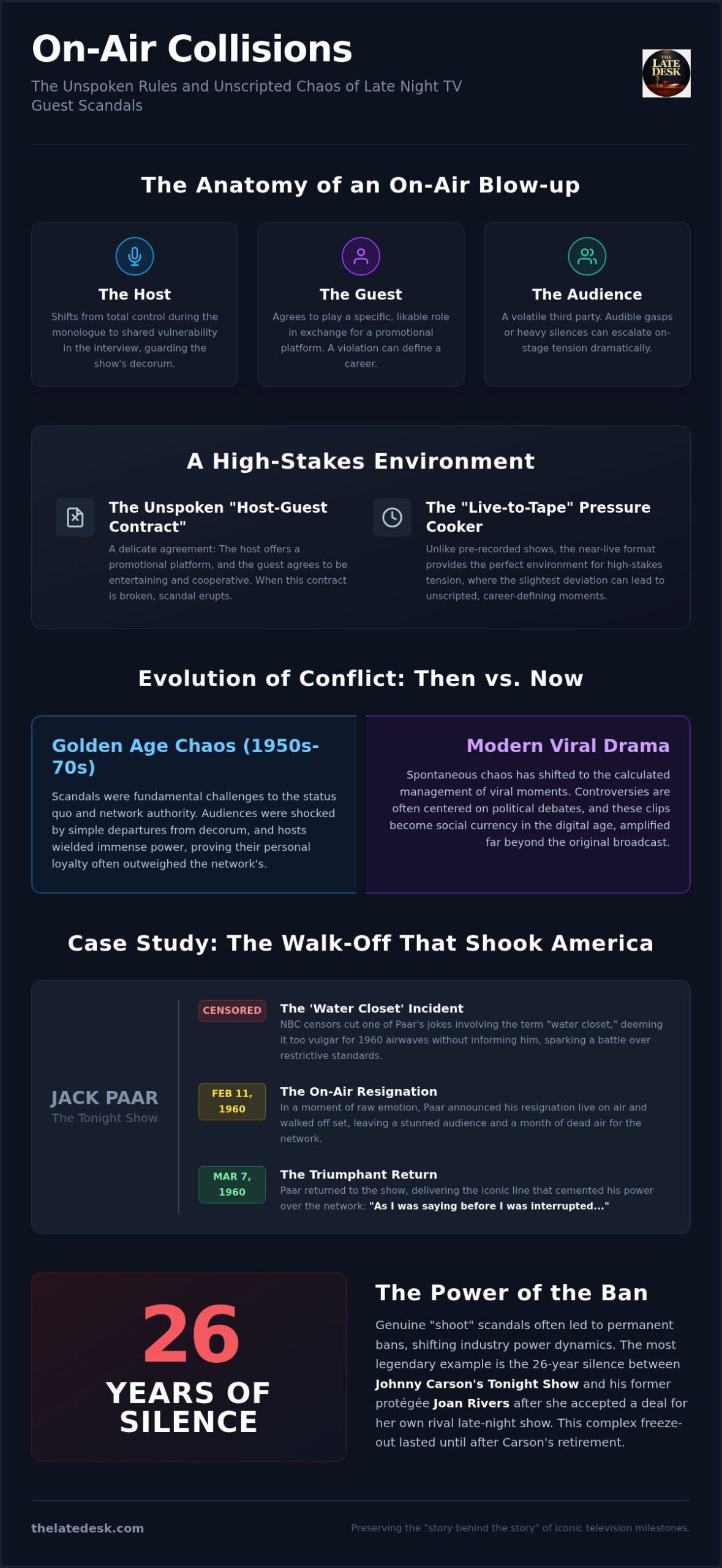
Behind the velvet curtains and the gleaming mahogany desks lies an environment designed for controlled spontaneity. While the audience sees a polished production, the “live-to-tape” nature of these programs creates a pressure cooker where the slightest deviation from the script can lead to disaster. Unlike a standard news segment, these shows rely on a delicate host-guest contract. The host offers a platform for promotion, and the guest agrees to play a specific, likable role. When this agreement is violated, the result is the birth of late night television guest scandals that become permanent fixtures in the archives of broadcasting.
A late-night scandal is a collision of celebrity persona and network decorum. It represents a moment where the artifice of show business is stripped away, leaving only the raw, often uncomfortable, reality of human conflict. A single ten-minute interview, if sufficiently volatile, can define a performer’s entire career. It has the power to overshadow years of professional achievements with one moment of poor judgment or unexpected defiance that lingers in the public mind for decades.
The Anatomy of an On-Air Blow-up
The transition from the host’s opening monologue to the first guest interview marks a shift from total control to shared vulnerability. The studio audience acts as a volatile third party in this dynamic. Their audible gasps or sudden, heavy silences escalate the tension between the two figures on stage, often pushing a guest further into a defensive or aggressive posture. Industry insiders often distinguish between “worked” scandals, which are carefully orchestrated for publicity, and “shoot” scandals, where the anger is genuine and the consequences are real. In the history of The Tonight Show, these genuine ruptures have frequently led to permanent bans and shifted the power balance between networks and talent.
Why We Can’t Look Away
Psychologically, there is a profound appeal in witnessing high-status individuals lose their composure. In a world of PR-managed images, seeing a celebrity’s mask slip provides a rare moment of authenticity that feels earned by the viewer. Expectations have evolved significantly since the early days of broadcasting. While audiences in the 1950s were shocked by simple departures from decorum, today’s digital-age viewers often seek out these moments as a form of social currency. To understand how these standards of behavior were first established, one can explore The Cinematic History of Late Night Television, which details the rigid expectations of early television hosts and the decorum they fought to maintain.
Chaos in the Golden Age: Unscripted Moments That Shocked America
While modern audiences often associate late-night friction with viral political debates, the foundation of these conflicts was laid decades ago in the smoke-filled studios of mid-century New York. The “Golden Age” of broadcasting is frequently remembered as a time of rigid decorum, yet it was during this era that the most explosive late night television guest scandals first redefined the relationship between the network and the talent. These were not merely awkward exchanges. They were fundamental challenges to the status quo that proved the host was often more powerful than the executives in the boardroom.
A heavy, suffocating silence descended upon NBC’s Studio 6B as Jack Paar stood before the cameras on February 11, 1960, his eyes welling with a mixture of betrayal and exhaustion. He announced his resignation to a stunned nation and simply walked off the stage. This departure left the network with a month of dead air and a profound realization: the man behind the desk was the show’s true heartbeat.
The Jack Paar ‘Water Closet’ Incident
The catalyst for Paar’s walk-off was a seemingly innocuous joke involving a “water closet,” a term for a toilet that NBC censors deemed too vulgar for the 1960 airwaves. The network cut the segment without informing Paar, sparking a censorship battle that highlighted the era’s restrictive standards. When Paar finally returned on March 7, 1960, he delivered one of the most famous opening lines in history: “As I was saying before I was interrupted…” This moment was a masterclass in professional defiance. It established the host as a figure with individual power, proving that the audience’s loyalty lay with the personality rather than the corporate logo. You can find more detailed accounts of these power shifts in the archives at The Late Desk.
Carson and the Art of the ‘Difficult’ Guest
When Johnny Carson took the reins, he encountered a new breed of unpredictability. Guests like the psychic Criswell or the falsetto-singing Tiny Tim challenged the traditional interview format, forcing Carson to develop his legendary “silent take.” By simply staring into the camera with a deadpan expression, Johnny could turn a guest’s bizarre behavior into a comedic win. However, some encounters were truly volatile. The legendary antics of actor Oliver Reed, who frequently appeared in a state of high-spirited (and often intoxicated) agitation, pushed the boundaries of safety and decorum. The traditional power structures of the desk were also challenged in more calculated ways, as when the Lucille Ball Tonight Show guest host appearance in 1974 briefly upended the late-night hierarchy by placing one of Hollywood’s most powerful executives behind Carson’s own desk. To understand how he maintained control during such chaos, one should read about The Tonight Show with Johnny Carson and his thirty-year mastery of the desk. For a broader look at the hidden power dynamics that fueled the most iconic appearances in broadcasting history, the deep dive into unforgettable talk show guest moments reveals the professional risks that hosts took every time the cameras rolled.
By the arrival of the 1970s, the landscape shifted again. The polite veneer of the early years began to crack as Vietnam-era cynicism and social upheaval seeped into the broadcast. Banter became sharper, and the “guest scandal” evolved from simple censorship battles into deeper ideological conflicts that mirrored a fractured America.
The Power of the Ban: Analyzing Industry Power Dynamics and Rivalries
In the high-stakes theater of network television, an invitation to sit beside the host’s desk is often seen as the ultimate validation for a performer. For those who violate the unspoken code of the studio, however, that invitation can be revoked with chilling permanence. These excommunications represent the most calculated variety of late night television guest scandals, where the conflict doesn’t end when the credits roll. Instead, the “Banned List” serves as a ledger of professional transgressions, revealing the absolute authority that hosts once wielded over the careers of their peers.
The decision to ban a guest is rarely about a single bad joke or a flat interview. It’s an exercise in gatekeeping that preserves the host’s status as the undisputed sovereign of the time slot. When a guest threatens that hierarchy, whether through perceived disloyalty or genuine physical danger, they find themselves cast out of the “Business of Laughter” entirely. These industry-wide blacklistings were once powerful enough to stall careers for decades, as the major networks moved in lockstep to protect their most valuable assets.
The Carson-Rivers Rift: A Case Study in Loyalty
In 1986, a single phone call shattered one of the most successful partnerships in broadcasting history. Joan Rivers, the long-time permanent guest host for Johnny Carson, accepted an offer to front her own show on the fledgling Fox network. Carson, who reportedly learned the news through a press release rather than from Rivers herself, felt a profound sense of betrayal. The result was a 26-year silence. Rivers was immediately banned from The Tonight Show, a decree that remained in place not only through the rest of Carson’s tenure but also throughout Jay Leno’s entire reign. To understand the structural reasons behind such a fierce reaction, one must analyze the late night tv power dynamics that dictated host behavior during the network wars of the 1980s.
The ‘Permanent’ Banned List
While the Carson-Rivers feud was fueled by personal ego and professional competition, other bans are born from a need for studio safety and basic decorum. Bobcat Goldthwait earned a permanent spot on Jay Leno’s blacklist in 1994 after he set fire to his chair during an appearance, a stunt that went far beyond the acceptable limits of “shock comedy.” Similarly, Artie Lange’s 2009 appearance on the short-lived Joe Buck Live became a masterclass in interview sabotage. His relentless, aggressive derailing of the segment led to the show’s cancellation and a definitive ban from future HBO sports programming. These moments highlight the criteria for a permanent ban: once a guest proves they’re a liability to the production’s physical safety or its relationship with advertisers, the desk is closed to them forever.
Cringe to Controversy: Modern Viral Late-Night Drama
In the digital age, the nature of the broadcast eruption has undergone a fundamental transformation. While the outbursts of the past were often genuine accidents of live television, contemporary late night television guest scandals are frequently filtered through the lens of viral potential and social media scrutiny. The shift from the “live-to-tape” tension of the Carson era to the “clip-ready” culture of the 21st century has turned the late-night desk into a high-stakes arena where a single interaction can be dissected by millions within minutes of airing.
David Letterman’s 2009 Confession
In October 2009, David Letterman stepped onto the stage of the Ed Sullivan Theater not to deliver his signature Top Ten list, but to dismantle a $2 million extortion plot in real time. By using his monologue to confess to workplace affairs before a blackmailer could leak the details, Letterman provided a masterclass in narrative control. This was a departure from the “Golden Age” scandals like Jack Paar’s walk-off; it was a deeply personal crisis managed with professional precision. It remains a definitive moment in broadcasting history, proving that the desk could be used as a shield as effectively as a stage. To explore more about how these legendary figures navigated their public lives, you can browse our full collection of historical television articles.
The Political Pivot
As the cultural landscape became increasingly polarized, the role of the late-night host shifted from neutral entertainer to political arbiter. This transition reached a breaking point during the 2016 presidential campaign when Jimmy Fallon playfully ruffled Donald Trump’s hair during an interview. What was intended as a lighthearted moment of “Tonight Show” whimsy was perceived by many as a dangerous normalization of a controversial figure. This single interaction served as a turning point for the program, illustrating how the stakes of late night television guest scandals had moved beyond simple decorum into the realm of civic responsibility. You can trace this evolution through the years by consulting The Lineage of Laughter, which examines the shifting responsibilities of those who have held the most famous job in comedy.
Not every modern scandal is rooted in politics or personal strife. Sometimes, the drama stems from pure, unadulterated awkwardness. Conan O’Brien’s 2001 interview with director Abel Ferrara remains a legendary example of “cringe” TV, where a guest’s bizarre, borderline-incoherent behavior threatened to derail the entire production. These moments remind us that despite the increased focus on manufactured viral clips, the ghost of live television’s unpredictability still haunts the studio, waiting for the mask to slip once more. The transition from accidental chaos to the curated controversy of today marks a new chapter in the history of the medium, one where the audience is always watching for the next unscripted crack in the facade.
Preserving the Archive: Why Historical Late-Night Scandals Still Matter
For years, the major networks treated their master tapes as disposable commodities, a decision that inadvertently scrubbed some of broadcasting’s most significant ruptures from the record. This practice of “wiping” tapes to save on production costs has turned many legendary late night television guest scandals into whispers and anecdotes rather than documented facts. However, these moments are more than just tabloid fodder. They function as cultural snapshots, revealing the shifting boundaries of what American society deemed acceptable, provocative, or forbidden at any given point in time. By examining these archives, we don’t just see a guest behaving badly; we see the evolution of the national temper.
The role of the media archivist is to act as a bridge between these forgotten ruptures and the modern viewer. While a scandal might be “cemented” in public memory by a specific narrative, access to original footage often reveals a different story. It might show a host’s subtle provocation or a guest’s genuine distress that was edited out of later retrospectives. These archival corrections are essential for understanding the true power dynamics of the era, ensuring that the “story behind the story” remains accurate for future generations of scholars.
The Hunt for Missing Media
The tragedy of lost footage is particularly acute when studying the early years of the medium. Significant portions of the Jack Paar era and the first decade of Johnny Carson’s thirty-year reign exist only in written accounts or low-quality audio recordings. This lack of visual evidence contributes to the mythology of late-night controversies, where the details of a walk-off or a banned guest grow more dramatic with every retelling. Digital preservation has become the modern frontline for historians, allowing us to recover and protect the remaining fragments of these high-stakes interactions before the magnetic tape degrades completely. If you’re interested in the technical side of this preservation, our Media History Guide offers essential research tips for navigating the world’s most important television vaults.
The Legacy of the Laughter
The ripple effects of a single broadcast eruption can be felt throughout the careers of everyone involved. From the whimsical anarchy of Steve Allen to the sharp, politically charged commentary of Seth Meyers, every host has had to navigate unscripted moments that threatened their authority. These events forced the men and women behind the desk to evolve from simple joke-tellers into sophisticated crisis managers. It’s a reminder that the late-night desk is a stage for human drama as much as it is a platform for comedy. It’s a place where celebrity egos and network interests collide in a way that no other medium can replicate. At The Late Desk, we are dedicated to curating these archives and providing a definitive resource for the next generation of fans. Subscribe to The Late Desk for more in-depth archival explorations and host biographies.
Rediscovering the Shadows of the Small Screen
While the credits roll and the studio lights fade, the cultural weight of a broadcast eruption often lingers long after the audience has gone home. We’ve explored how late night television guest scandals shifted from raw acts of professional defiance during the Jack Paar years to the calculated viral maneuvers seen in the digital age. These historical ruptures reveal a complex hierarchy where the unspoken host-guest contract dictates the very survival of a career. It’s a reminder that the desk is a site of profound human tension; a place where professional legacies are forged or dismantled in a single ten-minute segment.
As an independent media history publication, The Late Desk is committed to providing in-depth archival research that goes beyond surface-level viral clips. We curate narratives from the Golden Age of television to ensure the “story behind the story” is never lost to time or the tragedy of wiped tapes. Our mission is to document the human drama that occurs when the script is discarded and the mask of celebrity finally slips. To discover the hidden layers of broadcasting history, you can explore the full archives of late-night history at The Late Desk. The next chapter of television’s story is waiting to be uncovered.
Frequently Asked Questions
Why was Joan Rivers banned from The Tonight Show for so long?
Joan Rivers was banned for 26 years due to a perceived breach of loyalty toward Johnny Carson. When she accepted a contract with the Fox network in 1986 without personally informing Carson, he interpreted the move as a professional betrayal. This silence persisted through the rest of his life and was even maintained by his successor, Jay Leno, for many years.
Which late-night host had the most guests banned from their show?
Johnny Carson is historically recognized as the host who maintained the most significant and strictly enforced banned list. Over his three-decade reign, Carson blacklisted dozens of guests for reasons ranging from professional competition to simple personal dislike. This gatekeeping was a primary tool used to maintain the hierarchy of the late-night desk during the Golden Age.
What was the Jack Paar ‘water closet’ scandal about?
The Jack Paar ‘water closet’ scandal was a battle over network censorship regarding a joke about a toilet. On February 11, 1960, Paar walked off the set after discovering NBC executives had cut the segment without his permission. He remained absent for nearly a month, returning only after the network acknowledged his individual power over the broadcast.
Are late-night television guest scandals usually scripted for ratings?
Most historical late night television guest scandals were genuine ruptures rather than scripted stunts. While modern producers sometimes lean into “manufactured” moments to gain viral traction, the archival record shows that the most impactful scandals were spontaneous collisions of ego and network decorum. Authenticity remains the most potent ingredient for a lasting television controversy.
Did Johnny Carson ever walk off The Tonight Show?
Johnny Carson never walked off his program during a live broadcast, as he prioritized a cool, unflappable professional persona. While Jack Paar used the walk-off as a dramatic protest, Carson preferred to exert his influence behind the scenes during high-stakes contract negotiations. He valued the stability of the format, which was a cornerstone of his thirty-year legacy at NBC.
How did David Letterman handle his 2009 blackmail scandal on air?
David Letterman addressed his 2009 blackmail scandal by delivering a candid, narrative-driven monologue that revealed his workplace affairs to the audience. By choosing to break the news himself, he effectively neutralized a $2 million extortion plot. This masterclass in narrative control allowed him to maintain his position at the desk while managing a deeply personal crisis in the public eye.
What is the most controversial interview in late-night TV history?
The walk-off of Jack Paar in 1960 remains arguably the most controversial and consequential interview moment in the history of the medium. It shattered the illusion of network control and proved that a host could hold a broadcast hostage through sheer force of personality. This event established the blueprint for all future late night television guest scandals by proving that unscripted chaos could captivate a nation.
Why did Jimmy Fallon face backlash for his interview with Donald Trump?
Jimmy Fallon faced significant backlash for his 2016 interview with Donald Trump because he was perceived as trivializing a highly divisive political figure. By ruffling Trump’s hair, Fallon was accused of abandoning the role of a critical observer in favor of lighthearted entertainment. This moment is often cited as a turning point where late-night hosts were forced to become more politically accountable to their audiences.