Before the lights dimmed and the band struck up “Johnny’s Theme,” every guest on the Tonight Show understood a terrifying truth; the man behind the desk held the absolute power to make or break their future. It wasn’t just about being funny or famous. It was about navigating a labyrinth of unwritten expectations that few dared to challenge. You’ve likely wondered why certain comedy legends were suddenly banned or how the atmosphere could shift from warm to ice-cold in a single segment. Consolidated information on these professional standards is often buried under layers of surface-level nostalgia, leaving the logic of the era a mystery.
We’re pulling back the curtain to reveal the rigid Johnny Carson guest rules that governed the 1970s and 80s NBC era, moving beyond the gossip to explain the professional standards of the time. You’ll discover the significance of the “in-character” rule and why breaking it was considered a cardinal sin. We’ll also examine the weight of the “couch invitation,” a gesture that functioned as the ultimate industry endorsement. This is a deep dive into the invisible gatekeeping and power dynamics that defined the golden age of late-night television.
Key Takeaways
- Discover how Carson’s early career in magic influenced his need for absolute control over every broadcast second.
- Understand the “No Character” mandate and why the strict Johnny Carson guest rules required performers to leave their stage personas at the curtain.
- Learn the significance of the “post-performance wave” and how this simple gesture functioned as the ultimate industry endorsement.
- Explore the “Loyalty Clause” that turned former favorites like Joan Rivers into permanent outcasts after they challenged the NBC hierarchy.
- Grasp how these rigid professional standards created a high-stakes environment that defined the golden age of the late-night chat.
The Gatekeeper of Burbank: Why Johnny Carson Enforced a Strict Guest Code
To step onto the stage at NBC’s Burbank studios was to enter a sanctuary where the host was the undisputed sovereign. For three decades, the Tonight Show functioned as the ultimate gatekeeper of American culture. A single appearance could transform an obscure club comic into a household name overnight. However, this life-changing opportunity came with a price. Guests were expected to adhere to a rigid set of Johnny Carson guest rules that ensured the host remained in total command of the broadcast’s rhythm and tone. It wasn’t just a talk show; it was an audition for entry into the American consciousness.
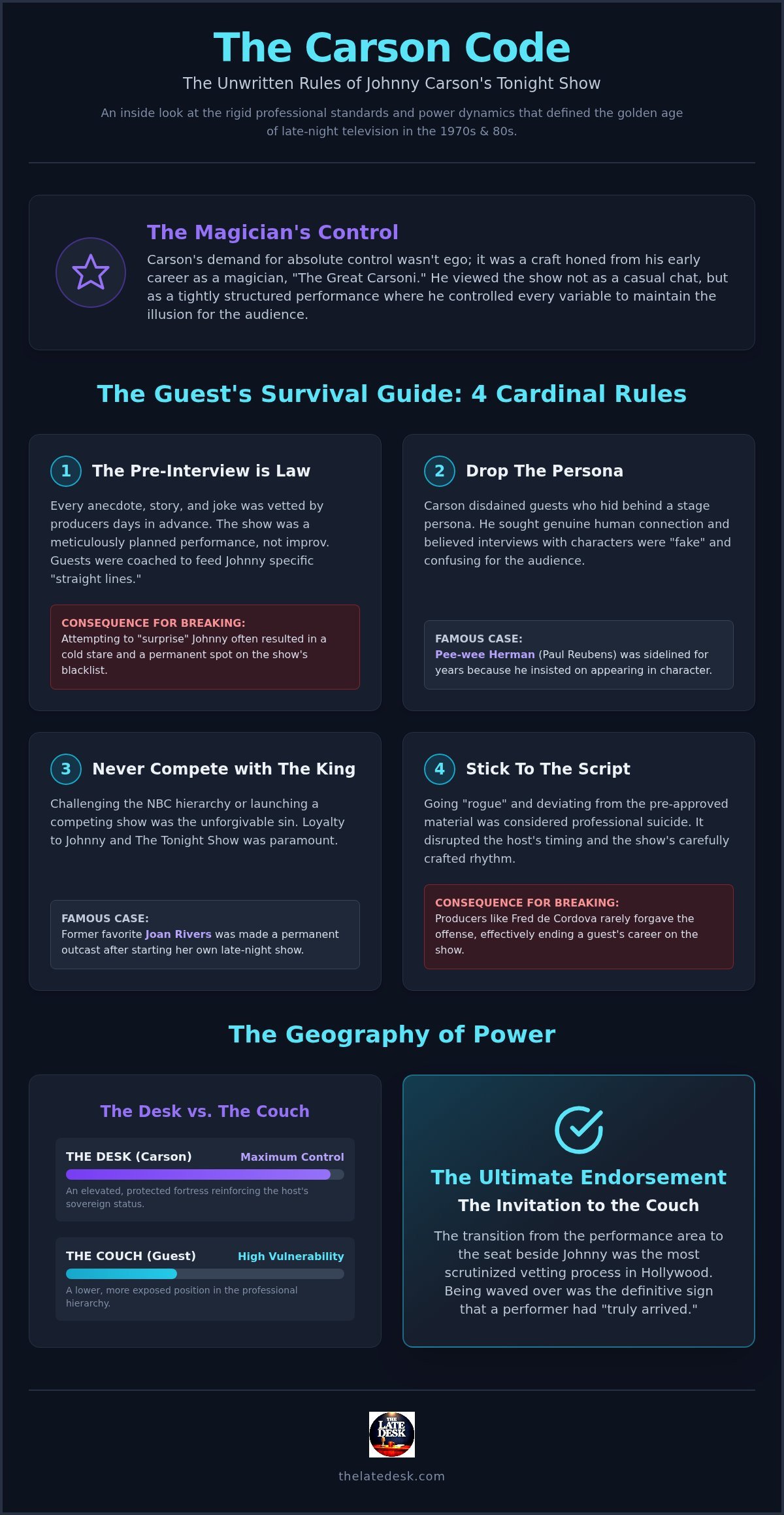
This demand for control wasn’t merely an ego trip. It was rooted in Carson’s early years as a magician, “The Great Carsoni,” and his disciplined background in radio. In magic, a performer must control the audience’s gaze and anticipate every variable to maintain the illusion. Carson translated this psychological mastery to the television screen. He viewed the talk show as a structured performance rather than a casual conversation. This philosophy birthed the mandatory pre-interview. Producers would vet every anecdote and joke days in advance. If a guest attempted to “surprise” Johnny with a story not cleared in the pre-interview, they often found themselves met with a cold stare and a permanent spot on the show’s blacklist.
The Power of the Desk
The physical geography of the set was a masterclass in power dynamics. Behind his mahogany fortress, Carson sat elevated and protected, while the guest occupied the lower, more vulnerable position on the couch. This layout reinforced a professional hierarchy that few dared to cross. The transition from the performance area to the seat beside the host was the most scrutinized vetting process in Hollywood. During the Tonight Show with Johnny Carson era, the desk-to-couch pipeline represented a move from outsider to insider. If you weren’t invited to sit, you hadn’t truly arrived.
The Invisible Hand of the Producers
Behind the scenes, legendary producers like Fred de Cordova and Peter Lassally acted as the enforcers of the “Carson Way.” They ensured that every segment followed a specific narrative arc designed to maximize the host’s reactions. The history of The Tonight Show Starring Johnny Carson is filled with stories of guests who were coached to “save the best for last” or to feed Johnny specific “straight lines.” Going rogue was considered professional suicide. To break the established flow was to disrupt the host’s timing, an offense that de Cordova rarely forgave. By maintaining these strict Johnny Carson guest rules, the production team preserved the show’s status as a high-prestige inner circle where only the most disciplined professionals were allowed to play.
The ‘No Character’ Mandate: Why Pee-wee Herman and Others Were Sidelined
While the audience at home saw a playful host engaging with the brightest stars of the era, the reality behind the scenes was often a battle for transparency. Johnny Carson possessed a deep-seated disdain for guests who refused to drop their stage personas. He believed that the talk show format relied on a specific kind of human connection that was impossible to achieve when a performer was hiding behind a mask. This philosophy was a cornerstone of the Johnny Carson guest rules; if you wanted to sit on the couch, you had to leave the costume in the dressing room. Carson famously feared “confusing the audience” by presenting a character as a real person, a concern that shaped the booking strategy for decades.
Paul Reubens, the creator of Pee-wee Herman, serves as the most famous casualty of this mandate. During the height of Pee-wee’s popularity in the 1980s, Reubens insisted on appearing in character for all public appearances. For Carson, this was a non-starter. He viewed an interview with a fictional persona as “fake” and devoid of the comedic tension that fueled his best segments. It took years of negotiation and the softening of Reubens’ stance before the “King of Late Night” would allow the bow-tied character near his desk. Carson wanted the man, not the manchild. He sought the genuine friction of two professionals talking, not a rehearsed bit that felt like a children’s show. You can explore more about these high-stakes interactions in our deep dives into classic television history.
The Psychology of Authenticity
Carson’s preference for “real” conversation was a defensive measure for the show’s credibility. He positioned the Tonight Show as a journalistic endeavor as much as an entertainment one. By enforcing the authenticity rule, he protected the program from becoming a platform for glorified infomercials or repetitive sketch comedy. The “character rule” acted as a formidable barrier to entry for 1980s alternative comics who refused to separate their stage personas from their personal identities. This rigidity is a key part of how Carson defined the rules of late-night television, ensuring that every guest felt like a peer rather than a prop.
When the Rule Was Broken
There were, of course, rare exceptions that proved the rule. Tiny Tim was allowed to maintain his eccentric persona because Carson sensed that for the falsetto-singing ukulele player, the “character” was the reality. There was no “off” switch. In the eyes of NBC standards, there was a clear line between a sketch and an interview; once the performance ended, the mask had to come off. These Johnny Carson guest rules eventually softened as the genre evolved. By the time Jay Leno and David Letterman took the reins, the “in-character” interview became a staple of the format, paving the way for the viral-ready, persona-heavy segments that dominate the late-night landscape today.
The Hierarchy of the Couch: The Symbolic Power of the Post-Performance Interview
For an aspiring comedian, the five minutes spent under the hot lights of Studio One were the most consequential of their professional life. While the laughter of the studio audience was necessary, it was ultimately secondary to the reaction of the man sitting thirty feet away. The Johnny Carson guest rules dictated a precise ritual for the conclusion of every stand-up set. If the set ended and Carson remained motionless, the comedian was expected to take what insiders called the “Death Walk.” They had to bow, wave to the crowd, and disappear behind the curtain immediately. To linger or, worse, to approach the desk without a summons, was a breach of etiquette that ensured they would never be invited back.
The psychological pressure was immense because the host’s approval functioned as a binary switch for a career. Carson didn’t just host a show; he presided over a court. If he enjoyed a set, he might offer a simple “OK” hand gesture or a subtle nod. But the “Holy Grail” was the wave over to the couch. This gesture signaled to the industry that the performer had been vetted and accepted into the inner circle. Those few seconds of televised walking from the performance mark to the seat beside Johnny were worth more than a decade of touring the club circuit. It was the moment the “King” shared his light, and it was governed by an unspoken hierarchy that favored those who respected the distance of the desk.
The Art of the Stand-up Set
Success on the show required more than just being funny; it required discipline. Performers had to navigate strict time limits, usually five to six minutes, and adhere to rigid “clean comedy” standards enforced by NBC. A single stray profanity could result in a segment being pulled or a guest being banned. Carson often used Ed McMahon as a barometer for the room’s energy, watching his sidekick’s genuine reactions to gauge a newcomer’s appeal. One of the most difficult Johnny Carson guest rules to master was the “no looking” mandate. Comedians were strictly forbidden from looking directly at Johnny during their set. Seeking his approval mid-joke was seen as a sign of weakness and professional desperation.
The ‘OK’ Sign and the Wave
The history of the “OK” sign and the wave over is the history of comedy legends being born in real-time. When Johnny signaled a performer to join him, he wasn’t just filling time; he was conferring status. This ritual established the late night tv power dynamics that still influence the genre today, creating a culture where the host’s desk is the ultimate destination. Famous examples, from Drew Carey to Roseanne Barr, saw their lives change based on that single invitation. It was a high-stakes game of professional chicken where the prize was a permanent seat at the table of entertainment royalty.
The Loyalty Clause: The Unforgivable Sin of Competing for the Desk
In the high-stakes ecosystem of NBC’s Burbank studios, loyalty was absolute. It functioned less like a professional courtesy and more like a blood oath. To sit beside the King was to be part of an elite family, but that membership came with an unwritten non-compete clause that was perfectly understood by every agent in Hollywood. This “One Master” policy was the most ruthless of the Johnny Carson guest rules. If you were a regular on the Tonight Show, you were expected to remain within the NBC orbit. Seeking a desk of your own on a rival network wasn’t seen as career progression. It was viewed as a personal betrayal that warranted immediate and permanent exile from the inner circle.
Carson’s demand for fealty extended beyond just the performers; it was a geographical mandate. When the show moved from New York to California in 1972, it solidified Burbank as the seat of late-night power. This created a “Burbank vs. New York” divide where talent was expected to choose a side. If you were a “Tonight Show person,” you didn’t flirt with the competition. Johnny viewed his platform as the sun around which all of entertainment revolved, and any attempt to build a separate solar system was met with a cold, professional silence that few careers could survive.
The Joan Rivers Fallout
The most high-profile casualty of this territoriality was Joan Rivers. For years, she was the show’s permanent guest host and Carson’s clear favorite. However, when she accepted an offer to host her own late-night program on the nascent Fox network in 1986, the relationship shattered instantly. The tragedy wasn’t the move itself, but the perceived breach of protocol. Rivers failed to call Carson personally before the news broke. In Johnny’s world, that silence was an unforgivable insult. He never spoke to her again, and she was banned from the Tonight Show for life. This professional “death sentence” didn’t just end a friendship; it altered the trajectory of women in late-night television for a generation, sending a clear message about the cost of ambition.
The Guest Host Vetting Process
Guest hosting was never just about keeping the seat warm. It was a probationary period where potential successors were scrutinized for their ability to maintain the format without outshining the host. Performers like Jay Leno and David Letterman had to navigate these territorial waters with extreme care. They understood that their career paths were dictated by their ability to appear both competent and subservient to the Carson legacy. NBC executives acted as the silent enforcers of these Johnny Carson guest rules, ensuring that the host’s authority was never undermined by a temporary replacement. To understand the full weight of these industry power plays, you can explore our deep dives into historical television articles.
The Carson Legacy: How His Rules Defined the Art of the Late-Night Chat
The Johnny Carson guest rules represented more than just a host’s personal preferences. They were the architectural blueprints for a cultural institution that demanded excellence through exclusion. By maintaining a high barrier to entry, Carson ensured that every seat on that couch felt earned rather than given. This rigid structure created a “gold standard” for late-night television, where the host wasn’t just a facilitator but a supreme arbiter of taste. Today’s landscape has largely abandoned this model in favor of immediate accessibility, but in doing so, it has lost the palpable sense of prestige that once defined the medium.
Modern talk shows have pivoted toward a “viral-ready” format. Instead of the high-stakes, fifteen-minute conversational arc that Carson perfected, we now see three-minute games and pre-planned skits designed for social media consumption. Modern hosts often struggle to replicate the gravitas of the Burbank era because the gatekeeping that once made an appearance feel like a coronation has been dismantled. The “prestige” of the interview was a direct result of the difficulty required to obtain it. Without the rules, the couch is just a piece of furniture; with them, it was a throne room.
The End of the Gatekeeper Era
The rise of the internet and social media has rendered the “no character” and “loyalty” mandates essentially obsolete. In an era where a performer can build a global audience from a bedroom, the idea of a single host acting as the sole entry point to stardom seems like a relic of a distant civilization. We’ve moved from a period of professional vetting to one of algorithmic popularity. While Carson operated in a meticulously controlled laboratory of celebrity, the media environment of 2026 resembles a chaotic, decentralized digital bazaar. The “in-character” rule that once sidelined alternative comics is now a requirement for digital creators who never drop their online personas.
Preserving the Late-Night Archive
Studying these professional standards is essential for anyone wishing to understand the history of late night television. These Johnny Carson guest rules were the invisible threads that held the “Golden Age” together, providing a framework for the most influential conversations of the 20th century. We invite you to delve deeper into our archives of the “King of Late Night” to discover the nuances of a career that will never be replicated. Johnny Carson remains the ultimate enigma of the small screen; he was a man who invited the world into his studio every night, yet never truly let them in.
Preserving the Majesty of the Golden Age
The era of the “King of Late Night” was defined by a specific kind of professional tension that modern television has largely traded for viral accessibility. We’ve seen how the psychological geography of the set and the demand for absolute authenticity turned a simple talk show into a high-stakes arena. These rigid Johnny Carson guest rules weren’t just about control; they were about maintaining a standard of prestige that made every invitation to the couch feel like a monumental achievement. By enforcing strict loyalty and forbidding the safety of characters, Carson ensured that his stage remained the ultimate proving ground for entertainment royalty.
Understanding these unwritten codes offers a window into a time when a single man’s nod could launch a thousand careers. We provide the historical context you won’t find on Wikipedia, bringing the “story behind the story” to life with expert analysis of classic media archives and in-depth biographies of television legends. Step behind the curtain of late-night history with The Late Desk and rediscover the moments that shaped the medium. The archives are waiting for you.
Frequently Asked Questions
Why did Johnny Carson ban Joan Rivers from The Tonight Show?
Carson banned Joan Rivers because she failed to notify him personally before announcing her move to a rival late-night show on Fox in 1986. While Rivers viewed the move as a professional step forward, Carson interpreted the lack of a phone call as a profound personal and professional betrayal. He never spoke to her again, and she remained absent from the Tonight Show stage for the rest of his life.
What was the ‘no character’ rule on the Johnny Carson show?
The “no character” rule required guests to sit for interviews as their authentic selves rather than maintaining a fictional persona. Carson believed that “in-character” interviews felt rehearsed and lacked the genuine human connection necessary for a compelling talk show segment. He famously worried about confusing the audience by presenting a character as a real person during the interview portion of the program.
Did Johnny Carson really pre-interview his guests?
Every guest underwent a rigorous pre-interview conducted by Tonight Show producers like Peter Lassally or Fred de Cordova. These sessions were essential for mapping out a guest’s anecdotes and ensuring there were no surprises during the broadcast. This vetting process was a core component of the Johnny Carson guest rules, allowing Johnny to set up the punchlines perfectly and maintain total control over the show’s rhythm.
What did it mean when Johnny Carson signaled a comedian to the couch?
A signal to the couch was the ultimate industry endorsement, signifying that a performer had been accepted into Carson’s inner circle. For a stand-up comic, this invitation meant their career was about to explode overnight. If Carson remained at his desk after a set, the comic had to exit immediately; the wave over was the difference between continued obscurity and immediate stardom.
Who were the most famous guests to be banned by Johnny Carson?
Beyond Joan Rivers, famous figures like Artie Johnson and several comedy legends found themselves on the “do not book” list for various professional infractions. Bans often resulted from guests “going rogue” during segments or violating the loyalty clause by appearing on competing programs. Carson valued the show’s prestige above all else and didn’t hesitate to cut ties with those who disrupted the established order.
How did Johnny Carson’s guest rules differ from modern talk shows?
Carson’s rules focused on gatekeeping and professional hierarchy, whereas modern talk shows prioritize viral potential and casual interaction. Today, guests often appear in character or perform pre-planned skits specifically for social media consumption. In the Johnny Carson guest rules era, the interview was a formal, high-stakes conversation that relied on the host’s status as a cultural arbiter rather than algorithmic popularity.
Was there a rule about what guests could wear on The Tonight Show?
While there wasn’t a written dress code, guests were expected to adhere to the high-prestige standards of the NBC era, which typically meant suits for men and cocktail attire for women. Appearing underdressed was seen as a sign of disrespect toward the host and the institution of the show. The goal was to maintain a sophisticated, professional atmosphere that matched the dignity of the “Golden Age” of television.
Why wasn’t Pee-wee Herman allowed on Johnny Carson’s show?
Pee-wee Herman was sidelined for years because Paul Reubens refused to appear on the show as himself. Carson’s “no character” mandate was non-negotiable for most of his reign. He felt that an interview with a manchild persona was “fake” and didn’t provide the comedic friction he preferred, though the rule eventually softened as the character’s cultural impact became too large to ignore.