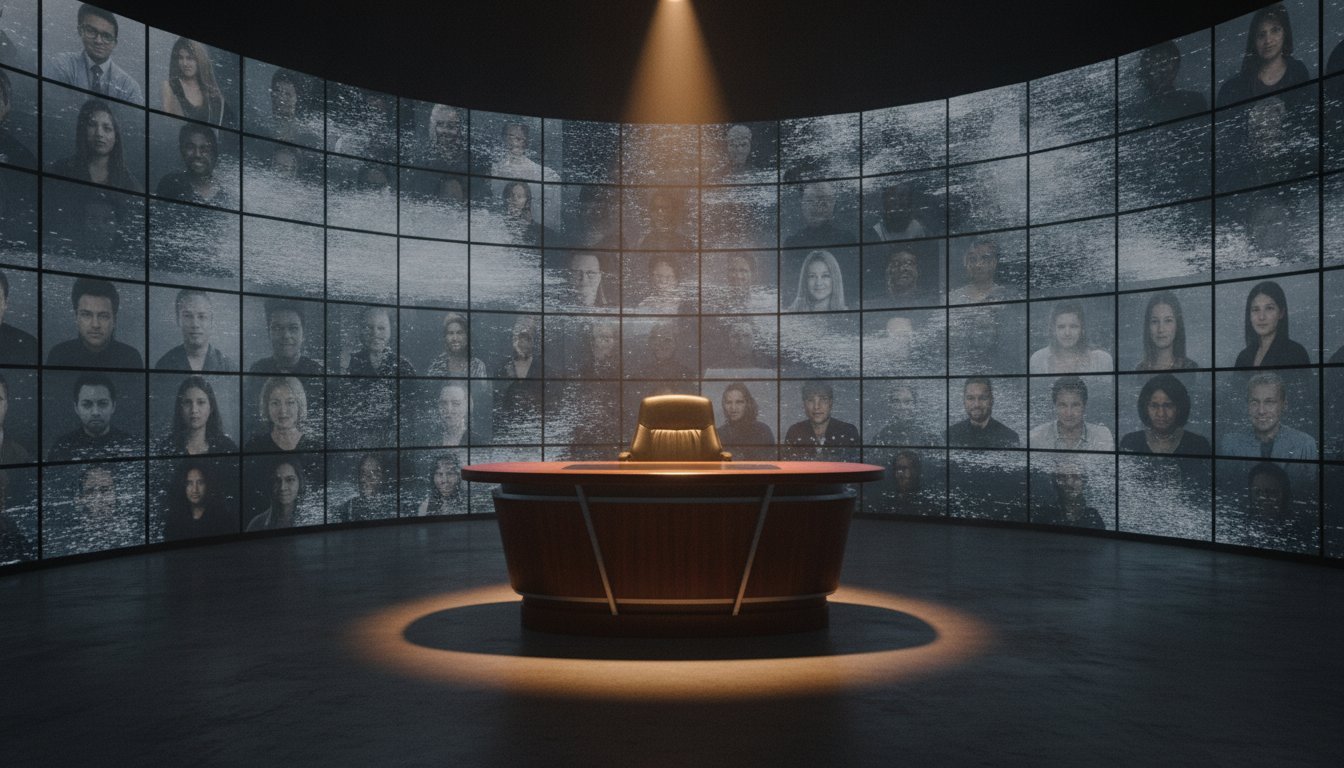
For decades, the most influential seat in American culture wasn’t found in a boardroom or a legislative chamber; it was situated behind a mahogany desk in a dimly lit studio in Midtown Manhattan. This was the “national fireplace,” a singular glow that once united millions of households in a shared ritual of monologue and melody. You likely feel the void left by this disappearing monoculture, especially as the retirement of the “Late Show” franchise in May 2026 signaled a final shift toward digital fragmentation. The cultural impact of late night tv was never just about the jokes. It was about who held the keys to the national conversation.
It’s natural to miss the era when a single host could validate a career or shift a political tide with a well-timed smirk. This article explores how late night transitioned from a lighthearted variety format into a sophisticated engine of global media standards. You’ll learn to appreciate the “Gatekeeper” role perfected by icons like Johnny Carson and trace the lineage of modern satire back to its broadcast roots. This is a journey through the power dynamics of the desk and the legacy of the voices that once defined the American identity before the world went to sleep.
Key Takeaways
- Understand the origins of the “national fireplace” and how the post-war broadcast era created a unified audience that defined the American experience.
- Decipher the profound cultural impact of late night tv by exploring the “Gatekeeper” role of hosts who acted as the ultimate arbiters of professional success.
- Follow the transformation of the monologue from lighthearted variety entertainment into a sharp, essential mechanism for navigating complex political discourse.
- Identify the architectural influence of the American talk show format as it was exported globally, shaping media standards in cultures from the UK to Brazil.
- Evaluate the high-stakes shift from shared appointment television to fragmented viral archives and what this evolution means for our collective cultural memory.
The National Fireplace: Establishing the Late-Night Monoculture
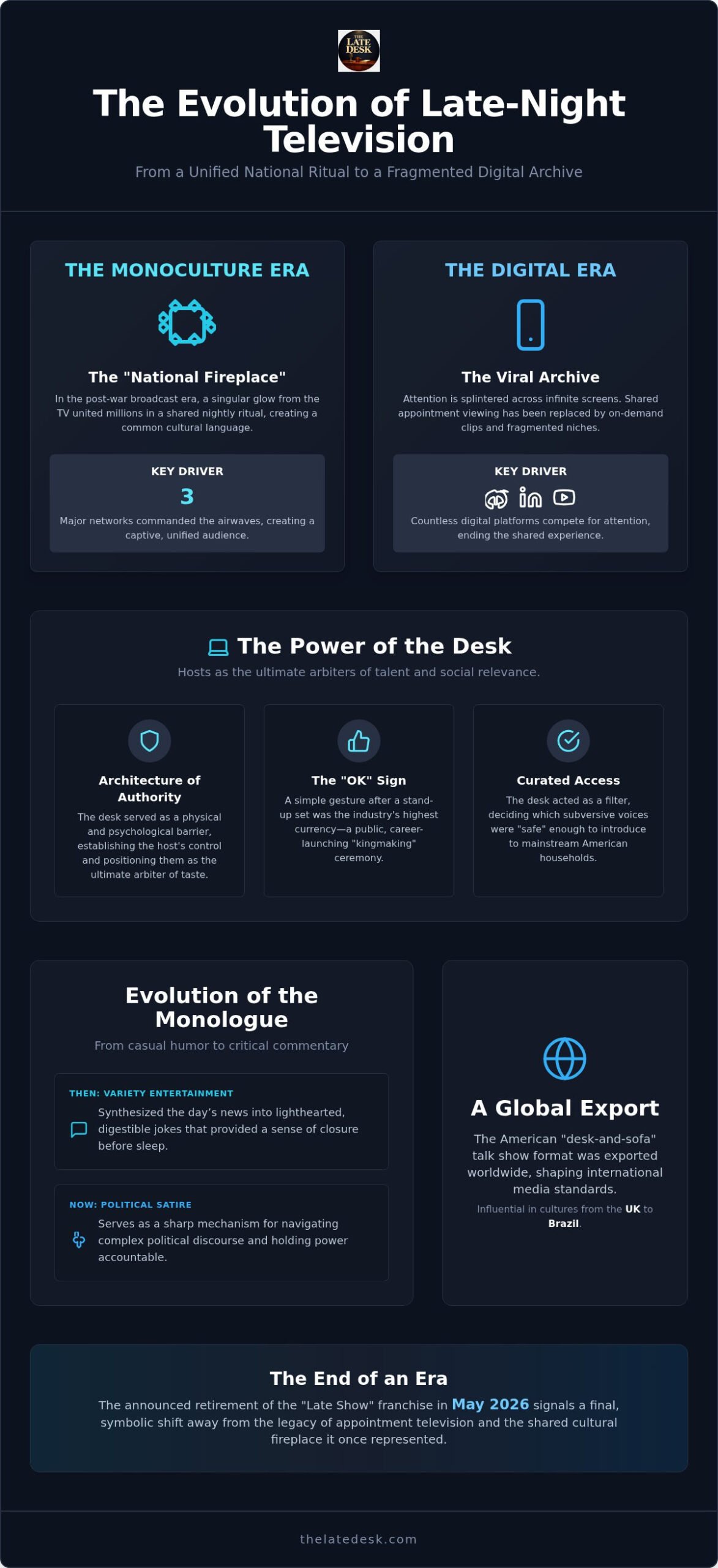
Before the digital era splintered our collective attention into a million flickering screens, there was a singular glow that united the American household. This was the “National Fireplace,” a term describing the nightly ritual of end-of-day viewing that began in the post-war era. For a nation settling into the suburban dream, the television set became the literal and figurative center of the home. With only three major networks commanding the airwaves, a captive audience emerged, turning the late-night hours into a shared cultural experience. The cultural impact of late night tv was rooted in this scarcity; because everyone watched the same programs, everyone spoke the same language the next morning. The nightly monologue served as the ultimate filter, synthesizing the day’s complex news into digestible, rhythmic humor that provided a sense of closure before sleep.
The Psychology of the Late-Night Ritual
The transition from radio variety shows to the visual intimacy of television changed how we perceived celebrity. While radio relied on the listener’s imagination, television allowed viewers to see the subtle twinkle in a host’s eye or the nervous fidgeting of a guest. This proximity created a profound “parasocial relationship,” where the host felt less like a distant performer and more like a trusted confidant invited into the sanctuary of the bedroom. In the context of 1960s television, monoculture refers to a unified state of media consumption where a majority of the population experiences the same cultural touchstones simultaneously through a limited number of broadcast channels. This shared experience acted as a social glue, bridging economic and social divides through a common set of jokes and references.
From Steve Allen to Johnny Carson: Building the Standard
To fully grasp the history of the late-night talk show, one must examine the physical evolution of the studio floor. We can trace the history of late night television from its experimental radio roots to the polished, conversation-driven standards set by Steve Allen and Johnny Carson. It was during this transition that the “desk-and-sofa” setup became the visual shorthand for authority and comfort. The desk functioned as a psychological barrier and a podium, establishing the host as the ultimate arbiter of taste, while the sofa provided a casual space for high-stakes conversation. This shift away from frantic, variety-heavy formats toward intimate, personality-driven entertainment solidified the cultural impact of late night tv as the primary architect of American social norms for over half a century.
The Power of the Desk: Hosts as Cultural Gatekeepers
The physical layout of the classic late-night set was never an accident of interior design; it was a calculated architecture of authority. While the guest sat exposed on a low sofa, the host remained anchored behind a heavy mahogany desk, a psychological barrier that signaled who held the power in the room. This physical arrangement solidified the cultural impact of late night tv by positioning the host as the ultimate arbiter of talent and social relevance. A single nod from this elevated position could launch a career, while a cold reception could effectively end one before the first commercial break. The “OK” sign, a subtle hand gesture from the host to the camera after a stand-up set, served as the industry’s highest form of currency. It wasn’t just a signal of approval. It was a kingmaking ceremony performed in front of millions of witnesses. The history of the late night talk show desk reveals just how deliberately this piece of furniture was engineered to project presidential authority and psychological dominance over every guest who sat across from it.
Guest bookings reflected the social hierarchies of the time, often acting as a controlled bridge between the mainstream and the counterculture. The host decided which subversive voices were “safe” enough for the American living room. This curated access meant that the desk functioned as a final filter for celebrity, where the following dynamics were constantly at play:
- Mainstream icons reinforced the stability of the established “old guard.”
- Subversive figures were introduced to test the boundaries of public discourse.
- New talent was vetted through a rigorous hierarchy of guest-hosting spots and couch invitations.
The Influence of Johnny Carson’s Tonight Show
For three decades, the 30-year reign of Johnny Carson served as the definitive era of the media gatekeeper. The most coveted prize in entertainment was the “couch invitation,” the moment Johnny signaled for a comedian to join him for a chat after their performance. During the peak of the 1970s, Carson’s Tonight Show commanded an average of 15 million nightly viewers, a staggering figure that granted him unprecedented leverage over the American cultural consciousness. This level of influence meant that the host’s personal taste dictated the national sense of humor for an entire generation.
The Gendered Desk: Joan Rivers and the Breaking of Glass Ceilings
While the desk established authority, it also functioned as a fortress for a specific kind of “boys’ club” mentality. The late night tv power dynamics of the era were notoriously rigid, often excluding female voices from the primary seat of power. Joan Rivers famously shattered this mold as Carson’s permanent guest host, yet her eventual move to start her own show led to a lifetime ban from the Tonight Show stage. This fallout highlighted the fragility of the gatekeeper system when a protégé dared to challenge the established hierarchy. These shifts in leadership often had a measurable effect on political opinion and social norms, as the person behind the desk decided which stories were worthy of the spotlight. The cultural impact of late night tv was often most visible during these moments of friction. If you find these industry shifts fascinating, you can spend hours exploring our archives for more hidden histories of the golden age.
Mirrors and Megaphones: Late Night’s Role in Political Discourse
While the morning papers provided the facts and the evening news delivered the gravity, it was the late-night monologue that offered the American public permission to process the truth through laughter. The cultural impact of late night tv was perhaps most profound in its ability to act as a mirror for national anxieties. For decades, the host functioned as the “common man’s” filter, translating dense political scandals into punchlines that stripped away the veneer of untouchable power. This wasn’t just entertainment. It was a nightly referendum on the state of the union, delivered with a wink and a well-timed double-take that made the corridors of power feel a little less intimidating.
The 1973 Watergate hearings provide the definitive case study for this dynamic. While the Senate investigation was a labyrinth of legal jargon and dry testimony, Johnny Carson’s nightly barbs made the corruption of the Nixon administration accessible to millions. By mocking the “plumbers” and the missing tapes, Carson didn’t just tell jokes; he signaled that the establishment had lost its moral authority. This shift from gentle ribbing to a sharper, more diagnostic form of commentary marked a turning point in how late-night shaped public perception, proving that the man behind the desk could influence the national mood as effectively as any news anchor. It transformed the studio into a megaphone for the collective frustrations of a skeptical public.
The Subtle Art of the Political Monologue
Classic hosts perfected the “Everyman” persona to normalize dissent during the turbulent 1960s counterculture. By maintaining a seemingly apolitical stance, they could speak truth to power without alienating half their audience, using a “gentle needle” rather than the “sledgehammer” approach favored by 21st-century activists. This subtlety allowed the host to remain a unifying figure while still highlighting the absurdities of the political class. It was a delicate dance of professional neutrality that shielded the network’s interests while quietly validating the frustrations of the viewer at home. The cultural impact of late night tv during this era was defined by this balance, ensuring that even the most cutting satire felt like a shared confidence rather than a partisan attack. To understand how these opening jokes evolved from radio-era patter into a finely honed political instrument, the evolution of the late night monologue traces the precise moments when a simple comedic ritual became a mechanism of national consensus.
When Politicians Went Late-Night
The relationship between the desk and the campaign trail changed forever when candidates realized that a well-timed appearance could “humanize” a stiff public image. Bill Clinton’s 1992 performance on the saxophone remains the gold standard for this strategy, transforming a policy-heavy governor into a relatable cultural figure. Today, a stop on the late-night circuit is a mandatory campaign requirement, though the risks remain high. A host challenging a political figure in a comedy setting can strip away a politician’s carefully crafted talking points, exposing the person beneath the persona in a way that traditional journalism often fails to do. It’s a high-stakes arena where the reward of relatability is balanced by the danger of a viral gaffe.
Exporting the American Dream: The Global Reach of the Talk Show
As the 20th century progressed, the American talk show format ceased to be a domestic curiosity and transformed into a sophisticated cultural blueprint. This “desk-and-sofa” architecture was packaged and sold as the visual language of the free world, providing a template for modernity that networks from London to New Delhi were eager to replicate. The cultural impact of late night tv was measured not just in domestic ratings, but in how successfully it exported American media values, such as the idolization of the individual and the casual interrogation of power. It established a global celebrity promotional circuit that made a stop at a late-night desk the ultimate validation for any entertainer seeking international stardom.
This exportation wasn’t a simple act of mimicry; it was a complex negotiation between American style and local substance. Global hosts adapted the monologue to navigate their own unique political minefields, often using the perceived “lightness” of comedy to deliver sharp social critiques that would have been censored in a news format. Whether it was the intellectual rigor of Brazilian talk shows or the star-studded glamour of Indian variations, the format proved incredibly resilient. It offered a recognizable structure that could be filled with the specific anxieties and aspirations of any given audience, turning a simple variety show into a powerful tool for cultural diplomacy.
The British Influence and the Transatlantic Exchange
The British “Chat Show” offers the most compelling point of comparison, highlighting the subtle differences in transatlantic sensibilities. While Johnny Carson maintained a structured, segmented pace, British hosts like Michael Parkinson favored long-form, deeply psychological inquiries that often felt more like an intimate dinner party than a broadcast production. The exchange of talent and format tweaks between the US and the UK became a hallmark of the industry, influencing everything from set design to the rhythm of interview questions. The first major international syndication of an American late-night show occurred when the Tonight Show began airing in the United Kingdom in the early 1980s, marking the beginning of a truly global media circuit.
Global Variations of the Late-Night Formula
In emerging media markets, the late-night style functioned as a potent symbol of nation-building and social critique. For post-Soviet nations, adopting the format was a deliberate signal of modernity, a visual break from the rigid, state-controlled broadcasting of the past. Today, the traditional broadcast format is increasingly giving way to localized digital hybrids that blend the classic desk-and-sofa setup with the frantic energy of social media. This evolution ensures that while the medium may change, the underlying structure of the late-night conversation remains a cornerstone of global media. To explore the untold stories of how these shows shaped the world, read our historical television articles and discover the legacies of the icons who built the industry.
The Fragmented Legacy: From Appointment Viewing to Viral Archives
The ritual of appointment viewing, once the rhythmic heartbeat of the American evening, has been largely dismantled by the relentless efficiency of the algorithm. Where millions once gathered simultaneously to witness a singular monologue, modern audiences now consume late-night in three-minute bursts on their smartphones during a morning commute. This shift from a cohesive broadcast to a fragmented viral archive has fundamentally altered the cultural impact of late night tv. While a digital clip of a celebrity playing a parlor game might garner millions of views, it often lacks the narrative weight and the communal resonance of a full, hour-long broadcast. The “story” is no longer a shared journey. It’s a curated highlight reel designed for a fleeting scroll.
The transition toward digital fragmentation reached a symbolic milestone with the retirement of the “Late Show” franchise in May 2026, a move that signaled the formal end of the traditional network dominance. Today, the primary impact of these shows is measured by social media engagement rather than traditional Nielsen ratings. While shows like “Jimmy Kimmel Live!” saw a ratings surge in mid-2026, the broader trend points toward a world where comedy is consumed in short, isolated bursts. This evolution has turned the “national fireplace” into a series of private screens, each flickering with a different version of the truth.
The Death of the Monoculture and the Rise of the Niche
The vanishing of the “cultural middle” is the most significant casualty of this digital migration. In the 1970s, the late-night desk functioned as a bridge between social classes, but today’s media landscape often reinforces existing echo chambers. This loss of a shared nightly ritual has strained social cohesion, as we no longer have a singular lens through which to process national scandals or cultural shifts. Modern clips are engineered for engagement rather than depth, often stripping away the sophisticated context that once made the monologue a vital piece of social commentary. Without that shared context, the cultural impact of late night tv becomes secondary to the pursuit of the next viral moment.
Preserving the Story Behind the Story
Understanding the history of the desk is essential for the next generation of digital storytellers who wish to grasp how authority is projected through media. Without the context of the “Gatekeeper” era, the evolution of modern satire remains a mystery. This is why the work of preservation is a cultural necessity. Utilizing online television archives for researchers allows us to reconstruct the shared memory of the golden age, ensuring that the nuances of industry power dynamics aren’t lost to time. We must look back to understand how the ghosts of the old networks still haunt our current digital habits.
The Late Desk serves as the definitive curator of these pivotal media moments, offering an insider’s perspective on the professional legacies that built the format. We don’t just report on the archives; we interpret the human drama that occurred when the cameras stopped rolling. The legacy of the icons who once ruled the midnight hour continues to shape how we communicate today. Explore the hidden history of late-night television at The Late Desk and rediscover the stories that once brought a nation together.
Preserving the Echoes of the Midnight Hour
The mahogany desks may be gathering dust in archival storage, but the architectural influence they exerted on the global media landscape remains undeniable. We’ve explored how the cultural impact of late night tv transformed a simple variety format into a sophisticated mechanism for national consensus and political vetting. From Carson’s kingmaking nod to the global exportation of the “chat show” template, these programs did more than just fill the silence before sleep. They established the very standards of modern celebrity and public discourse. While the era of appointment viewing has faded into a sea of viral clips, the lessons of the “national fireplace” continue to haunt our digital habits.
Understanding these professional hierarchies and the human drama behind the scenes is essential for anyone who values the history of storytelling. Our publication provides deep dives into archival media history and expert analysis of 20th-century entertainment icons. Rediscover the golden age of television at The Late Desk to see the “story behind the story” that defined a generation. It’s time to step back into the studio and see what the archives reveal about who we used to be.
Frequently Asked Questions
How did late-night TV influence American politics?
Late-night television influenced American politics by acting as a nightly referendum on the state of the union, translating complex scandals into relatable humor. Hosts helped the public process corruption through satire, while later candidates used the format to humanize their public image through performances like Bill Clinton’s 1992 saxophone solo. This dual role as both mirror and megaphone fundamentally shaped how voters perceived the leadership in Washington.
Why is the desk so important in late-night talk shows?
The desk serves as a psychological anchor of authority, creating a physical and symbolic barrier between the host and the guest. While the guest sits exposed on a low sofa, the host remains positioned behind a heavy mahogany structure that mimics the gravity of a boardroom. This arrangement solidified the cultural impact of late night tv by establishing the host as the ultimate arbiter of taste and professional relevance.
Who was the most influential late-night host in history?
Johnny Carson remains the most influential figure in the history of the format due to his thirty year tenure and his ability to command a unified national audience. His Tonight Show was the primary architect of the American monoculture, reaching an average of 15 million viewers nightly during the peak of the 1970s. Carson’s approval was the industry’s highest currency, capable of turning an unknown comedian into a household name in a single evening.
How did Johnny Carson change the cultural landscape of the US?
Johnny Carson changed the cultural landscape by establishing the “national fireplace,” a nightly ritual that brought millions of diverse households together in a shared experience. He created a common language of jokes and references that bridged economic and social divides across the country. His presence provided a sense of closure to the day, making him the most trusted voice in entertainment for three decades.
Is late-night TV still culturally relevant in 2026?
Late-night TV remains culturally relevant in 2026, though its power has shifted from broadcast ratings to digital engagement and viral archives. While the retirement of the “Late Show” franchise in May 2026 marked the formal end of the traditional network era, clips from remaining shows continue to drive social media discourse. The format now functions as a content factory for short bursts of commentary rather than a unified nightly ritual.
What was the “Gatekeeper Effect” in classic television?
The Gatekeeper Effect refers to the immense power hosts once held to launch or destroy a professional career with a single gesture of approval. In the golden age, a host decided which subversive voices were safe for the American living room and which remained in obscurity. The “OK” sign from a host like Carson was a kingmaking ceremony that validated new talent in front of a massive, captive audience.
How did the late-night format spread to other countries?
The late-night format spread through international syndication and the deliberate exportation of American media values during the late 20th century. Networks in the UK, Brazil, and India adapted the desk-and-sofa template to fit their own unique social and political contexts. This transatlantic exchange of talent and format tweaks ensured that the cultural impact of late night tv became a global standard for broadcast entertainment.
Why did the “monoculture” of late-night TV disappear?
The monoculture of late-night TV disappeared due to the fragmentation of the media landscape and the rise of on-demand digital platforms. As viewers moved away from appointment television toward personalized streaming and viral clips, the shared nightly ritual was dismantled. This loss of a “cultural middle” has led to deeper societal polarization, as audiences no longer consume the same satirical filter simultaneously.