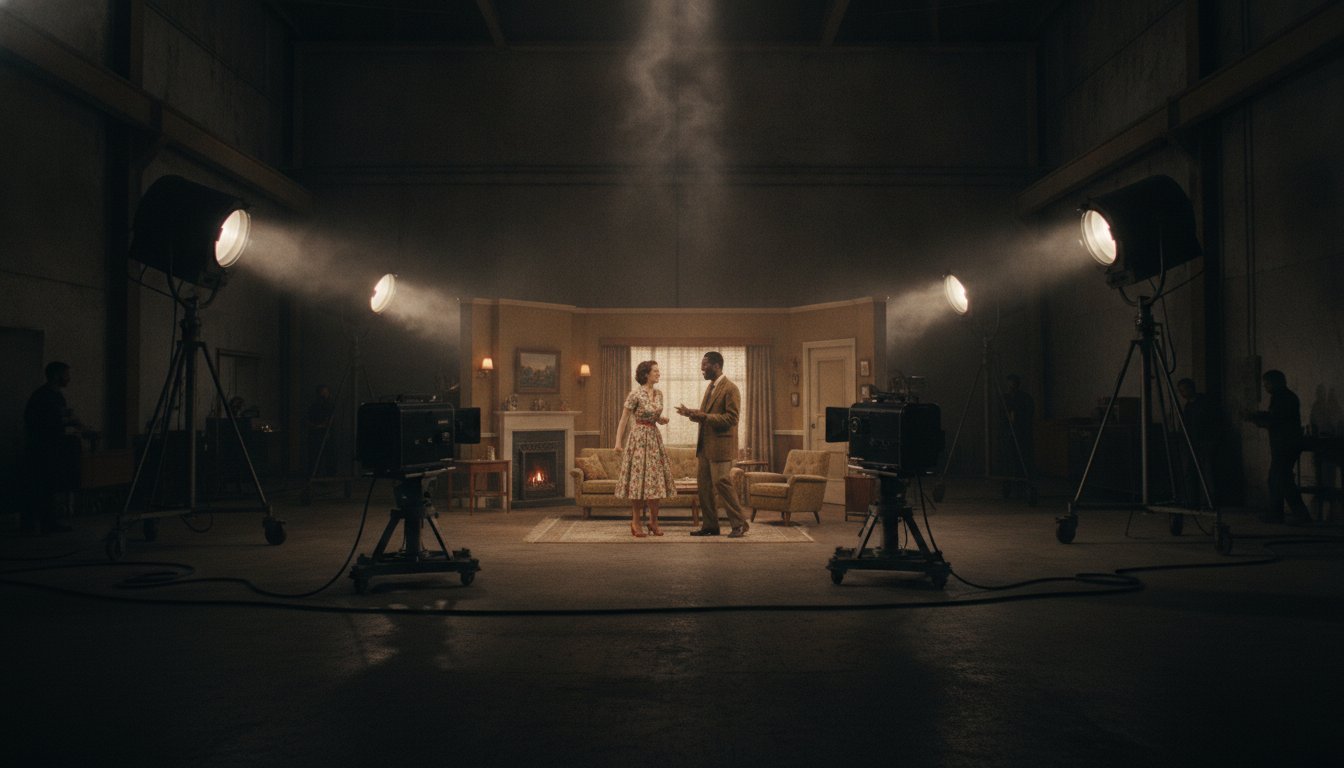
Imagine standing under 5,000-watt carbon-arc lamps that could literally blister paint, all while being forced to maintain a breezy, sitcom smile for a live studio audience. This was the punishing reality of classic tv behind the scenes, where the so-called golden age was often forged in an environment more akin to a steel mill than a creative playground. We typically look back at these programs through a soft-focus lens of nostalgia, assuming the production was as effortless as the finished product appeared on a grainy Zenith screen.
You likely feel a deep affection for these pioneers, but the true story is far more complex than an oversimplified trivia list. This article promises to reveal the high-stakes reality, technical hazards, and rigid power dynamics that actually defined the industry during its most formative years. You’ll gain a deeper appreciation for the evolution of the studio system and the mechanical craft that turned a chaotic, often dangerous workspace into the polished illusions we still celebrate today.
Key Takeaways
- Understand how the polished aesthetic of the era was actually a byproduct of industrial network control and a chaotic transition from radio to television.
- Discover the alarming physical hazards of the hot light era, including the use of toxic materials like asbestos and lead that were common in classic tv behind the scenes.
- Uncover the complex power dynamics of the studio system, where ironclad contracts and immense psychological pressure dictated the lives of the era’s biggest icons.
- Learn how to decode archival footage by spotting technical artifacts like boom mic shadows that reveal the true physical geography of the set.
- Move beyond simple nostalgia to appreciate the gritty, human effort required to maintain the illusion of effortless entertainment during broadcasting’s formative years.
The Illusion of Perfection: Why Classic TV Sets Were More Industrial Than Glamorous
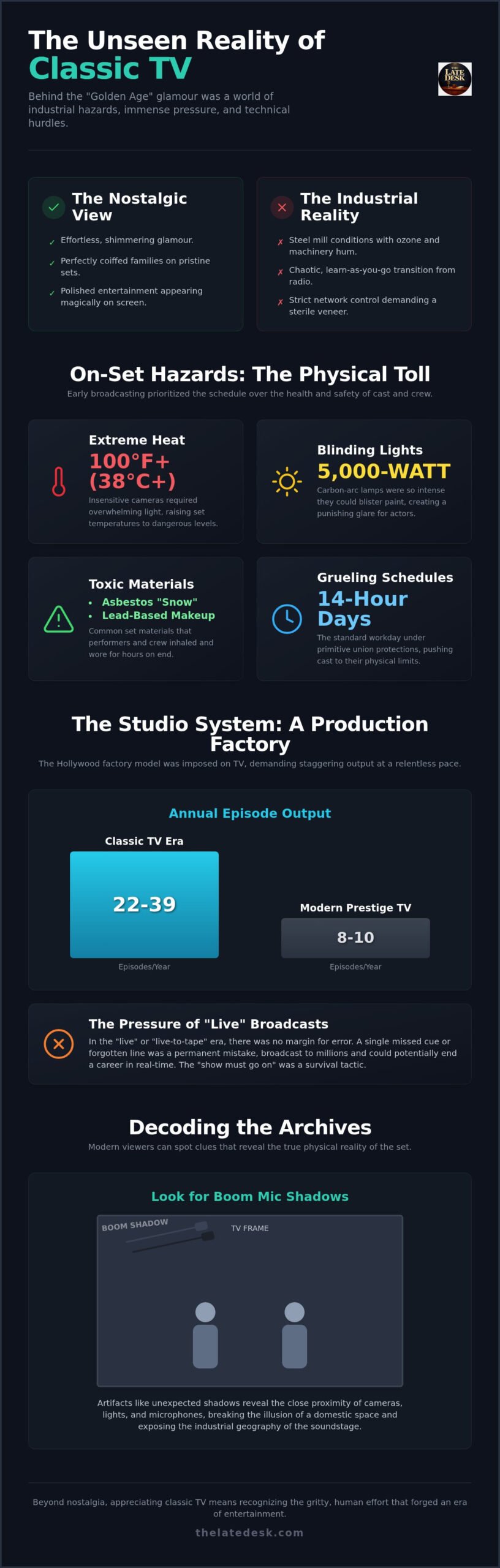
The term “Golden Age” evokes images of shimmering evening gowns and perfectly coiffed families, yet the reality of classic tv behind the scenes was often defined by the smell of ozone and the relentless hum of heavy machinery. This aesthetic was rarely a purely artistic choice. Instead, it was a byproduct of strict network control and the sheer limitations of mid-century hardware. The Golden Age of television was a period where technical innovation often outpaced safety regulations.
Transitioning from radio to television meant moving from a medium of imagination to one of unforgiving visual scrutiny. It was a chaotic, learn-as-you-go environment where technical crews were essentially building the plane while it was in the air. Producers had to satisfy the stern oversight of Broadcast Standards and Practices, a department tasked with maintaining a sterile, wholesome veneer. This department functioned as the ultimate filter, ensuring that the industrial grime of the production floor never leaked into the living rooms of America.
The Studio System and the Birth of the Soundstage
Hollywood film studios didn’t just open their doors to television; they imposed a factory model designed for maximum output. While modern prestige series might spend months on a handful of episodes, the classic era demanded a staggering 22 to 39 episodes per year. This relentless pace turned soundstages into high-speed assembly lines where efficiency was valued above all else. Performers faced the immense psychological weight of “live” or “live-to-tape” broadcasts. In this high-pressure environment, a single missed cue wasn’t just a mistake; it was a permanent record of failure broadcast to millions of homes simultaneously.
The Shift from Radio Roots to Visual Spectacle
In its infancy, television was essentially radio with pictures. Early scripts relied heavily on dialogue to explain action, leading to awkward, static visual staging where actors stood in rigid clusters. To understand the evolution of classic tv behind the scenes, one must look at how early sets often looked “flat” to accommodate primitive lighting and camera tubes. The evolution of the multi-camera setup eventually allowed for more dynamic movement, but it came with a technical cost. Lighting had to be bright and uniform to ensure the cameras could register an image, sacrificing cinematic depth for the sake of a clear signal. This industrial necessity shaped the very look of the era, creating a visual language that felt both domestic and strangely clinical.
The Physical Toll of Early Broadcasting: Heat, Hazards, and High Stakes
The sound of a classic television set wasn’t just the canned laughter of a studio audience; it was the constant, low-frequency crackle of carbon-arc lamps. Early television cameras, specifically those utilizing the Image Orthicon tubes of the late 1940s and 50s, were remarkably insensitive to light. To produce a broadcast-quality image, studios had to be flooded with an aggressive, almost blinding level of illumination. In an era before sophisticated climate control, 1950s studio lights could raise set temperatures to over 100 degrees Fahrenheit.
Beyond the sweltering heat, the physical landscape of classic tv behind the scenes was littered with hidden dangers that would be unthinkable by modern safety standards. Actors often wore heavy wool costumes and thick, lead-based makeup designed to prevent their features from washing out under the glare. On winter-themed sets, “snow” was frequently made of loose asbestos fibers, which performers and crew members inhaled for hours on end. These 14-hour workdays were the standard, often occurring under primitive union protections that prioritized the broadcast schedule over the literal health of the cast.
Technical Limitations as Creative Hurdles
The “Kinescope” era presented its own set of unique trials for performers. Because the recording quality was so poor, actors were often directed to over-emote, ensuring their expressions reached the viewer through the fuzzy resolution. Live broadcasts left no margin for error. A missed cue or a forgotten line wasn’t just a minor blooper; it was a professional catastrophe that could end a career in real-time. This reality of classic tv behind the scenes meant that the “show must go on” mentality was less of a theatrical tradition and more of a desperate survival tactic.
The Danger of Special Effects in the Pre-Digital Age
Without the safety net of modern CGI, practical effects were often uncomfortably close to the actors. Pyrotechnics were notoriously unpredictable, and mechanical stunts were frequently performed by the stars themselves rather than seasoned doubles. The lack of safety protocols meant that injuries were often hidden behind a smile until the red tally light finally dimmed. For those who want to explore the narratives of late-night legends who survived this grueling era, the archives reveal a startling level of resilience required just to get through a single taping. The grit behind the glamour was a mandatory requirement for anyone stepping onto the soundstage.
Power Behind the Curtain: The Dynamic Between Stars and the Studio Machine
The image of a smiling television star was often a carefully managed asset, owned and operated by a network that viewed talent as interchangeable parts of a broadcast machine. In the reality of classic tv behind the scenes, these icons were frequently bound by ironclad contracts that extended far beyond the soundstage. Studios didn’t just buy a performer’s time; they often purchased their name, their likeness, and even their right to a private life. It was a professional ecosystem where the studio’s authority was absolute, and the price of fame was a total surrender to the network’s vision.
The Ironclad Contract: Ownership of Persona
Networks utilized morality clauses to ensure that the public image of their stars remained pristine. A single headline regarding a divorce or a legal indiscretion could trigger a termination clause, ending a multi-year career in a single afternoon. This level of control created a climate of constant apprehension, yet it also sparked significant rebellions. Some icons eventually realized that the only way to survive the studio machine was to own the production themselves, shifting the power from the boardroom back to the performer. This struggle for autonomy is a core theme in The Business of Laughter: A Historical Analysis of Late Night TV Power Dynamics, which examines how the shift from employee to owner changed the industry forever.
Late Night Rivalries and Booking Wars
Nowhere was this power dynamic more visible than behind the desk of a late-night talk show. Hosting a program like The Tonight Show required more than just comedic timing; it demanded the ability to navigate a rigid hierarchy where the host was the undisputed center of the universe. Johnny Carson famously maintained a sense of professional distance that kept even his most frequent guests on edge. One of the most dramatic examples of how this dynamic could permanently fracture a professional relationship is documented in the story of the Joan Rivers Tonight Show ban, a 26-year exile that illustrated just how absolute a host’s power over the program could be. This environment was fueled by intense booking wars, where producers fought tooth and nail to secure exclusive appearances from the day’s biggest celebrities, often blacklisting guests who dared to appear on a rival program.
The competition wasn’t just for laughs; it was for survival in a medium where ratings were the only currency that mattered. You can see the legacy of these conflicts in The High Stakes of Midnight: A Television Ratings History of Classic Era Battles. These feuds shaped the very landscape of late-night, turning the space behind the scenes into a battlefield of egos and network mandates. The sidekick, while often appearing as a jovial companion, was a vital part of this managed spectacle. They served as a buffer between the host and the unpredictable energy of a live guest, ensuring the star always remained in control of the room. Yet the bandleader occupied an equally strategic position in this hierarchy; as explored in the history of late night tv band leaders, the musical director was often the only figure on stage who could redirect the energy of a broadcast without triggering the host’s wrath.
Decoding the Archives: How Modern Viewers Can Spot Production Secrets
While we often view these programs as seamless windows into another world, the archives contain subtle clues that expose the mechanical reality of the soundstage. To truly understand classic tv behind the scenes, one must learn to look past the actors and into the shadows. The boom mic shadow, a frequent uninvited guest in early broadcasts, serves as a map for the curious viewer. It marks the physical boundary of the set and reveals the low, cramped ceilings necessitated by the massive lighting rigs that defined the era.
Directors utilized specific blocking, where actors were positioned in a triangular or semi-circle formation, to subtly direct attention away from the missing fourth wall where the cameras and crew stood. This choreography was essential because the sets were rarely three-dimensional environments. Standard definition provided a necessary low-resolution veil that effectively hid the industrial grit. Tape, staples, and unpainted plywood were invisible to the home viewer, allowing the studio to maintain a facade of domestic perfection that would crumble under the scrutiny of modern high-definition lenses.
Identifying Set Recyclability
The factory model of production mentioned previously relied heavily on the economics of stock sets. If you look closely at the background of various network shows from the same era, you will often spot the same grand staircase or the same generic office hallway. Studios maintained massive backlots where a single street served as a dozen different cities, with only a change of signage and a few parked cars to differentiate New York from Chicago. This recycling was a financial necessity in an era where production budgets were stretched thin by the demand for dozens of episodes per season.
The Evolution of the Audience Reaction
The transition from genuine live reactions to the “canned” laugh track was perhaps the most significant shift in the viewer’s experience. Charley Douglass, a sound engineer, revolutionized the industry with his “Laff Box,” a mysterious device that could trigger specific types of laughter at the touch of a key. This was a closely guarded industry secret for years. The impact on comedic pacing was profound; actors began to “pause for the laugh,” a technique that became a hallmark of the sitcom format. If you want to dive deeper into the technical evolution of the medium, explore our full collection of historical television articles to see how these secrets were kept for decades.
Preserving the Narrative: Why the Stories Behind the Desk Matter Today
The velvet curtains and polished monologues of the mid-century era suggest a world of effortless grace, yet we know now that this was a hard-won illusion. Looking past the nostalgia allows us to recognize the human cost and the industrial grit that defined the era. When we peel back the layers of classic tv behind the scenes, we don’t just find technical errors or hazardous conditions. We find a story of immense resilience and creative problem-solving that laid the groundwork for everything we watch today. Understanding these production struggles doesn’t diminish the magic of the “Golden Age”; it deepens our appreciation for the performers and crews who mastered a medium that was still in its dangerous, experimental infancy.
The Late Desk remains committed to archiving these “lost” narratives, acting as a bridge between the dusty canisters of the past and the digital screens of the present. By documenting the professional hierarchies and the physical toll of the studio system, we ensure that the human effort behind the broadcast is never forgotten. This history is a reminder that television was never just about the talent in front of the lens. It was a massive, collective endeavor that required a unique blend of artistry and industrial stamina.
The Fragility of Television History
There is a profound tragedy in the fragility of early media history, particularly the practice of “wiping” magnetic tapes. In the 1950s and 60s, networks often erased original recordings of classic broadcasts to save money on expensive tape stock, leading to the permanent loss of thousands of hours of cultural history. Digital preservation is no longer just a technical preference; it’s an essential duty for future generations of media scholars. Archivists and dedicated fans play a vital role in tracking down these physical artifacts, from kinescopes to script drafts, to piece together the full story of the era.
From Carson to Today: The Lasting Legacy of Production Innovation
The techniques pioneered during the 1960s, from the multi-camera sitcom setup to the rhythmic pacing of the late-night monologue, still dictate the flow of modern entertainment. While we’ve moved from the industrial soundstage to a more democratized digital stage, the core principles of the talk show format remain remarkably consistent. The desk remains the same, but the world behind it has changed forever. Today’s creators stand on the shoulders of those who worked under blistering lights and ironclad contracts. To explore these legacies in greater detail, we invite you to consult our Online TV Archives for Researchers and join us in the ongoing work of media history preservation.
Step Into the Living History of the Small Screen
The polished veneer of the mid-century era was a product of factory-like efficiency and strict network control. By understanding the physical hazards and the complex power dynamics of the studio system, we transform our view of classic tv behind the scenes from a simple nostalgic trip into a deep study of human resilience. These archives reveal that the magic of television was never accidental; it was manufactured through grit and a relentless commitment to the broadcast schedule.
The Late Desk honors this legacy through expert analysis of the Carson era and in-depth historical media research designed for the modern fan. Our narrative-driven approach invites you to look past the fourth wall and rediscover the mechanical heart of the industry. Discover the untold stories of late-night legends at The Late Desk. The history of the medium is far richer than the grainy footage suggests, and the most compelling chapters are often the ones that were never meant to be televised.
Frequently Asked Questions
Why were early TV sets so hot for the actors?
Early television cameras were notoriously insensitive to light, requiring a staggering amount of illumination to produce a clear broadcast signal. High-wattage carbon-arc and incandescent lamps were packed into the rafters, generating immense heat that often pushed set temperatures past 100 degrees Fahrenheit. This sweltering environment was a standard hurdle of classic tv behind the scenes, forcing performers to maintain a cool composure while their heavy makeup and wool costumes became nearly unbearable.
Did classic TV shows really use live audiences for every episode?
Variety programs and early dramas were often broadcast live with an audience, but many filmed sitcoms utilized a single-camera setup that precluded a studio gallery. Pioneering shows like I Love Lucy introduced the multi-camera filmed format before a live audience; however, other programs relied entirely on post-production audio. The presence of an audience was often a strategic choice dictated by the show’s format and the technical capabilities of the studio soundstage.
What is a ‘laugh track’ and why was it invented?
A laugh track is a pre-recorded sequence of audience reactions, famously managed by Charley Douglass and his proprietary “Laff Box.” It was invented to provide a consistent comedic rhythm for shows filmed without an audience or to “sweeten” genuine reactions that were deemed too quiet or poorly timed. This technical intervention allowed producers to maintain total control over the emotional arc of a broadcast, ensuring that every joke landed with the intended impact.
Were there any safety regulations for child stars in the 1950s?
Regulations like the 1939 Coogan Act provided some financial protections, but physical safety and labor standards were primitive by modern metrics. Children often worked grueling hours under the same intense heat and hazardous conditions as their adult counterparts. While basic union standards for child actors existed in the 1950s, the “show must go on” mentality frequently led to long days that would be strictly prohibited under contemporary labor laws.
Why did so many classic TV shows have the same set designs?
The repetition of sets was a direct result of the industrial “factory model” adopted by major studios to manage high-volume production schedules. Building entirely new environments for every program was financially unsustainable, so networks relied on stock sets and shared backlots. A single suburban living room or a generic office hallway might be redressed dozens of times to serve as the backdrop for multiple competing series across the same network.
What happened to the original tapes of classic late-night shows?
Thousands of hours of early late-night history were lost because networks routinely erased or “wiped” magnetic tapes to reuse the expensive stock. High-profile programs, including early episodes of The Tonight Show, were victims of this cost-cutting measure, leaving only scattered kinescopes behind. This tragic loss of media history is why modern archival efforts are so vital for preserving the few remaining fragments of broadcasting’s formative years.
How did the studio system control the personal lives of TV stars?
Networks utilized ironclad contracts that included morality clauses, giving the studio the power to terminate a performer’s career for any perceived private indiscretion. These documents often gave the network control over a star’s public appearances, their choice of spouse, and even their physical appearance. The studio system treated talent as a corporate asset, and any deviation from the carefully curated public image was seen as a threat to the network’s bottom line.
What are some of the most dangerous practical effects used in classic TV?
The use of loose asbestos fibers to simulate snow is perhaps the most notorious example of hazardous classic tv behind the scenes practices. Pyrotechnics were also frequently handled with minimal safety distance, and mechanical stunts were often performed by the stars themselves without the benefit of safety doubles. These risks were taken in an era where technical ambition frequently outpaced the development of safety protocols, leaving a legacy of grit behind the glamorous finished product.