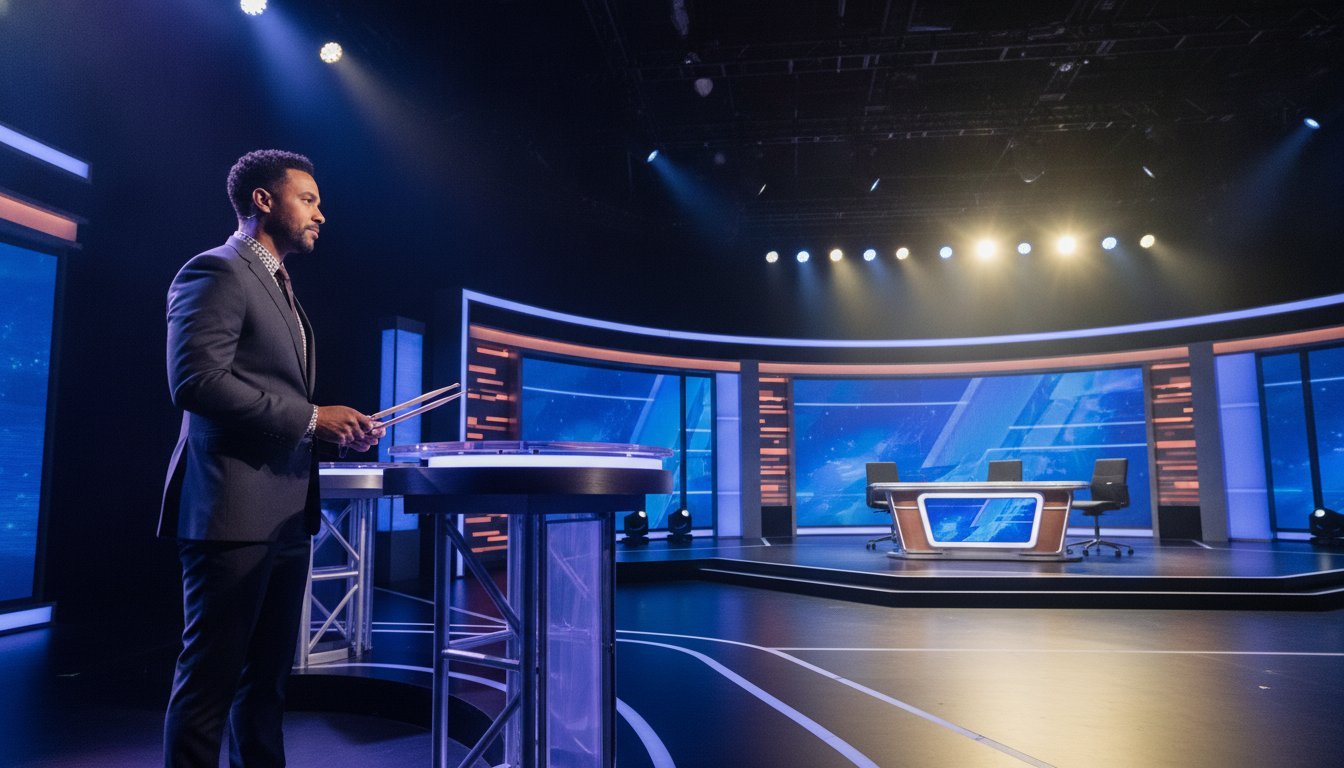
For decades, the man holding the baton was often the only person on stage allowed to tell the King of Late Night he was wrong without fearing for his job. While the host commanded the desk, the bandleader commanded the room, serving as a vital bridge between the scripted joke and the spontaneous roar of the studio audience. To truly understand the history of late night tv band leaders, one must look past the sequins and the trumpets to the high-stakes power dynamics of the broadcast booth. It is a story of professional survival hidden behind the mask of a nightly party.
You probably recognize the familiar theme songs that signaled the end of your day, yet the role of the musical director was never just about the melody. It was about rhythm, timing, and an unspoken telepathy with the host. In this article, you’ll discover how the late-night bandleader evolved from a radio-era necessity into the comedic heartbeat and cultural curator of television’s most iconic programs. We will trace the lineage of these essential sidekicks, from the formal elegance of the early years to the improvisational mastery that turned a musician into a legendary co-star.
Key Takeaways
- Trace the lineage of the musical director back to 1940s variety shows, where the house band first transitioned from a radio necessity to a structural pillar of the broadcast.
- Analyze the history of late night tv band leaders through the lens of Doc Severinsen, whose sartorial flair and sharp wit defined the archetype of the musical sidekick.
- Examine the evolution of the bandleader from a supportive accompanist to a primary comedic character, as pioneered by Paul Shaffer’s work with David Letterman.
- Learn how modern ensembles like The Roots have transformed the bandstand into a hub for cultural curation and social media influence.
- Gain an insider’s perspective on the industrial grit and professional hierarchies required to produce high-stakes live music on a nightly basis.
The Radio Roots and the Birth of the Late Night House Band
The late-night bandleader is often viewed as a decorative fixture, yet the role’s origin is rooted in the cold pragmatism of early broadcasting. When television emerged as the dominant medium in the mid-1950s, it didn’t create a new musical template. Instead, it inherited the massive studio orchestra model from the high-budget radio variety shows of the 1940s. This transition marked the true beginning of the history of late night tv band leaders, shifting the focus from invisible airwaves to the visual spectacle of the bandstand. The bandleader was more than a conductor; they were the show’s musical director and, eventually, its secondary personality.
The Technical Necessity of Live Music
In the early days of live television, silence was the enemy. Primitive production techniques required significant time for set changes and costume swaps, leaving gaps that could feel like an eternity to a home viewer. Without a live ensemble to fill this “dead air,” the broadcast would have stalled. The band functioned as the show’s nervous system, adjusting the emotional tempo of the room to match the host’s energy or mask a technical glitch. Eventually, the sprawling ensembles like the NBC Symphony were replaced by a more agile, specialized unit that would become The Tonight Show Band. This shift allowed for a more intimate connection between the music and the comedy, turning the orchestra into a responsive tool for the host.
Skitch Henderson: The Architect of the Sound
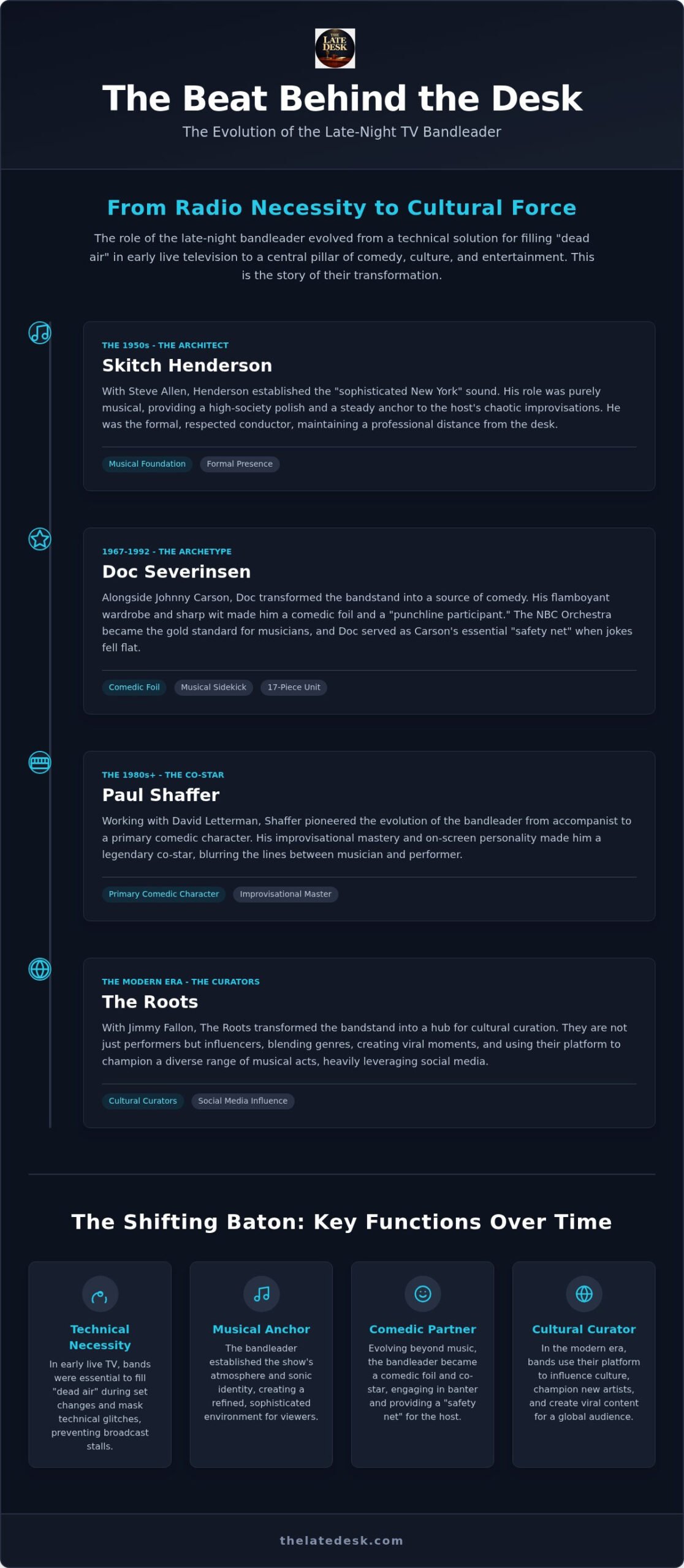
Skitch Henderson arrived at the dawn of the Steve Allen era with a pedigree that demanded respect. He didn’t initially function as a comedic partner. In those early broadcasts, a physical and professional distance existed between the host’s desk and the conductor’s podium, reflecting the formal hierarchies of the time. Henderson focused on the music, bringing a high-society polish to the chaotic energy of Allen’s improvisations. While Allen was busy jumping into vats of gelatin or interviewing people on the street, Henderson remained the steady, sophisticated anchor in the studio. Henderson established the “sophisticated New York” sound of early late night, creating a refined atmosphere that made the midnight hour feel like an exclusive club for the urban elite.
Doc Severinsen and the Archetype of the Musical Sidekick
If Skitch Henderson built the foundation of the late-night sound, Doc Severinsen painted the house in neon colors. Taking the baton in 1967, Doc began a tenure that would span three decades, fundamentally altering the history of late night tv band leaders. While his predecessor was a refined presence in the background, Doc stepped directly into the spotlight. His flamboyant wardrobe, characterized by sequins, clashing patterns, and vibrant silks, served as a brilliant comedic foil to The Tonight Show with Johnny Carson and its host’s buttoned-down midwestern reserve. This visual irony wasn’t just vanity; it was a strategic shift that transformed the bandstand into a primary source of banter.
The NBC Orchestra under Doc’s leadership became the gold standard for session musicianship throughout the 1970s. In an era before digital backing tracks, playing in this 17-piece unit was the pinnacle of a professional music career. These musicians weren’t just playing for the home audience. They were providing the sonic architecture for a high-stakes live broadcast. Doc’s role evolved into that of a “punchline participant,” where a well-timed trumpet flare or a dry remark during the monologue carried as much weight as a written joke. He became the first leader to truly integrate the music into the comedy of the desk.
The Interpersonal Alchemy of the Carson Era
The dynamic in Studio 6B relied on a delicate balance between three men. While Ed McMahon was the reliable announcer and “first fan,” Doc provided the “safety net” for Carson’s improvisations. When a joke died on the vine, Carson could turn to the bandstand for a rescue, often finding it in Doc’s quick wit or a self-deprecating musical sting. Doc’s cues, particularly the iconic opening theme, became synonymous with Carson’s golf swing and entrance. This era represented the peak of traditional broadcasting polish before late night’s embrace of the fringes began to favor alternative acts and leaner, more chaotic band structures.
The Bandleader as a National Celebrity
Doc Severinsen’s persona eventually transcended the studio walls. He wasn’t just a sidekick. He was a national celebrity who leveraged his nightly exposure into sold-out solo tours and best-selling albums. This success established the “Doc and Johnny” blueprint that every subsequent host-leader pairing has since attempted to replicate. Behind the scenes, the industrial grit required to manage a 17-piece orchestra daily was immense. Doc navigated complex union contracts and grueling rehearsal schedules, ensuring the music remained flawless even when the comedy was experimental. To explore more about the professional hierarchies of this era, you can browse our television archives for deep dives into production history.
Paul Shaffer and the Rise of the Bandleader as Comedic Character
When David Letterman launched his NBC program in 1982, he didn’t just hire a musical director; he recruited a co-conspirator. Paul Shaffer, a veteran of the early Saturday Night Live years, brought a sharp, ironic edge that fundamentally broke the traditional “sidekick” mold. This was a pivotal moment in the history of late night tv band leaders. Shaffer didn’t rely on the flamboyant sincerity of the Carson era. Instead, he adopted an affectation of old-school showbiz enthusiasm that subtly mocked the very industry it celebrated. His ensemble was famously dubbed “The World’s Most Dangerous Band,” a title that signaled a definitive departure from the polite, tux-clad studio orchestras of the past.
Shaffer’s presence was an exercise in subversive contrast. While Doc Severinsen was a vibrant foil to Carson’s reserve, Shaffer was a mirror to Letterman’s cynicism. He traded the baton for a synthesizer and the conductor’s podium for a seat at the desk, establishing an “insider” personality that felt more like a downtown club owner than a corporate employee. This shift allowed the bandleader to transition from a background musician to a primary comedic character who could hold his own against the host’s biting wit.
Subverting the Format: The Letterman-Shaffer Dynamic
Shaffer became an essential co-writer and a recurring character within the show’s sketches. He pioneered the “Paul-as-expert” trope, where he would frequently fact-check Letterman or offer overly dramatic anecdotes about legendary performers he supposedly knew. This partnership was forged during the high-stakes late night tv ratings battles of the 80s and 90s. As the networks fought for a younger, more irreverent audience, the Shaffer-Letterman dynamic proved that a show could be successful by deconstructing the very format it inhabited.
The Musical Director as Curator
Beyond the comedy, Shaffer possessed a terrifyingly vast musical memory. He was expected to lead the band through a James Brown funk groove one moment and a Bob Dylan folk anthem the next, often with little to no rehearsal. This “musical encyclopedia” requirement became the new standard for the modern era. Shaffer’s CBS Orchestra eventually redefined the “Late Show” sound for a new generation, proving that a bandleader could be a musical heavyweight while simultaneously serving as the show’s rhythmic conscience. It was no longer enough to just play the hits; the leader had to curate the entire cultural vibe of the broadcast.
The Roots and the Modern Era of Cultural Curation
When Jimmy Fallon was tapped to succeed Conan O’Brien, he made a decision that fundamentally disrupted the history of late night tv band leaders. He didn’t look to the jazz clubs of Manhattan or the session rooms of Los Angeles. Instead, he recruited The Roots, a legendary Philadelphia hip-hop ensemble. This wasn’t merely a change in genre; it was a total reimagining of what a house band could be. The Roots brought a level of street credibility and rhythmic precision that made the traditional big-band sound feel instantly antiquated. This move signaled that the midnight hour was no longer just for the “cocktail and cigarette” crowd, but for a generation raised on the breakbeat.
Questlove, the band’s drummer and frontman, transformed the role from a musical director into a high-level cultural influencer and social media power player. The band became central to the show’s digital strategy, particularly through segments like “Classroom Instruments.” These viral clips were engineered for the YouTube era, proving that the band wasn’t just there to play the show into a commercial break. They were the content. This “remixing” of the format allowed the show to live beyond its time slot, reaching millions of viewers on their smartphones the following morning. The bandleader’s job description expanded to include viral architect and digital curator.
Genre-Bending and the Digital Shift
The foundation of the late-night band shifted from the brass-heavy swing of the 1960s to the drum-forward pulse of Hip-Hop. This evolution paved the way for experimental outliers who defied easy categorization. Reggie Watts brought a surrealist, loop-based approach to “The Late Late Show,” eschewing traditional arrangements for spontaneous, improvised soundscapes that felt more like performance art than a variety show. Similarly, Jon Batiste’s “Stay Human” ensemble brought a “New Orleans street party” energy to Stephen Colbert’s stage. They blended high-brow musicality with a communal, inclusive spirit that resonated with a modern audience looking for authenticity in a scripted landscape.
The Bandleader as Producer
Modern leaders like Questlove and Batiste aren’t just conductors; they’re high-level music producers with their own independent legacies. They manage the integration of the band into every facet of the show’s brand identity, from the walk-on music to the digital sketches. The band is no longer a separate entity providing accompaniment. It’s the show’s primary aesthetic engine. This shift from “background music” to “brand identity” has made the bandleader one of the most influential figures in the broadcast booth. If you want to understand the grit behind these productions, read our deep dive into classic tv behind the scenes to see how the industry has changed.
The Industrial Grit: Navigating the Power Dynamics of the Bandstand
Behind the velvet curtains and the gleaming brass, the bandstand is a place of relentless labor. To truly understand the history of late night tv band leaders, one must look past the music to the professional hierarchy that governs the studio floor. While the host is the public face of the franchise, the bandleader acts as a vital middle manager who balances the creative whims of the star with the rigid demands of the network producer. This position requires more than perfect pitch; it requires a thick skin for the classic tv behind the scenes pressures that come with producing sixty minutes of live television every single night. The bandleader sits at a unique intersection of corporate strategy and creative expression, often serving as the only person in the room who can tell the host a joke isn’t working through a simple musical cue.
The survival of the bandleader is inextricably linked to the broader late night tv power dynamics of the network era. In the 1970s and 80s, the house band was an untouchable institution. Today, that status is under constant negotiation. As networks face declining ratings and the fragmentation of the traditional audience, the bandstand has become a target for cost-cutting measures. Navigating these industrial shifts requires a leader who is as much a businessman as they are a musician.
The Business of the Band
The logistics of the bandstand are governed by a complex web of union regulations and session fees. Most late-night musicians belong to the American Federation of Musicians, meaning every rehearsal hour and overtime minute is strictly accounted for in the show’s budget. This creates a natural tension between the host’s desire for spontaneous creative freedom and the network’s adherence to rigid financial standards. Within this framework, the bandleader functions as the musical diplomat between the host’s desk and the musical guest’s ego, ensuring that the transition from interview to performance is seamless and professional. They manage the internal politics of the ensemble while keeping the network executives satisfied that the music isn’t exceeding its allocated time slot.
The Future of the Late Night Sound
As we enter the mid-2020s, the traditional large-scale house band faces an existential threat. Rising production costs have led some programs to downsize their ensembles or eliminate them entirely in favor of smaller, more versatile units. We’re seeing a move toward leaner structures that rely on digital assistance rather than a full 17-piece horn section. While some wonder if the bandleader role can exist without a live orchestra, the human element remains essential to the late-night format. The improvisational spark between a host and a leader can’t be replicated by a pre-recorded track, and it’s this very connection that continues to justify the bandleader’s seat at the desk. The music provides the show’s heartbeat, and without it, the midnight hour would lose its rhythmic soul.
Beyond the Final Note: The Legacy of the Midnight Maestro
The bandstand has always been more than a collection of chairs and instruments; it is the show’s rhythmic conscience. From Skitch Henderson’s early sophistication to Questlove’s digital mastery, the role has mirrored the evolution of television itself. These leaders didn’t just play the theme song. They navigated the industrial grit of the network era while providing the essential human element that makes late night feel alive. Throughout the history of late night tv band leaders, the most successful figures were those who understood that their baton carried the same weight as the host’s microphone.
Understanding these behind-the-scenes dynamics reveals the true complexity of the broadcast booth. If you’re ready to dive deeper into the power dynamics and forgotten stories of the golden age, you can explore the archives of late-night television history at The Late Desk. Our expert-led media archives offer in-depth historical analysis and polished, authoritative storytelling that brings the story behind the story into sharp focus. Discover the hidden layers of broadcasting’s most iconic moments with us today.
Frequently Asked Questions
Who was the first bandleader on The Tonight Show?
Skitch Henderson was the foundational musical director for The Tonight Show during the Steve Allen era, starting in 1954. While the role was initially formal, Henderson’s sophisticated arrangements established the urban, late-night atmosphere that became the show’s signature. He bridged the gap between the studio and the audience, ensuring the transition from radio to television felt seamless for a new generation of viewers who were accustomed to the big-band sound.
Why do late night talk shows always have a band?
Late-night programs utilize live bands to manage the show’s energy and provide a rhythmic bridge between segments. Historically, these ensembles were a technical necessity, filling “dead air” during primitive set changes and costume swaps in live broadcasts. Today, they remain essential for setting the emotional tempo and acting as a responsive tool for the host’s comedic timing, ensuring the broadcast never feels static or hollow during transitions.
How long did Doc Severinsen lead the Tonight Show Band?
Doc Severinsen held the baton for 25 years, serving as the musical director from 1967 until Johnny Carson’s retirement in 1992. During this quarter-century reign, he transformed the position into a national celebrity role. His tenure remains the gold standard for the history of late night tv band leaders, characterized by a unique blend of high-level musicianship and flamboyant showmanship that defined an entire era of American broadcasting.
What is the role of a late night bandleader vs a sidekick?
A bandleader manages the show’s sonic identity and musical timing, whereas a sidekick typically functions as an announcer and audience proxy. While the sidekick, like Ed McMahon, provides verbal support, the bandleader uses musical cues and stingers to punctuate jokes. In many iconic programs, these roles eventually blurred. Leaders like Paul Shaffer became primary comedic characters who participated directly in the show’s sketches and nightly banter.
Who are the most famous late night bandleaders in history?
The pantheon of legendary leaders includes Doc Severinsen, Paul Shaffer, and Questlove, each representing a different era of television. Max Weinberg’s tenure with Conan O’Brien and Jon Batiste’s work with Stephen Colbert also stand as significant milestones. These individuals are recognized not just for their musical talent, but for their ability to curate the cultural vibe of their respective programs through decades of nightly broadcasts and high-stakes performances.
Did Johnny Carson ever ban a bandleader?
While “banning” is a dramatic term, Carson famously replaced Milton DeLugg with Doc Severinsen in 1967 to achieve a specific interpersonal chemistry. This transition underscored the high-stakes power dynamics within the studio. The host required a leader who could act as a comedic foil, and if the professional alchemy wasn’t perfect, the network didn’t hesitate to make a change to preserve the show’s delicate timing and sophisticated atmosphere.
How much input does a bandleader have in the show’s comedy?
Modern bandleaders often have significant input, frequently serving as co-writers or improvisational partners during the monologue. In the history of late night tv band leaders, the shift from background musician to comedic character began in earnest with Paul Shaffer in the 1980s. Today, leaders like Questlove are integral to the show’s digital strategy and viral sketches, proving that the bandstand is as much a source of laughter as the host’s desk.
Are late night bands actually playing live?
Yes, late-night house bands play live during every broadcast, including the walk-on music for guests and the segments leading into commercials. This live element is crucial for maintaining the show’s spontaneous energy and responding to the host’s improvisations in real-time. While pre-recorded elements might be used for complex digital sketches, the nightly performance on the bandstand remains one of the last bastions of professional live music on network television.