
For decades, the true center of American power wasn’t a boardroom in Manhattan or a corridor in Washington, but a small set of desks under the hot lights of Burbank and New York. While the public focused on the jokes, the networks were locked in a cold war where the only ammunition that mattered was the decimal point in a Nielsen report. These late night tv ratings battles were never just about who was funniest; they were proxy wars for cultural dominance and billion-dollar advertising legacies.
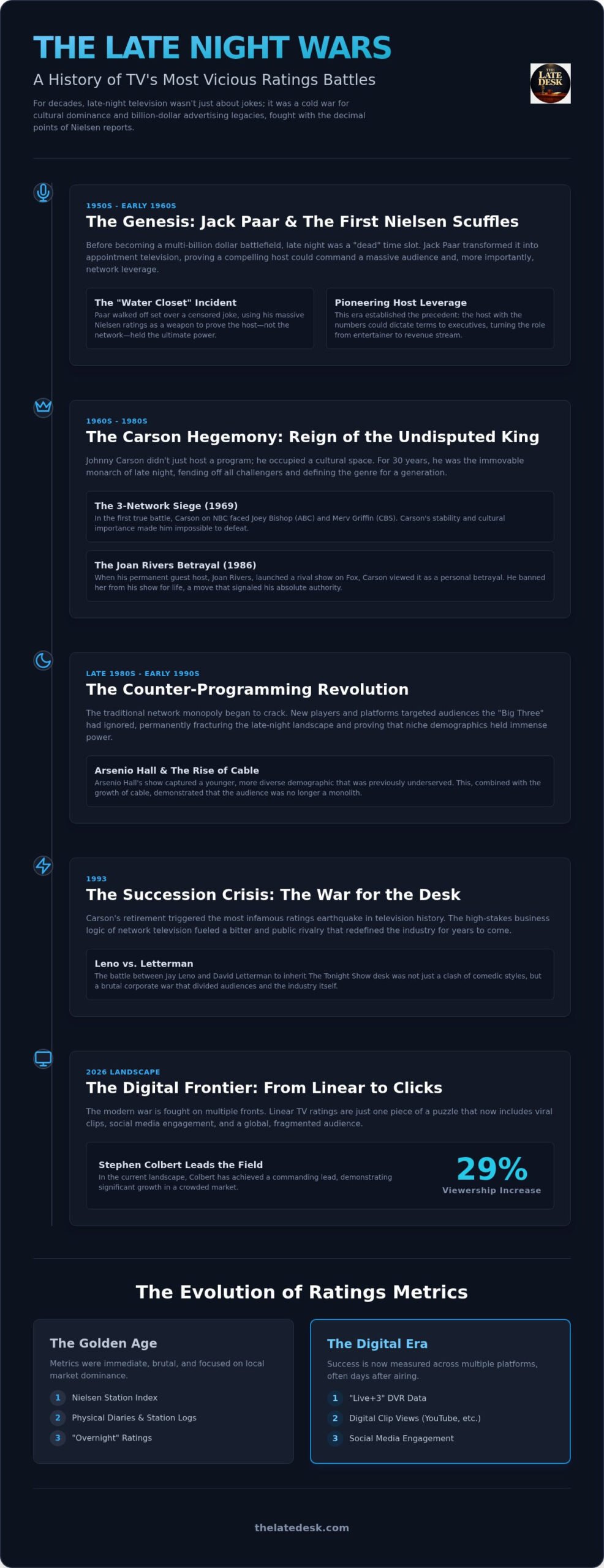
You likely recall the bitter rivalry between Jay Leno and David Letterman, yet the full story of these conflicts is far more complex than a simple clash of egos. We’re going to peel back the curtain on the dramatic history of these competitions, from the undisputed reign of Johnny Carson to the high-stakes transitions that redefined the industry. We will explore the shifting metrics of the 1960s, the business logic behind the 1990s wars, and the data driving the 2026 landscape where Stephen Colbert currently leads the field with a 29 percent increase in viewership. This is a comprehensive timeline of the rivalries that kept a nation awake and the numbers that kept network executives in their seats.
Key Takeaways
- Explore how Jack Paar pioneered the use of audience metrics as a strategic power play, establishing the precedent for host leverage against network executives.
- Deconstruct the legendary late night tv ratings battles of the 1960s and 70s to see how Johnny Carson maintained his hegemony against a rotating cast of challengers.
- Examine the 1993 succession crisis to understand the high-stakes business logic that fueled the era’s most infamous ratings earthquake.
- Discover how Arsenio Hall and the rise of cable television permanently fractured the traditional network monopoly by capturing a younger, ignored demographic.
- Trace the evolution of the midnight hour from the massive household shares of the golden age to the fragmented, digital-first landscape of 2026.
The Genesis of the Midnight War: Jack Paar and the First Nielsen Scuffles
Before the midnight hour became a multi-billion dollar battlefield, it was a graveyard of test patterns and local news repeats. NBC’s early experiments transformed this “dead” time slot into a lucrative frontier, igniting the first true late night tv ratings battles. This era wasn’t defined by the polished, demographic-targeted precision we see today. Instead, it was a raw, unpredictable scramble for advertising dollars that proved people would stay awake if the host was compelling enough. The transition from the chaotic variety-hour format of the early 1950s to the structured desk-and-guest format we recognize today was born out of a simple necessity: keeping the audience from turning off the set.
In 1960, the industry witnessed a landmark moment in host-network relations known as the “Water Closet” incident. Jack Paar, the temperamental heart of the show, walked off the set after censors cut a joke regarding a toilet. While it seemed like a fit of pique, it was actually the first instance of a host using his massive audience as a weapon. Paar knew the Nielsen Station Index numbers were on his side. He wasn’t just a comedian; he was a revenue stream. This event proved that in the late-night landscape, the host with the numbers held the ultimate leverage. Unlike modern “Live+3” data that accounts for days of digital viewing, these early metrics were immediate and brutal, focusing on local market dominance through physical diaries and station logs.
From Steve Allen to Jack Paar: Creating the Audience
Steve Allen originally proved that the 11:30 PM slot was profitable, but Jack Paar turned it into a cultural obsession. Allen brought the variety format, yet it was Paar’s emotional volatility that kept the “Nielsen boxes” clicking. Under his tenure, The Tonight Show history became a record of high-stakes drama. He moved the needle from simple entertainment to “appointment television,” making NBC the sole incumbent of the night before the 1960s challengers arrived. Paar’s ability to drive ratings through personal transparency created the blueprint for every host who followed.
The First Blows: ABC and CBS Enter the Fray
Seeing NBC’s success, ABC and CBS finally attempted to disrupt the monopoly. ABC introduced The Les Crane Show in 1964, featuring a shotgun microphone and a confrontational style that predated modern talk radio. However, the attempt failed to gain traction against the established giant. During this period, regional syndication often created “ratings shadows.” A show might win in New York but remain invisible in the Midwest, confusing advertisers who were used to prime-time uniformity. This confusion led to the introduction of the “Overnight” ratings system in major markets, providing the first real-time look at how the late-night audience was shifting between the big three networks.
The Carson Hegemony: Defeating the Challengers of the 1960s and 70s
By the late 1960s, the midnight hour had graduated from a regional skirmish into a full-scale corporate siege. In 1969, for the first time in history, the three major networks stood toe-to-toe: Johnny Carson on NBC, Joey Bishop on ABC, and Merv Griffin on CBS. This was the high-water mark for the first generation of late night tv ratings battles. While the challengers brought celebrity and charm, they lacked the architectural stability of the Tonight Show. Carson didn’t just host a program; he occupied a cultural space that proved nearly impossible to vacate.
The most dramatic fracturing of this era occurred in 1986, when Joan Rivers, Carson’s long-time permanent guest host, signed a deal to launch her own show on the fledgling Fox network. To Carson, this wasn’t merely business; it was a betrayal of the professional hierarchy. He never spoke to her again, enforcing a ban that lasted for decades. This ban was a calculated signal to the industry that the King did not share his desk, a narrative we explore further in The Tonight Show with Johnny Carson: The 30-Year Reign. The full complexity of this professional rupture and its lasting consequences are examined in our deep dive into the Joan Rivers Tonight Show ban, which reveals how a single act of perceived disloyalty reshaped the power dynamics of the entire industry. If you’re fascinated by these power dynamics, you might enjoy our archival deep dives into the Carson era.
The Joey Bishop and Merv Griffin Threat
Joey Bishop attempted to leverage his Rat Pack associations to win the night, yet this cool, insider energy failed to translate into sustainable ratings. It felt like a private club where the audience was an afterthought. Meanwhile, Merv Griffin’s move from a successful afternoon slot to the 11:30 PM hour was met with a devastating “affiliate revolt.” Local stations, skeptical of his late-night appeal, began bumping his show in favor of movies or local news repeats. Carson neutralized these threats by strategically using “Best of Carson” repeats during his vacations, ensuring that the NBC brand remained the default choice for viewers even when the host was away. The grueling production demands that made such consistency possible are vividly captured in the industrial grit of classic tv behind the scenes, where studio conditions were far more punishing than audiences ever imagined.
The Intellectual Alternative: Dick Cavett’s Ratings Niche
Dick Cavett presented a different kind of threat. His show was the intellectual alternative, a space for long-form conversation that felt more like a salon than a circus. While Cavett consistently lost the total viewer count, he won the demographic war by attracting high-income, urban professionals that advertisers were desperate to reach. ABC kept a “loser” on the air for years because his prestige advertising rates were incredibly lucrative. The Cavett/Carson rivalry stands as the first true instance of “class vs. mass” programming in the history of late night tv ratings battles.
The 1993 Succession Crisis: Leno, Letterman, and the War for the Desk
When Johnny Carson announced his retirement in May 1991, he didn’t just end a thirty-year era; he ignited a firestorm that would consume the industry for the next decade. This wasn’t merely a change in personnel. It was the most visible and vicious of all late night tv ratings battles, pitting the reliable, broad appeal of Jay Leno against the ironic, subversive brilliance of David Letterman. While the public saw two comedians, the networks saw two different futures for their balance sheets. The August 1993 ratings earthquake, where Letterman’s CBS debut crushed Leno’s Tonight Show, seemed to signal a permanent shift in power that NBC might never recover from.
The conflict was so intense it eventually earned its own historical moniker: The Late Shift. It was a period defined by secret meetings, hidden pagers, and a level of corporate espionage usually reserved for international diplomacy. To understand the deeper corporate mechanics and the psychological toll this era took on the participants, you can explore our analysis on The Business of Laughter: Late Night TV Power Dynamics. This battle proved that the “Tonight Show” brand was not bulletproof, especially when faced with a host who had spent a decade building a loyal, younger following at 12:30 AM.
The NBC Executive Miscalculation
NBC executives, influenced by the aggressive and often controversial maneuvering of Leno’s manager Helen Kushnick, chose Leno because he was perceived as a “safer” bet for middle-American affiliates. However, they underestimated the depth of Letterman’s cult of personality and the sting of Carson’s silence. Without a public blessing from the King, Leno’s early years were a struggle for legitimacy. NBC’s brand loyalty initially faltered as viewers flocked to CBS to see the man many felt had been robbed of his rightful inheritance.
The Hugh Grant Interview: The Turning Point
The tide finally turned through a combination of a celebrity scandal and a scheduling miracle. In June 1995, Jay Leno booked Hugh Grant following the actor’s highly publicized arrest. That single interview provided the ratings pivot Leno needed to finally overtake Letterman in the weekly averages. Yet, the victory wasn’t just about guests. NBC’s “Must See TV” lineup, featuring juggernauts like Seinfeld and ER, provided a massive lead-in that Letterman’s CBS could never match. The 11:35 PM start time became a fortress, and the booking war, where exclusive contracts became a standard weapon, ensured that the battle for midnight would remain a game of corporate attrition.
The Counter-Programming Revolution: Arsenio Hall and the Rise of Cable
While NBC and CBS were busy measuring the drapes in their respective boardrooms, a seismic shift was occurring in the living rooms of younger America. Arsenio Hall didn’t just enter the late night tv ratings battles; he effectively rewrote the demographic map of the midnight hour. By targeting the “MTV Generation,” Hall captured a market that Johnny Carson and David Letterman had largely ignored in favor of broader, older audiences. This wasn’t merely a change in guest lists. It was a revolution in tone that proved independent syndication could, for a brief and shining moment, humble the network giants.
The success of this counter-programming era relied on a delicate “Affiliate Battle.” Local stations across the country faced a lucrative dilemma. They could either stick with the traditional network feeds provided by ABC or CBS, or they could opt for the high-energy, youth-oriented appeal of a syndicated hit like Arsenio. For several years, the “Woof Woof” of the Arsenio audience was louder than the network monologues. However, this independence was fragile. When Letterman moved to CBS in 1993, he brought a “cool” factor that networks had previously lacked, causing many local stations to abandon their syndicated experiments in favor of the safety and prestige of a major network brand.
Arsenio Hall and the Youth Demographic
Arsenio’s “Woof Woof” chant wasn’t just noise; it was a primitive form of audience engagement that predated social media by decades. It created a sense of community that the formal desk-and-chair format of the 1970s couldn’t match. The peak of this influence arrived in June 1992, when Bill Clinton appeared in dark sunglasses to play the saxophone. This single moment signaled a ratings peak for independent syndication and forced the “Big Three” to modernize their guest lists. If you want to understand the business logic behind these demographic shifts, you can find more in our detailed analysis of television history.
The Cable Disruption: Jon Stewart and Bill Maher
Then came the cable disruption. Instead of fighting for “Total Viewers,” new players like Comedy Central began focusing on “Median Age” as the key industry metric. They realized that a smaller, younger, and more politically engaged audience was worth more to certain advertisers than a massive, aging one. Jon Stewart’s The Daily Show and Bill Maher’s Politically Incorrect changed the late-night format for a fraction of the budget required by the networks. These shows thrived by capitalizing on the 24-hour news cycle, making the traditional network monologues feel slow and increasingly out of touch with the rapid pace of the information age. Ultimately, the rise of cable proved that relevance was often more profitable than raw reach.
The Legacy of the Ratings Wars: From Linear Dominance to Digital Clips
In the 1970s, a 15.0 household share was the baseline for survival; today, a 1.5 share is often celebrated as a triumph of modern broadcasting. This stark contrast illustrates the fundamental dissolution of the television monolith that Johnny Carson once commanded. While the late night tv ratings battles of the past were fought for total control of the American living room, the current conflict is a fragmented struggle for “Share of Voice.” The goal is no longer just to win the 11:35 PM time slot. Instead, it is to ensure that a three-minute monologue segment becomes the primary conversation on social media by the following morning.
We have seen a curious return to the “Paar Model” through the Gutfeld! phenomenon on Fox News. Much like Jack Paar in the early 1960s, Greg Gutfeld has leveraged polarized loyalty to carve out a dominant position in the 2025-2026 landscape. By leaning into a specific ideological niche rather than seeking the broad, middle-of-the-road consensus of the Leno era, the show has proven that a dedicated, smaller audience can often outweigh a disinterested mass. This shift marks a move away from “Share of Households” toward a more tribal, demographic-driven success. The battle is no longer about who watched at midnight, but who engaged with the clip on TikTok at 8:00 AM.
The 2026 Landscape: Colbert, Kimmel, and the New Guard
The current “Big Three” battle mirrors many of the historical precedents we have explored, yet it operates with new, digital-first rules. In the second quarter of 2026, Stephen Colbert’s The Late Show solidified its position as the industry leader, averaging 3.49 million total viewers. This represented a massive 29 percent increase from the previous quarter, largely driven by a 54 percent spike in the key 18-49 demographic. Meanwhile, Jimmy Fallon’s Tonight Show averaged 1.39 million viewers, using stunts like “Odyssey Week” to mimic the high-energy publicity plays of the 1970s. Even with host absences, the use of seasoned guest hosts like Rosie O’Donnell has helped networks maintain stability in an era where total late-night viewership grew 17 percent year-over-year.
The Future of the Ratings Battle
As linear television continues its slow retreat, many wonder if the “Desk and Monologue” format will survive at all. We are already seeing the rise of vertical soaps and social-first spin-offs, such as The Daily Show’s White House soap opera, which prioritize mobile-first consumption over traditional broadcasting. Yet, despite these technological shifts, the enduring human need for a “Midnight Guide” remains. Whether it is delivered through a high-definition broadcast or a compressed digital stream, the spirit of the late night tv ratings battles persists. It is the same search for a familiar voice to help make sense of the day’s chaos, proving that while the metrics change, the cultural role of the late-night host remains a permanent fixture of the American psyche.
Preserving the Narrative of the Midnight Hour
The history of the midnight hour reveals a fascinating evolution from the raw leverage of Jack Paar to the precision-targeted digital strategies of 2026. While the metrics have shifted from massive household shares to viral social clips, the fundamental drive remains the same: the pursuit of a voice that resonates in the quiet of the night. These late night tv ratings battles have shaped not only what we watch, but how we understand the professional hierarchies and cultural shifts of the last seventy years.
Understanding the “story behind the story” requires more than a casual glance at the headlines. As the definitive source for Johnny Carson era analysis and a trusted resource featured in media history research guides, we are dedicated to preserving these intricate narratives. Our work is curated by expert television archivists who believe that every decimal point in a Nielsen report carries a human drama worth exploring. Explore the full archives of late-night history at The Late Desk to uncover the hidden layers of television’s golden age. The lights may have dimmed on the classic era, but the legacy of these legendary conflicts continues to illuminate our media landscape today.
Frequently Asked Questions
What was the highest-rated late-night TV show in history?
Johnny Carson’s final broadcast on May 22, 1992, remains the highest-rated late-night episode ever recorded, drawing an astounding 41.2 rating and a 70 share. Approximately 50 million people tuned in to witness the end of an era. This singular event represents the absolute peak of the “monolith” era, occurring just before the industry fractured into the multi-network competition of the 1990s.
Who won the ratings war between David Letterman and Jay Leno?
Jay Leno eventually won the long-term war, though David Letterman dominated the first two years of their legendary rivalry. Following the 1993 transition, Letterman’s Late Show held the lead until June 1995. It was the combination of Leno’s interview with Hugh Grant and a massive NBC lead-in from Seinfeld that finally flipped the script, allowing Leno to maintain a total viewer lead for nearly two decades.
Why did Johnny Carson always win the ratings battle?
Johnny Carson’s dominance in late night tv ratings battles was rooted in his unparalleled affiliate clearance and a “big tent” approach to comedy. While challengers tried to be edgy or intellectual, Carson remained the default choice for a broad American audience. His strategic control over NBC’s late-night infrastructure meant that competitors often struggled just to find a station willing to air them in the same time slot.
How did the Joan Rivers ‘ban’ affect her show’s ratings?
The ban imposed by Carson made it nearly impossible for Joan Rivers to book A-list talent, which directly stifled her show’s ratings growth. Because guests feared being blacklisted from the Tonight Show, Rivers was often forced to settle for second-tier bookings. This talent vacuum, combined with a lack of affiliate support for the fledgling Fox network, led to her show’s cancellation after only one season. The full story of how this 26-year Joan Rivers Tonight Show ban unfolded and persisted long after Carson’s retirement reveals just how deeply personal grievances could shape the business of late-night television.
What are Nielsen ratings and how do they work for late-night TV?
Nielsen ratings measure the percentage of households with televisions tuned to a specific program at a given time. In the classic era, these were recorded through physical diaries and “Overnight” reports in major cities. Today, the system has evolved to include Live+3 data. This modern metric accounts for DVR and digital viewing within three days of the original broadcast, reflecting the shift toward non-linear consumption.
Did Dick Cavett ever beat Johnny Carson in the ratings?
Dick Cavett never defeated Johnny Carson in total household ratings, but he frequently won the battle for high-income, urban demographics. Advertisers were willing to pay a premium for Cavett’s audience, even if his total viewer count was significantly lower than NBC’s. This was the first major instance in late night tv ratings battles where demographic quality began to matter as much as raw quantity to network executives.
How do 2026 late-night ratings compare to the 1970s?
Late-night ratings in 2026 are a mere fraction of the 1970s figures, with average household shares dropping from 15.0 to approximately 1.5. This decline reflects the shift from a three-network monopoly to a fragmented digital landscape. While Stephen Colbert currently leads the 2026 field with 3.49 million viewers, the cultural “Share of Voice” is now spread across social media clips rather than just linear broadcasts.
Why did Arsenio Hall’s ratings drop so quickly in 1994?
Arsenio Hall’s ratings plummeted in 1994 primarily because David Letterman’s move to CBS reclaimed the “cool” and “youthful” audience that Hall had previously monopolized. Furthermore, many local affiliates that had carried Hall’s syndicated show dropped him to clear space for the new CBS Late Show. Without those local time slots, his national numbers became unsustainable almost overnight, leading to his eventual departure from the airwaves.