Imagine a world where the undisputed queen of comedy is suddenly erased from the very stage she helped build. For over two decades, the joan rivers tonight show ban stood as a silent monument to a bridge burned in the heat of a high-stakes industry betrayal. Most fans of late-night history remember the scandalous headlines; yet, the truth behind the silence remains buried under layers of Hollywood gossip and conflicting memories. You’ve likely heard different versions of the infamous “betrayal” phone call, or wondered why the exile persisted through the entire tenure of Jay Leno long after Johnny Carson retired.
We’re going to peel back those layers to reveal the complex power dynamics and personal wounds that fueled this 26-year blackout. It wasn’t just a personal spat. Instead, it was a collision between the old guard of network loyalty and the aggressive new era of multi-network competition. You’ll discover the professional etiquette of the 1980s that turned a career move into a scandal, the definitive timeline of the exile, and the eventual, quiet end of the most famous ban in broadcasting history.
Key Takeaways
- Trace Rivers’ ascent from her 1965 debut to her role as “Permanent Guest Host,” revealing the professional intimacy that made her eventual departure so painful.
- Analyze the 1986 Fox deal and the “silent phone call” that triggered the joan rivers tonight show ban, effectively ending her relationship with Johnny Carson forever.
- Examine the industry-wide blacklisting effect that forced guests to choose sides, fundamentally altering the competitive landscape of 1980s television.
- Discover the unspoken codes of loyalty that led Jay Leno to uphold the exile long after Carson had stepped away from the spotlight.
- Detail the 2014 invitation from Jimmy Fallon that finally brought Rivers back to Studio 6B, resolving a 26-year saga of silence and pride.
The Protégé and the King: The Rise of Joan Rivers on The Tonight Show
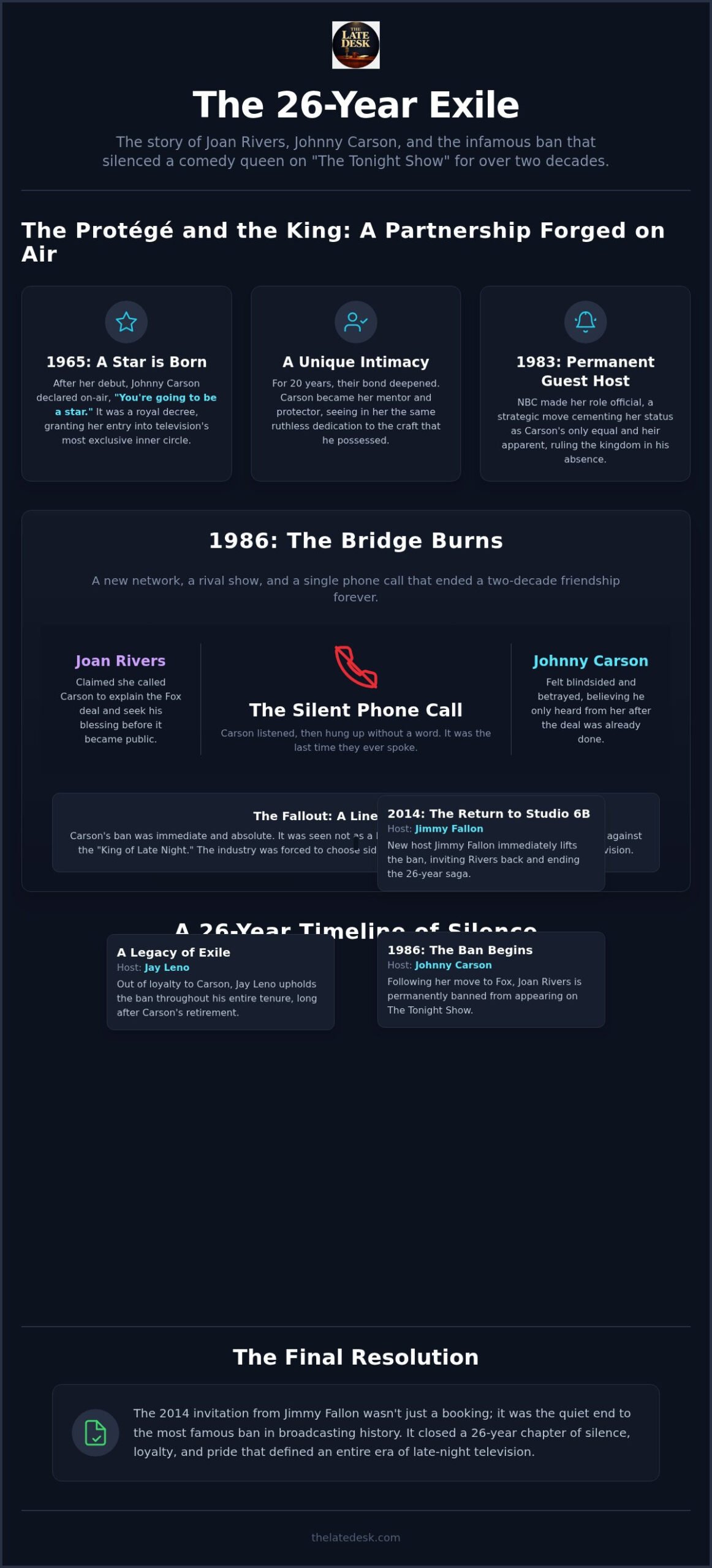
On a cold February night in 1965, a nervous, raspy-voiced comedian from Brooklyn stepped onto the stage of Studio 6B. Joan Rivers wasn’t just another guest; she was a woman fighting for a career that many in the industry had already written off. When Johnny Carson leaned over after her set and told the national audience, “You’re going to be a star,” the trajectory of television history shifted. This wasn’t merely a compliment. It was a royal decree that granted Rivers entry into the most exclusive inner circle in entertainment. For the next twenty years, she would remain the King’s favorite, a status that made her eventual fall from grace all the more jarring.
Over the next two decades, the bond between the two deepened into a unique professional intimacy. By the early 1980s, Rivers had evolved from a frequent guest into Carson’s most trusted confidante on screen. This relationship was the foundation of what would eventually become the most famous exile in Hollywood. The seeds of the joan rivers tonight show ban were, ironically, sown during these years of absolute peak loyalty. In the rigid hierarchy of 1980s network television, Carson was the sun around which all other stars orbited. To be his protégé was to accept a code of total fealty to the NBC throne.
The ‘Permanent Guest Host’ Distinction
In 1983, NBC and Carson did something unprecedented: they officially named Rivers the “Permanent Guest Host.” This wasn’t just a fancy title. It was a strategic move that allowed Carson to reduce his grueling schedule while ensuring the show’s ratings remained dominant. The “Carson seal of approval” was the industry’s most valuable currency; by handing her the keys to the desk, Johnny was telling the world she was his only equal. The industrial grit of the NBC Burbank studios, with its frantic energy and high-pressure tapings, became Rivers’ second home. She wasn’t just filling a seat. She was ruling the kingdom in the King’s absence.
A Friendship Built on Mutual Wit
Their on-screen chemistry was electric, rooted in a shared, biting sense of humor that few others could match. Behind the scenes, Carson provided the private encouragement Rivers needed during her leanest years, acting as both a mentor and a protector. He saw in her the same ruthless dedication to the craft that he possessed. He wasn’t just her boss; he was the architect of her fame. Their relationship was one of royal succession rather than mere employment. This unspoken contract of loyalty defined the Carson-era hierarchy, making her eventual move to a rival network feel like a personal strike against the crown. The studio itself was a carefully orchestrated environment, where even the history of late night tv band leaders who filled the room with music were bound by the same unspoken codes of loyalty to the host.
The 1986 Betrayal: Why Johnny Carson Never Spoke to Joan Again
By the time the flashbulbs popped at the Fox press conference in May 1986, the bridge between Joan Rivers and Johnny Carson was already engulfed in flames. Rivers stood before the media as the face of a brand-new network, ready to host The Late Show starring Joan Rivers. To the public, it was a triumphant moment of female empowerment in a male-dominated industry. To Johnny Carson, it was a personal act of treason. The joan rivers tonight show ban was not a gradual cooling of relations; it was a sudden, seismic shift that left a two-decade partnership in ruins overnight. Carson, who had hand-picked Rivers as his successor in all but name, viewed her move to a rival network as a violation of the sacred loyalty that governed the NBC hierarchy.
The core of the dispute remains centered on the infamous “silent phone call.” Rivers maintained until her death that she attempted to reach Johnny several times before the news broke, hoping to explain the Fox deal and receive his blessing. Carson’s camp told a vastly different story, claiming he was blindsided by the announcement and only heard from her after the ink was dry. When she finally did get through to him, Carson reportedly listened for a moment and then hung up without saying a word. It was the last time the two legends would ever speak. This silence became the defining characteristic of their relationship, proving that in the world of late-night television, the only thing more powerful than a host’s voice is their refusal to use it.
Much of the friction was attributed to Edgar Rosenberg, Joan’s husband and producer, who served as the primary architect of the Fox negotiation. His hard-nosed approach and perceived arrogance during the secret deal-making rubbed the NBC brass and Carson’s inner circle the wrong way. Rosenberg was seen as the instigator who pushed Rivers to challenge the King, a move that Carson could never forgive. Exploring the archives of The Late Desk reveals how these industrial skirmishes often left permanent scars on the medium’s legacy, turning professional rivals into lifelong enemies.
The Fox Gamble and the End of NBC Monopoly
Fox’s entry into the late-night arena was a direct challenge to the NBC monopoly that had existed for decades. By poaching Carson’s “Permanent Guest Host,” the fledgling network wasn’t just looking for ratings; they were aiming for legitimacy. The stakes were incredibly high, as Rivers was now positioned as a direct competitor to the man who made her a star. At NBC, the reaction was scorched earth. Rivers’ name was immediately scrubbed from the show’s history, and guests were subtly warned that appearing on her new program could result in their own exile from the Carson stage.
The Psychology of Johnny Carson
Carson was a man of immense public charm but legendary private coldness, known for “icing out” anyone he felt had crossed him professionally. This event fits into the larger late night tv power dynamics of the era, where the host’s desk was treated as a sacred, guarded territory. While his public persona was one of sophisticated wit, the reality of the ban was cold and calculated. To Carson, Rivers hadn’t just changed jobs; she had attempted to steal his crown, and the only appropriate response in his eyes was total, permanent erasure.
The Industry Fallout: How the Fox Deal Reshaped Late-Night Rivalries
When the first ratings reports for the 1986 season arrived, they suggested a potential changing of the guard. The Late Show starring Joan Rivers premiered to impressive numbers, fueled by the sheer spectacle of the first woman to headline a major late-night talk show. However, the reality of competing against the Carson juggernaut soon set in, revealing the true weight of the joan rivers tonight show ban. This wasn’t just a refusal to host her; it was a comprehensive effort to starve her program of its lifeblood: the celebrity guests. The industry quickly learned that the King’s favor was a finite resource, and Rivers had exhausted hers in a single afternoon.
The “blacklisting” effect was immediate and devastating. Fred de Cordova, Carson’s long-time producer, reportedly made it clear that any guest who sat on Rivers’ couch would find their path to the Tonight Show stage permanently blocked. In an era where a single appearance with Johnny could launch a career or revive a dying one, this was an existential threat. Many stars, even those who considered themselves Rivers’ close friends, chose the safety of NBC over the uncertainty of Fox. This professional isolation turned her tenure into a tragic struggle. Within a year, the show’s ratings plummeted, and by 1987, Rivers was fired from her own program, leaving her career in tatters and her personal life in a state of profound grief following the suicide of her husband, Edgar Rosenberg.
The First Shot in the Late Night Wars
The move to Fox broke the long-standing “gentleman’s agreement” that had kept late-night television relatively polite for decades. Before this conflict, the networks operated under a quiet understanding of territory and professional courtesy. By challenging Carson directly, Rivers effectively fired the first shot in what would become the multi-billion dollar history of late night television rivalries. The 1986 season marked the definitive end of the Golden Age of host unity. It paved the way for the ruthless, scorched-earth competition that would later define the legendary battles between Jay Leno and David Letterman.
The Gender Dynamics of the Ban
One cannot analyze the severity of the exile without addressing the stark gender imbalances of the 1980s broadcasting world. It’s hard to imagine a male host being subjected to a 26-year silence for a similar career advancement. Rivers often reflected on the reality of being the only woman in the room, noting that her ambition was frequently misinterpreted as a lack of gratitude. The industry-wide message sent by Carson’s unwavering stance was clear: a woman’s place was at the guest host’s desk, not behind her own. This power struggle wasn’t just about ratings; it was a territorial dispute over who was allowed to own the late-night hours.
A Legacy of Exile: The Ban Through the Leno and O’Brien Years
When Johnny Carson stepped away from the curtain for the final time in 1992, many industry insiders expected the joan rivers tonight show ban to vanish along with his tenure. Instead, the exile became institutionalized. The transition of power to Jay Leno did not signal a reconciliation; rather, it reinforced the “unwritten rule” that governed the Burbank studios. For Rivers, the seat at the desk remained a forbidden territory for another two decades. This period of her career was defined by a remarkable paradox: she was arguably the most visible woman in comedy while remaining persona non grata at the institution she once helped build.
The brief and tumultuous era of Conan O’Brien offered no relief either. By the time O’Brien took the helm in 2009, the ban had become a fixed point in NBC culture, a piece of inherited lore that no one seemed willing to challenge. It was no longer just about Carson’s personal grudge. It had transformed into a structural reality of the program itself. Rivers spent these years in a professional wilderness, moving from a daytime talk show to the burgeoning world of home shopping on QVC. Yet, even as she was shut out of the 11:30 p.m. slot, her influence on the medium only grew sharper from the sidelines.
The Leno Doctrine: Loyalty Beyond the Grave
Jay Leno’s refusal to book Rivers was often framed as an act of profound “respect for Johnny.” By maintaining the blackout, Leno positioned himself as the loyal guardian of Carson’s legacy, a move that carried significant weight during the industrial grit of the 1990s ratings battles. Protecting his own position meant adhering to the established hierarchies of the past. To invite Rivers back would have been seen as a betrayal of the man who had reluctantly handed Leno the keys to the kingdom. The irony was palpable: Rivers was achieving massive success elsewhere while the show she once piloted as a “Permanent Guest Host” continued to treat her as a ghost.
The Red Carpet Pivot
Exiled from the late-night circuit, Rivers was forced to innovate. She didn’t just survive in the wilderness; she conquered it. By pivoting to the red carpet, she invented a new genre of entertainment journalism that relied on her status as a sharp-tongued outsider. Her “fashion police” persona was a direct byproduct of her exclusion from the traditional talk show format. Her comedic voice became more dangerous and less restrained because she no longer had a network monopoly to protect. For those interested in the granular details of this era, you can explore online television archives for researchers to see how her comedic voice evolved during these years of exile.
Explore our full collection of historical television articles at The Late Desk to understand the power shifts that define the industry.
The Return to Studio 6B: Lifting the Ban and the Final Resolution
On February 17, 2014, the heavy curtain at 30 Rockefeller Plaza parted to reveal a face that hadn’t been seen on that particular stage since the Reagan administration. Jimmy Fallon, in his inaugural night as host, did what two predecessors had refused to do: he invited Joan Rivers back. The joan rivers tonight show ban, which had stood as a rigid monument to a 1986 betrayal, finally crumbled under the weight of a new era. It was a homecoming that few expected to see, occurring exactly 26 years after the exile began. For Rivers, walking back into the spotlight of Studio 6B wasn’t just a career milestone; it was the closing of a wound that had defined her professional life for nearly three decades.
The emotional gravity of the moment was palpable. Rivers appeared in a brief, celebratory segment alongside other stars, but her presence carried the most historical weight. She later described the experience as “surreal,” noting the irony of returning to the very hallways where she had once been the “Permanent Guest Host.” Sitting on that stage one last time before her death in September 2014 allowed her to reclaim her legacy. She was no longer the woman who had “betrayed” the King; she was once again a pioneer of the medium, welcomed back by a generation that valued her contribution more than the old guard’s grudges.
Jimmy Fallon and the Changing of the Guard
Fallon was perhaps the only host capable of breaking the seal. Unlike Jay Leno, he didn’t feel the need to protect the Carson-era hierarchy through second-hand loyalty. His “fan-first” approach to late-night culture prioritized the history of comedy over the politics of the past. By moving the show back to New York, Fallon returned the program to its roots, making Rivers’ return feel like a natural part of the show’s restoration. The lifting of the ban signaled the final, definitive transition away from the Carson era, proving that the rigid codes of 1980s network television had finally lost their grip on the 11:30 p.m. hour. Part of that restoration included reuniting the show with the full energy of a live band, a tradition whose roots stretch deep into the history of late night tv band leaders who helped define the sound and soul of the format.
The Final Word: A Legacy Reclaimed
The story of the ban remains one of the most compelling tragedies in broadcasting history. It serves as a stark case study in the “Business of Laughter,” where personal relationships are often sacrificed at the altar of network dominance and ratings. Rivers’ place in history is now secure as both a pioneer who shattered glass ceilings and a pariah who survived the industry’s longest exile. From the perspective of a cultural archivist, her 26-year silence is a reminder of how fragile fame can be when it collides with the ego of a king. To understand the world that Rivers both conquered and lost, you can explore more Tonight Show with Johnny Carson history and the 30-year reign that shaped the medium.
Reclaiming the Late-Night Narrative
The joan rivers tonight show ban stands as a definitive case study in the collision between old-world loyalty and the modern era of aggressive competition. It reveals how a single professional decision could trigger a lifetime of exile within the rigid hierarchies of 20th-century broadcasting. The exile was absolute. This 26-year silence reminds us that behind the polished wit of the Golden Age lay a complex web of personal betrayals and industrial grit. When the curtain finally opened for Rivers in 2014, it signaled the final transition into a more collaborative late-night culture.
Understanding these hidden layers requires a deep dive into the archives of media legacy. Our expert analysis of television history brings these moments to life, moving beyond the headlines to find the human heart of show business. Explore the full history of late-night power dynamics at The Late Desk to discover curated narratives from the Golden Age. We invite you to continue your journey through our in-depth historical archives and rediscover the stories that defined a generation.
Frequently Asked Questions
Why did Johnny Carson ban Joan Rivers for 26 years?
Johnny Carson issued the ban because he perceived Rivers’ move to Fox as a profound breach of professional and personal loyalty. As her mentor and the man who made her a star, he expected to be consulted before she signed a deal to compete directly against him in the late-night time slot. To Carson, the secret nature of the negotiation was an unforgivable act of treason.
The joan rivers tonight show ban wasn’t just about a change in networks. It was about the violation of an unspoken code that governed the NBC hierarchy. Carson felt that his protégé had attempted to steal his crown, and his response was to erase her from the show’s history entirely.
Did Joan Rivers ever apologize to Johnny Carson before he died?
They never reached a formal reconciliation or a moment of apology. Rivers maintained until her final days that she had tried to call Carson to explain the Fox deal before the news went public, but he refused to take her calls or listen to her side of the story. She felt that as a professional, she had the right to seek her own show, while he felt she owed him total fealty.
Why did Jay Leno continue the ban on Joan Rivers?
Jay Leno maintained the exile primarily out of a stated respect for Carson’s legacy. He believed that booking Rivers would be seen as a slight against the man who had built the franchise. By keeping her off the guest list, Leno reinforced his image as the loyal guardian of the Tonight Show tradition, though the decision also helped him avoid the internal politics of the old guard.
When did Joan Rivers finally return to The Tonight Show?
Joan Rivers finally returned to the program on February 17, 2014. This appearance took place during Jimmy Fallon’s debut episode as host, ending a 26-year absence from the stage where she once served as the “Permanent Guest Host.” It was a symbolic moment that signaled the definitive end of the Carson-era grudges.
What was the name of Joan Rivers’ competing talk show on Fox?
Her program was titled The Late Show starring Joan Rivers. It premiered in October 1986 and represented the fledgling Fox network’s first major attempt to challenge the late-night dominance of NBC. The show’s launch was the catalyst for the permanent fracture in her relationship with Johnny Carson.
How did the Joan Rivers ban change late-night television?
The joan rivers tonight show ban effectively ended the “gentleman’s agreement” that had kept late-night TV relatively polite for decades. It introduced a period of ruthless competition and “blacklisting” where guests were forced to choose sides between rival programs. This conflict paved the way for the aggressive, ratings-driven warfare that defined the 1990s battles between Leno and Letterman.
Was Joan Rivers the first female late-night host?
She was the first woman to host a late-night talk show on a major broadcast network. While other women had appeared in the format as guests or temporary hosts, her 1986 deal with Fox broke the glass ceiling for female comedians in the 11:30 p.m. time slot. It was a historic milestone that challenged the male-dominated hierarchy of the era.
Did Johnny Carson ever speak to Joan Rivers after 1986?
No, they remained in a state of permanent silence until Carson’s death in 2005. After their final, brief phone conversation in 1986, Carson never spoke to her again. He maintained a total blackout, refusing to acknowledge her name or her career in any public or private capacity for the remainder of his life.