For most viewers, the history of late-night television begins with the cool, composed presence of Johnny Carson. However, the real foundation of the genre was poured years earlier by a man whose restless intellect and musical wit defined an entire medium. It’s common to feel that the pre-Carson era is a blurry collection of black and white stills, missing the vibrant energy that actually built the industry. You might even find yourself confusing the legends of the seventies with the true pioneers of the fifties.
You deserve to understand the “magic” behind the curtain rather than just reading a list of dates. In this deep dive, you’ll see how Steve Allen, the first tonight show host, didn’t just occupy a time slot; he engineered a cultural phenomenon. We’re exploring the specific innovations he introduced during the September 27, 1954 debut and tracing how those early sketches became the DNA of modern entertainment. From the first opening monologue to the very first desk, we are revisiting the night the world learned how to stay up late.
Key Takeaways
- Identify Steve Allen as the first tonight show host and discover the high-stakes atmosphere of his September 27, 1954, debut.
- Explore how Allen’s jazz sensibilities and radio background forged the improvisational DNA that every modern host relies on today.
- Trace the evolution of the “Man on the Street” and the opening monologue back to their experimental roots in a mid-century New York studio.
- Examine the physical comedy and legendary stunts that transformed late-night television from a quiet experiment into a high-energy spectacle.
- Connect the dots between Allen’s original innovations and the contemporary musical comedy seen on today’s late-night stages.
The 1954 Genesis: How NBC Invented Late Night with Steve Allen
In the early 1950s, the television screen flickered to black long before the city truly slept. Broadcasting was a rigid frontier, confined to the daylight hours and the structured respectability of primetime. This changed forever on September 27, 1954, when a bespectacled polymath sat down at a piano and greeted a national audience for the first time. Steve Allen was the first tonight show host, taking a local New York experiment and projecting it into living rooms across America. While the show began as a modest late-night filler on WNBT-TV in 1953, its immediate local success forced NBC to recognize they had captured lightning in a bottle.
The Hudson Theatre: Late Night’s First Home
The show found its soul within the ornate walls of the Hudson Theatre on 44th Street. Unlike the sterile, cavernous studios of the modern era, the Hudson provided an intimate, almost dangerous energy. It was a Broadway house that forced the production to adapt to its physical limitations, creating a sense of beautiful chaos. Broadcasting live at 11:30 PM in 1954 was a technical nightmare. The lighting was harsh, the cables were heavy, and the microphones were temperamental. Yet, this grit became part of the charm, as Allen navigated the unpredictability of a live theater environment with the ease of a seasoned performer. The audience wasn’t just watching a broadcast; they were part of a nightly happening in the heart of Manhattan.
Sylvester Weaver’s Vision for “Tonight!”
Behind the scenes, the program was the brainchild of NBC President Sylvester “Pat” Weaver. He was a visionary who didn’t just want to fill time; he wanted to change how Americans consumed media. Weaver envisioned a “magazine” format for television, a concept that had already birthed the Today show in 1952. While Today served as the morning’s informational newspaper, Tonight was designed to be the evening’s sophisticated cocktail party. It was a high-stakes gamble for the network. Many industry insiders believed the late-night slot was a graveyard for sponsors. Weaver disagreed, believing that “enlightenment through entertainment” could thrive even in the midnight hour. Steve Allen’s versatile career as a composer and comedian made him the perfect vessel for this experiment. He wasn’t just a presenter; he was a conductor of a new kind of visual symphony. By the time the first national broadcast concluded, the blueprint for every late-night show that would follow over the next seventy years had been etched into the airwaves.
To understand the man who would become the first tonight show host, one must first understand the restless energy of a jazz musician. Steve Allen wasn’t merely a presenter; he was a true polymath who felt as comfortable writing a symphony as he did performing a pratfall. As a pioneer American television entertainer, he brought an intellectual weight to the medium that hadn’t existed before. He was a renaissance man in horn-rimmed glasses, a songwriter with thousands of titles to his name, and a satirist who could deconstruct a news headline with surgical precision.
The Radio Roots of a Television Icon
Allen’s path to the Hudson Theatre began in the competitive world of Los Angeles radio. It was here that he mastered the art of the “ad-lib,” a skill that would later define the talk show genre. On his late-night radio program, he discovered that the most compelling moments didn’t come from a script. They came from the audience. He began reading “nutty” letters from listeners and venturing into the studio audience with a microphone, transforming the listeners into the stars of the show. When he moved to New York, he didn’t leave these audio-only tricks behind. Instead, he translated them into a visual language. The casual, conversational style he honed behind a radio mic became the very foundation of the television talk show.
The Piano as a Late-Night Weapon
The image of the host seated at a desk is iconic today, but for Allen, the piano was his primary command center. It served as far more than a musical instrument. It was a tool for timing. He used the keys to punctuate a joke, bridge an awkward transition, or heighten the drama of a guest’s entrance. This setup established the industry standard for “cool” sophistication in the 1950s. The piano allowed him to maintain a sense of high-brow elegance even when the comedy veered into the absurd. It gave him the freedom to improvise, treating the entire broadcast like a jazz set where the melody was the script and the riffs were his wit. If you’re curious about how this musicality influenced later legends, you can explore our archival features on late-night’s evolution.
This duality defined the “Steverino” persona. He could engage a philosopher in a deep debate and, moments later, dive into a vat of Jell-O for a laugh. It was a calculated blend of high-brow intellect and low-brow physical comedy. By refusing to be just one thing, Allen ensured that his show was never predictable. He proved that the first tonight show host needed to be a conductor, a comedian, and a confidant all at once. His ability to pivot from a soulful piano solo to a chaotic street segment set a bar that every successor has spent decades trying to reach.
The Blueprint of Cool: Segment Innovations That Still Rule TV
Modern viewers often accept the late-night format as an immutable law of nature, as if the desk, the band, and the monologue simply appeared fully formed. In reality, these elements were the specific, experimental inventions of the first tonight show host. Steve Allen didn’t just occupy a studio; he built a laboratory for a new kind of visual language. He established the “desk” not merely as a piece of furniture, but as a psychological anchor. Behind it, the host was the master of ceremonies; in front of it, the guest was an invited traveler. This physical boundary created a sense of professional intimacy that defined the era. He further textured the atmosphere by introducing the Tonight Show Band, providing a rhythmic heartbeat that signaled to the audience that they were in a space where spontaneity was the only rule.
Even the monologue, which has become a polished stand-up routine in the hands of modern hosts, began as a casual, improvisational chat from the piano. Allen would riff on the day’s headlines while his fingers danced over the keys, a technique that softened the edge of his satire. This spirit of exploration led directly to the “Man on the Street” segments. By taking the cameras outside the studio to interact with unsuspecting New Yorkers, Allen created the true ancestor of every remote bit seen on television today. These segments weren’t just filler; they were the first time television captured the unpredictable energy of real life, a trope that continues to dominate the digital clips of the 2020s.
The Invention of the Celebrity Interview
Before the Allen era, guests appeared on television to perform a rehearsed “act,” usually a song or a scripted comedy routine. Allen fundamentally changed the power dynamic of the guest appearance. He moved away from these rigid performances in favor of candid, armchair conversations. This was the birth of the “Late Desk” philosophy: the idea that the viewer should feel like a privileged insider eavesdropping on a sophisticated New York party. Early guests like Sammy Davis Jr. and a witty Carl Reiner didn’t just perform; they talked. This shift from performance to personality set the tone for every celebrity booking that would follow over the next seven decades. To see how this tradition evolved across every era of the franchise, the definitive history of Tonight Show hosts traces the full arc from Allen’s armchair conversations to the digital age.
Audience Participation and Meta-Comedy
Long before David Letterman or Conan O’Brien made their production staff into recurring characters, the first tonight show host was busy breaking the fourth wall. Allen treated the mechanics of the broadcast as part of the comedy, frequently wandering into the audience with a microphone to find humor in the mundane. His “Question Man” sketch, where he provided absurd answers to unseen questions, was the direct inspiration for Johnny Carson’s legendary “Carnac the Magnificent.” By making the studio itself a character in the show, Allen invited the audience to laugh at the artifice of television, a meta-comedic approach that remains the gold standard for late-night irreverence.
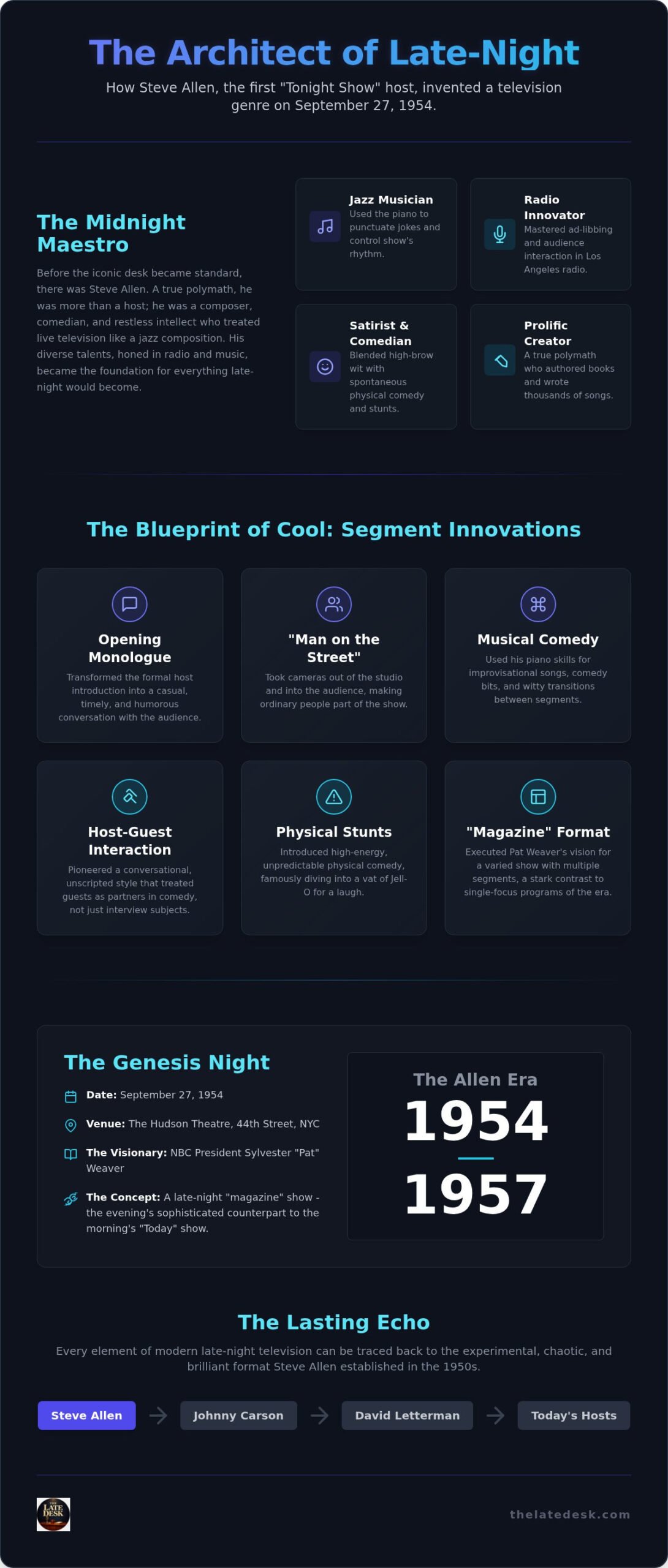
The Chaos and Comedy of the Allen Era: 1954–1957
The years between 1954 and 1957 were a whirlwind of creative anarchy. As the first tonight show host, Allen didn’t just sit behind a desk; he treated the entire studio as a playground for high-concept stunts. One night, he might be turned into a human banana split, covered in toppings for the amusement of a national audience. Another, he might be found diving into a giant vat of Jell-O. These weren’t just cheap gags. They were the first attempts to see how far the visual medium could be pushed before it broke. This era of “Tonight” was defined by a frantic, live energy that felt like a nightly high-wire act.
By 1956, the success of the program forced a professional crisis. NBC decided to pit Allen against the formidable Ed Sullivan on Sunday nights, launching The Steve Allen Show as a direct competitor to CBS’s variety juggernaut. For a grueling period, Allen pulled “double duty,” hosting his late-night franchise during the week and a high-stakes variety hour on the weekend. The professional pressure was immense. Eventually, the network realized that their star was burning out. In January 1957, Allen made his final bow on the late-night stage to focus exclusively on the Sunday night wars.
The Rivalry with Ed Sullivan
The battle for Sunday night supremacy was more than just a ratings fight; it was a clash of television philosophies. While Sullivan offered a traditional vaudeville “toast of the town,” Allen provided a hip, improvisational alternative. This rivalry fundamentally changed the landscape of broadcasting. NBC’s gamble paid off in ratings, but it cost them the stability of their late-night slot. When Allen left, the network briefly experimented with Tonight! America After Dark, a news-heavy magazine format that lacked a central host. It was a spectacular failure, proving that the audience didn’t just want information. They wanted a personality they could trust.
Ernie Kovacs: The Secret Co-Host
During the final year of Allen’s tenure, the workload became so heavy that the network brought in Ernie Kovacs to host on Monday and Tuesday nights. Kovacs was a visual genius whose surrealist style perfectly complemented Allen’s verbal wit. While Allen used the piano and the audience, Kovacs used camera tricks and silent-film logic to distort reality. Much of this era exists now only in the “lost archives,” as many tapes were wiped or lost to time. For those seeking to preserve the legacy of these pioneers, you can explore our curated historical television archives to see how these early moments were saved from obscurity.
This period of transition was messy, brilliant, and essential. It proved that the first tonight show host had created something so vital that even his absence felt like a seismic event in American culture. The chaos of the late fifties ensured that whoever followed would have to be more than just a presenter. They would have to be an icon. The high-stakes audition process that unfolded during this transitional period is vividly captured in the story of the famous tonight show guest hosts who stepped into the spotlight whenever the primary star was away.
The Lasting Echo: Why Every Modern Host Owes Steve Allen a Debt
Every time a host sits behind a polished wooden expanse to interview a movie star, they are inhabiting a space designed by the first tonight show host. Steve Allen created the “Late Night DNA” that Jack Paar and Johnny Carson would later refine into a national ritual. While Allen’s era was defined by a certain experimental chaos, he provided the structural integrity that allowed the format to survive for seven decades. You’ll see his direct influence in Jimmy Fallon’s current iteration, where musical comedy and high-energy games echo the “Steverino” spirit of the fifties. The desk itself became more than furniture; it became a symbol of late-night authority, a pulpit from which the host could interpret the culture for a drowsy nation.
From Allen to Carson: Passing the Torch
The transition from the Allen years to Johnny Carson’s 30-year reign marked the moment late-night transformed from a creative playground into a massive profit center. Allen was the innovator who proved the time slot was viable, while Carson was the cultural institution who perfected the “Business of Laughter.” As the show evolved, the host’s role shifted from a restless inventor to a nightly companion. The stakes grew higher as the industry realized that those midnight hours were worth millions in advertising revenue, yet the foundational elements Allen introduced remained untouched. He was the “Big Bang” of the genre, the source from which all subsequent tonight show hosts expanded.
Preserving the Allen Legacy
For those who wish to witness the “magic” of the 1954 debut, the quest for surviving footage is a journey through media history. Much of the early era was lost due to the practice of wiping tapes, but significant portions have been salvaged. We recommend consulting online television archives for researchers to view the surviving clips that capture Allen’s piano monologues and street segments. His personal papers and recordings are primarily housed in the archives at UCLA and the Library of Congress, ensuring that future biographers can still study the blueprints he left behind.
Steve Allen was the architect who realized that television didn’t have to be formal to be meaningful. He took the spontaneity of jazz and the intimacy of radio to create a visual language that we still speak today. He remains the first tonight show host, a man who taught us that the best way to end the day was with a song, a laugh, and a conversation. To understand the hidden forces that continue to shape the industry, you can explore more deep-dives into late-night power dynamics.
The Legacy of the Midnight Maestro
Steve Allen didn’t just fill a time slot; he created a genre. From the piano-side monologues to the chaotic street segments, he established a visual language that remains the industry standard today. Identifying him as the first tonight show host is more than a trivia fact. It’s a recognition of the intellectual curiosity and musical wit that transformed a local experiment into a global blueprint. He proved that late-night television could be a place for both sophisticated debate and unbridled absurdity, a balance that every successor has since tried to strike.
Understanding these early years requires a deep dive into media archives and the power dynamics of 1950s broadcasting. We specialize in providing expert analysis of the “story behind the story” that contemporary headlines often missed. As the definitive source for classic television narratives, we invite you to continue your journey through the archives of entertainment history. There is always a hidden layer to discover in the moments that shaped our collective memory. Explore the Golden Age of Late Night at The Late Desk and rediscover the pioneers who built the world of the small screen.
Frequently Asked Questions
Who was the very first host of The Tonight Show?
Steve Allen was the first tonight show host, assuming the national mantle in 1954. While he had previously fronted a local version of the program on New York’s WNBT-TV starting in 1953, the NBC network premiere solidified his role as the architect of the genre. His unique background as a jazz musician and radio personality allowed him to create a conversational atmosphere that had never been seen on television before.
When did the first episode of The Tonight Show air?
The inaugural national broadcast of the show aired on September 27, 1954. It originated from the historic Hudson Theatre in New York City, marking the moment NBC officially expanded its programming into the late-night hours. This debut transformed the post-11:00 PM landscape from a graveyard of local news and test patterns into a vibrant destination for sophisticated entertainment and improvisational comedy.
Why did Steve Allen leave The Tonight Show?
Allen departed the program in January 1957 due to the immense professional strain of hosting two major shows at once. NBC had launched a Sunday night variety program to compete directly with Ed Sullivan, forcing Allen into a grueling “double duty” schedule. Eventually, the network and the host agreed that he should focus exclusively on the Sunday night wars, leading to his reluctant exit from the late-night franchise he helped build.
Was Steve Allen the first late-night host ever?
He was not the first person to host a program in the late-night time slot, as Jerry Lester’s Broadway Open House preceded him in 1950. However, Allen was the first tonight show host to establish the specific talk show format that we recognize today. He was the pioneer who integrated the desk, the house band, and the celebrity armchair interview into a single, cohesive late-night experience.
Did Steve Allen invent the Tonight Show monologue?
He did invent the concept, though it was far more improvisational than the scripted stand-up routines favored by modern hosts. Allen’s monologue often took place at his piano, where he would riff on the day’s events and read humorous letters from the audience while playing jazz chords. This casual opening established the host as a relatable, witty companion rather than a formal master of ceremonies.
How long did Steve Allen host The Tonight Show?
His tenure lasted approximately three years, beginning with the show’s national debut in September 1954 and concluding in January 1957. Despite this relatively brief period, his impact was seismic. In just over 800 episodes, he managed to invent the recurring segments and visual tropes that would sustain the franchise through the subsequent eras of Jack Paar, Johnny Carson, and beyond.
Who took over The Tonight Show after Steve Allen?
Jack Paar eventually became the permanent host in July 1957, but only after a disastrous interim period. Following Allen’s departure, NBC briefly experimented with a news-magazine format called Tonight! America After Dark, which lacked a central host and failed to capture the audience’s imagination. The failure of this experiment proved that the show required a singular, charismatic personality to anchor the late-night hours.
Are there any recordings of the first Steve Allen Tonight Show episodes?
Surviving recordings of the earliest episodes are unfortunately rare because the practice of “wiping” magnetic tapes for reuse was standard industry procedure in the fifties. However, several significant moments were preserved on kinescopes, which are film recordings made directly from a television monitor. These precious fragments are now housed in specialized collections like the Library of Congress and the UCLA Film and Television Archive for historical research.