In the early 1970s, a technician at NBC could have erased a piece of American history just to save the cost of a fresh spool of magnetic tape. It’s a chilling reality for any fan who has searched in vain for the earliest years of television’s most iconic franchise. You likely feel the sting of those missing decades, where the work of pioneers like Steve Allen and Jack Paar exists only in grainy fragments. Understanding the tonight show archives history requires us to look back at the “wiping” era, a period when networks viewed their own output as disposable filler rather than cultural treasure.
This guide explores the dramatic rescue of that legacy, anchored by Johnny Carson’s unprecedented demand for ownership and his decision to store his life’s work in a Kansas salt mine. You’ll find a clear map of where to stream surviving episodes in 2026 and how to access the 54 linear feet of scripts held by the Library of Congress. We’re moving from the heartbreak of lost tapes to the definitive story of how late-night was saved for the next generation of viewers. Discover where the surviving treasures are hidden and how the king of late-night ensured his show would never truly go dark.
Key Takeaways
- Understand why the early eras of Steve Allen and Jack Paar were largely lost to the industry practice of “wiping” tapes to save on production costs.
- Discover how Johnny Carson’s 1980 contract battle changed the tonight show archives history by securing his ownership of the master recordings.
- Locate the specific streaming platforms and physical media collections where thousands of hours of digitized episodes are currently available to the public.
- Learn how to access the extensive paper archives at the Library of Congress and USC for a deep dive into original scripts and production notes.
- Explore how modern restoration techniques are being utilized to preserve and upscale the surviving grainy kinescopes of the 1960s.
The Erasure of Early Late Night: Before the Archives Existed
In the dimly lit hallways of NBC’s Rockefeller Center during the 1960s, a quiet destruction took place every morning. It wasn’t born of malice, but of cold, hard accounting. At the time, a single reel of two-inch quadruplex videotape cost hundreds of dollars, a staggering expense for a network producing hours of daily content. To balance the books, engineers were instructed to record over previous broadcasts. This practice has left a gaping hole in the tonight show archives history, particularly during the formative years that defined the genre. What we consider a national treasure today was once viewed as nothing more than a reusable line item on a budget sheet.
The technical evolution of the medium played a cruel role in this loss. Before the widespread adoption of videotape, the only way to preserve a show was through a kinescope, a process of literally filming a television monitor. These recordings were often grainy and lacked the vibrant immediacy of the live broadcast. When videotape arrived, it offered superior quality but carried a heavy price tag. Because the tape was magnetic, it could be erased and used again. For the network, a tape was a tool, not a time capsule. Thousands of hours of cultural history simply vanished into the magnetic ether.
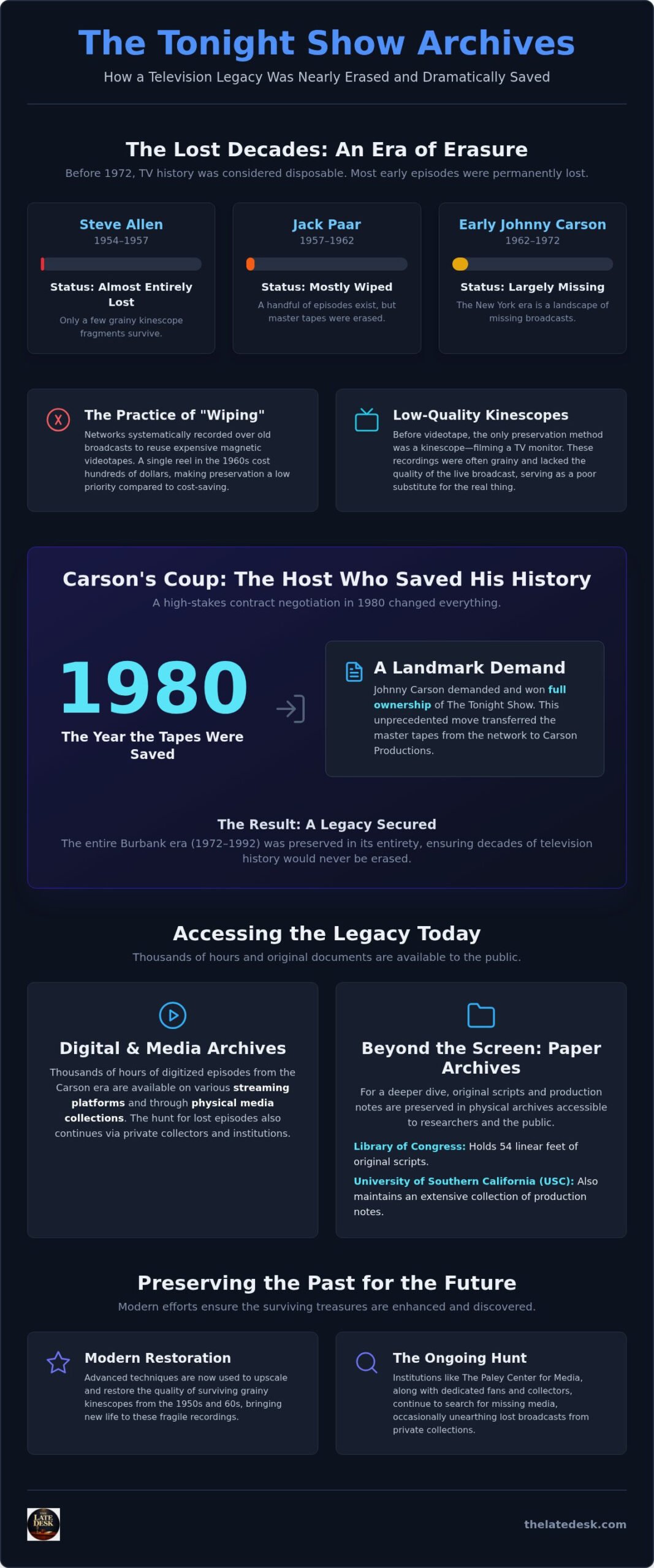
This era of “wiping” claimed the legacies of the show’s first two titans. The Steve Allen years (1954–1957) are nearly non-existent in their original form. Jack Paar’s tenure (1957–1962) fared only slightly better, with a handful of kinescopes surviving while the master tapes were scrubbed clean. Even the early Johnny Carson era, from his 1962 debut through the move to Burbank in 1972, remains a landscape of missing New York episodes. The search for these fragments continues to define the study of late-night television.
The Cultural Crime of Wiping
The economic logic of the 1960s was simple: reuse was cheaper than storage. Wiping is the systematic reuse of magnetic tape by recording new broadcasts over existing material. This short-sightedness didn’t just delete host monologues; it erased the early career milestones of legendary guests. Rare appearances by Lucille Ball or a young Joan Rivers were casualties of this cycle. By treating the history of The Tonight Show as a disposable commodity, the industry inadvertently created a “lost” decade that historians are still struggling to reconstruct.
The Hunt for Missing Media
While the official vaults may be empty, the search for these fragments has moved into the hands of dedicated collectors. Private home recordings and rare overseas kinescopes occasionally surface, offering a flickering glimpse into the past. These discoveries fuel the ongoing fascination with lost late night tv episodes, as fans hope to find a misplaced reel in an attic or a basement. Organizations like the Paley Center for Media work tirelessly to catalog these finds, serving as a vital bridge for the tonight show archives history. They provide a sanctuary for the remnants of an era that the networks themselves tried to erase.
Carson’s Coup: How the King of Late Night Saved His Own History
In May 1980, the power dynamics of broadcasting shifted forever during a high-stakes contract negotiation that most viewers never saw. While NBC was desperate to keep their late-night star from jumping to a rival network, Johnny Carson was playing a much longer game than just salary or vacation time. He demanded, and eventually won, full ownership of the show. This maneuver was the single most important event in the tonight show archives history. It transformed the host from a mere employee into the proprietor of his own cultural footprint. Where the network saw a storage problem, Carson saw a legacy worth protecting.
Carson’s demand for control was a direct response to the “wiping” era he had witnessed during his first decade. He knew that if the tapes remained in the hands of network accountants, they would eventually be erased to save a few dollars. By moving the masters under the banner of Carson Productions, he ensured that the Burbank era, spanning from 1972 to 1992, would be preserved in its entirety. It was a rare moment of a performer recognizing that the real power in show business lies not in the performance itself, but in the ownership of the recording.
The Salt Mine Sanctuary
To protect this newly won empire, Carson Productions moved the master tapes away from the precarious humidity of coastal cities. They chose the Underground Vaults & Storage facility in Hutchinson, Kansas. Located 650 feet below the prairie, these salt mines provide a stable, natural environment that is essentially immune to the ravages of time. The constant 68-degree temperature and 40 percent humidity are the ideal defense against “vinegar syndrome,” the chemical decay that turns old film and tape into a brittle, acidic mess. By the mid-1980s, the collection had grown into a massive library of thousands of tapes, each meticulously logged and preserved in a subterranean fortress that remains the gold standard for archival storage.
The Business of Legacy
This foresight was not just about vanity; it was a brilliant business strategy. Because Carson owned the rights, he was able to curate and sell “Carson’s Comedy Classics,” a syndicated series that introduced his best sketches to a new generation. He became the architect of his own memory, ensuring that his 30-year reign remained visible and profitable long after he left the air. This shift in power paved the way for how we understand the history of late night television today. To truly appreciate the scale of this achievement, one must look at how Carson’s meticulous nature turned a nightly broadcast into a permanent institution. You can explore more deep dives into television history to see how other legends managed their own legacies.
Digital Resurrection: Navigating Tonight Show Streaming and Media Archives
The transition from the silent, cool corridors of the Kansas salt mines to the vibrant, chaotic landscape of the digital age marks a new chapter in the tonight show archives history. Today, the legacy of Johnny Carson isn’t just a physical collection of magnetic tapes; it’s a living digital library. Carson Entertainment Group has successfully digitized all 3,300 hours of existing footage from his 30-year tenure, ensuring that his quick-witted monologues and legendary guest interactions are accessible to a global audience. This massive undertaking has transformed a subterranean vault into a searchable, streamable asset for fans and scholars alike.
For the modern viewer, the primary challenge isn’t finding the content, but navigating the various ways it is served. The official Johnny Carson YouTube channel functions as a masterclass in modern digital archiving, offering high-quality clips that preserve the pacing and atmosphere of the original broadcasts. However, for those seeking the full, immersive experience, the landscape is more varied. Collectors often point to the “Vault Series” DVD releases as the gold standard, as these physical copies often contain material that hasn’t yet migrated to the cloud.
Streaming the Legend
As of August 2026, fans can find full episodes of the show on several major platforms. Services like Pluto TV and The Roku Channel offer free, ad-supported streaming, while fuboTV provides access for subscribers. These platforms allow viewers to relive the late-night ritual, often presented in blocks that mimic the original nightly broadcast schedule. In July 2025, Shout! TV partnered with the Carson Entertainment Group to release 50 previously unaired episodes, a move that delighted historians. This curated approach ensures that even “new” content continues to emerge from the vaults, providing a deeper look into the daily rhythm of the show.
The Music Rights Hurdle
While the digitization effort has been comprehensive, a complex legal web still occasionally obscures the past. If you’ve ever noticed a jarring edit or a missing musical guest, you’ve encountered the music rights hurdle. In the 1970s, variety show licensing often didn’t account for future technologies like streaming or home video. Clearing the rights for a single song can be a prohibitively expensive and time-consuming process. This is why some segments are still edited or omitted entirely from digital releases. Navigating these gaps is a central part of recovering lost johnny carson episodes and understanding the full scope of the tonight show archives history. Despite these hurdles, the digital resurrection of the show remains a monumental achievement in television preservation.
Beyond the Screen: The Johnny Carson Tonight Show Script Collection
While the flicker of the digitized image captures the charisma of the performance, the intellectual blueprint of the show remains preserved in ink and paper. Deep within the USC Cinematic Arts Library, researchers find the tangible evidence of a comedy empire. This collection represents a vital, often overlooked chapter of the tonight show archives history. It serves as the primary home for the paper trail left by Johnny Carson and his production team, spanning the most influential years of his tenure. Here, the glamorous facade of television is stripped away to reveal the meticulous labor of writers, producers, and the host himself.
The collection is not merely a stack of final drafts. It includes treatments, production notes, and intimate correspondence that detail the internal mechanics of a nightly institution. For comedy historians, these documents are the Rosetta Stone of late-night. They offer a rare glimpse into the unperformed scripts, those jokes and sketches that were deemed too risky, too topical, or simply not sharp enough for the broadcast. By studying these rejected pages, scholars can map the shifting boundaries of American taste and the evolution of political satire over three decades.
A Map for Researchers
Navigating the 23.0 linear feet of television history at USC requires the patience of a true archivist. This massive acquisition was made possible through the Academy of Television Arts & Sciences Foundation Library, ensuring that the documents remained accessible to the public. For those pursuing a career in media studies, this repository is an essential stop. You can learn more about utilizing these resources in our guide to television history for scholars. The collection acts as a bridge between the ephemeral nature of a broadcast and the permanent record of cultural impact.
The Anatomy of a Monologue
The true value of these archives lies in the margins. The scripts are often covered in Johnny’s own annotations, showing where he sharpened a punchline or cut a segment for time. These edits provide an insider view of a late-night icon, revealing a man who was as much a disciplined editor as he was a gifted performer. Paper archives provide the essential context that video alone cannot capture, documenting the intent behind every creative decision. If you want to understand the engine under the hood, read our other deep dives into the production secrets of the golden age.
The Future of Late Night History: Preserving the Tonight Show Legacy
While the salt mines of Kansas hold the definitive record of the Burbank era, a phantom remains in the heart of Manhattan. The quest to recover the missing New York years continues to haunt collectors and historians alike. Every few years, a rumor of a lost kinescope or a private home recording surfaces, sparking hope that the early 1960s might one day be reconstructed in their entirety. This persistent search is the heartbeat of the tonight show archives history, proving that the desire to witness the origins of late-night television hasn’t faded with the passage of time.
The archives don’t just exist as a museum of the past; they serve as the foundational DNA for every host who has followed in the king’s footsteps. From the structure of the monologue to the specific rhythm of the “desk piece,” the blueprints established during the Carson era continue to dictate the terms of modern entertainment. At The Late Desk, we remain committed to narrating these unheard stories, peeling back the layers of the archives to reveal the human drama that occurred just out of the camera’s reach. The legacy of the show is a living thing, constantly being rediscovered by new generations of fans.
Technological Frontiers
The next decade promises a revolution in how we experience these classic moments. AI-driven restoration is no longer a fantasy, as engineers begin the delicate process of upscaling 1960s kinescopes to modern standards. These grainy recordings, once the only evidence of Jack Paar’s brilliance, are being cleaned and stabilized to reveal details lost for sixty years. There’s also the potential for 4K restoration of 1970s videotape, bringing the vibrant colors of the Burbank studio back to life with startling clarity. Beyond the visuals, AI metadata is making the archives searchable for specific guests or keywords, a tool that will prove invaluable for researchers. Fan-led digital preservation communities play a crucial role here, often finding and restoring clips that the networks overlooked during the initial digitization process.
The Final Word on Legacy
The journey of these tapes has been one of survival, moving from a culture where they were “wiped” for a few dollars to an era where they are worshipped as historical artifacts. This transition reflects a broader change in how we value our collective memory. Understanding the late night tv power dynamics that allowed for this preservation is essential for any true student of the medium. The Tonight Show archives stand as a testament to the foresight of those who knew that laughter, while ephemeral, deserves a permanent home. Subscribe to The Late Desk for more deep dives into television history as we continue to explore the treasures hidden within the vaults.
Secure Your Seat in Late-Night History
The journey through the tonight show archives history reveals a narrative as dramatic as any monologue delivered under the studio lights. We’ve traced the path from the tragic loss of the Allen and Paar eras to the subterranean sanctuary in Kansas that saved Johnny Carson’s legacy. It’s clear that the survival of these tapes was no accident; it was a calculated act of defiance against a network culture that once viewed history as disposable. By securing ownership of his work, Carson ensured that the Burbank years would remain a permanent fixture of our collective memory.
Whether you are a casual fan streaming digitized episodes on Pluto TV or a scholar leafing through the 23.0 linear feet of scripts at USC, you are participating in the ongoing life of a cultural institution. These archives don’t just store old jokes; they preserve the creative evolution of a medium that redefined American evenings. The transition from grainy kinescopes to AI-restored 4K footage marks a new era of accessibility for everyone who cherishes the golden age of broadcasting.
If you’re ready to dive deeper into the golden age of television, you can explore the full archives of Late Night history at The Late Desk. Our expert analysis provides the deep-dive narratives on Carson, Paar, and Allen that you won’t find anywhere else. The story of late-night is still being written, and the best parts are often found in the shadows of the past. Keep exploring, and keep the legend alive.
Frequently Asked Questions
Why are the first ten years of Johnny Carson’s Tonight Show missing?
The first decade of Johnny Carson’s tenure is largely missing because NBC followed the industry standard of “wiping” master tapes. During the 1960s, magnetic videotape was an expensive commodity, often costing hundreds of dollars per reel. To manage budgets, the network systematically recorded new broadcasts over older ones. Consequently, most episodes from 1962 to 1972 exist only as grainy kinescopes or have vanished entirely from the historical record.
Where are the physical master tapes of The Tonight Show stored today?
The surviving master tapes from the Burbank era are stored in a specialized subterranean facility in Hutchinson, Kansas. This location provides a naturally stable environment with a constant temperature of 68 degrees and 40 percent humidity. These conditions are vital for preventing chemical decay like vinegar syndrome. By housing the collection 650 feet underground, Carson Productions ensured that thousands of hours of footage would be protected from the atmospheric fluctuations found in traditional warehouses.
Can I visit the Johnny Carson archives at USC in person?
Researchers can access the Johnny Carson Tonight Show collection at the USC Cinematic Arts Library in Los Angeles. While the physical tapes are restricted to preserve their integrity, the extensive paper archives are available for scholarly study. You will typically need to contact the library in advance to schedule a viewing and may need a reader identification card. This repository is a cornerstone of the tonight show archives history, offering a tangible connection to the show’s creative process.
Are there any full episodes of Steve Allen or Jack Paar available?
Finding full episodes from the Steve Allen and Jack Paar eras is incredibly difficult due to the lack of preservation during the 1950s. While a handful of kinescopes survived, they represent only a tiny fraction of the thousands of hours broadcast. Most available footage consists of short clips or “best of” segments rather than complete, uncut episodes. These remnants are often found in specialized libraries like the Paley Center for Media rather than on mainstream streaming platforms.
Who owns the rights to the Johnny Carson Tonight Show archives?
The rights to the archives from 1962 to 1992 are owned by the Carson Entertainment Group, not NBC. Johnny Carson successfully negotiated for full ownership of the show during a pivotal contract battle in 1980. This landmark agreement allowed his production company to control the licensing, syndication, and digital preservation of his 30-year legacy. It remains a rare example of a television host gaining complete authority over their own historical footprint and professional work.
Why are some Tonight Show musical performances cut from streaming versions?
Musical performances are frequently omitted from streaming versions because of complex licensing agreements from the 1970s and 80s. When these shows were originally produced, the contracts didn’t account for future technologies like digital streaming or home video. Clearing the rights for a single song today can be prohibitively expensive for distributors. As a result, musical segments are often edited out to avoid legal complications, leaving only the comedy and interviews intact for modern viewers.
What is the “salt mine” archive often mentioned in late-night history?
The “salt mine” refers to the Underground Vaults & Storage facility in Hutchinson, Kansas, where the Carson archives are permanently housed. It is a repurposed salt mine that provides an ideal sanctuary for delicate magnetic media. Because the facility is deep underground, it offers natural protection against disasters and extreme weather. This subterranean fortress has become a symbol of late-night preservation, representing the lengths taken to protect the tonight show archives history for future generations.
How much of the Tonight Show script collection is available online?
Very little of the actual script collection is available for digital viewing online. The majority of the 23.0 linear feet of material is housed physically at the USC Cinematic Arts Library and requires an in-person visit for detailed study. While some finding aids and metadata can be searched through the Online Archive of California, the scripts themselves remain largely on paper. This physical restriction underscores the importance of traditional archives in preserving the show’s intellectual history and creative labor.