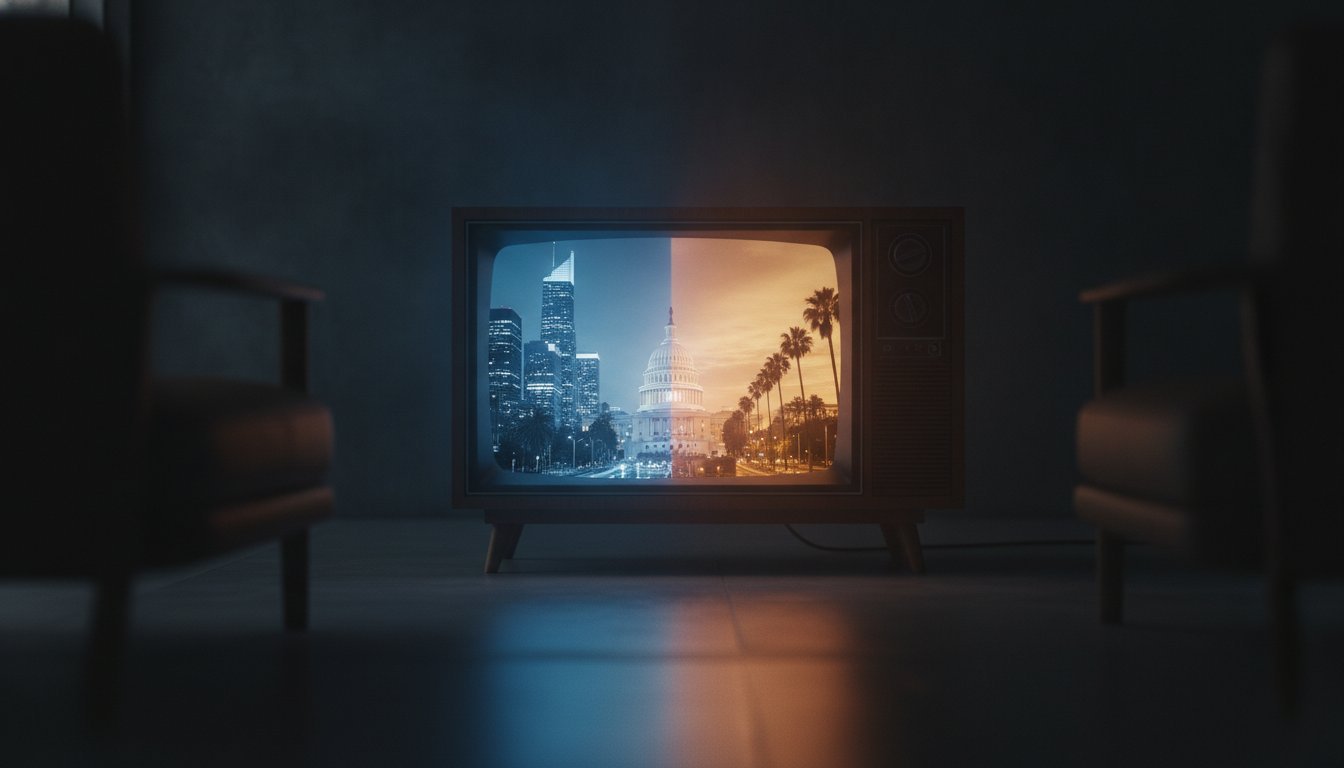
In May 1972, Johnny Carson moved The Tonight Show from the humid, vertical energy of Manhattan to the sun-drenched sprawl of Burbank, a transition often dismissed as a mere logistical shift. In truth, it was the moment the industry’s center of gravity shattered, forever altering 1970s late night tv culture. You likely remember the era for its velvet curtains and easy laughter, yet beneath that polished surface, the medium was undergoing a radical transformation. It evolved from a harmless variety format into a sophisticated, often cynical mirror of an American psyche bruised by political scandal and social upheaval.
While standard retrospectives focus on the highlight reels, they frequently overlook the story behind the story that defined this golden age. This article promises to deconstruct how the move to Los Angeles and the shadow of Watergate turned the monologue into a vital cultural weapon. We’ll explore the shifting power dynamics of the NBC hierarchy, the raw intimacy of Tom Snyder’s Tomorrow show, and the enduring archival value of these midnight broadcasts. Prepare to see the decade’s television legacy not just as entertainment, but as a cinematic record of a nation in transition.
Key Takeaways
- Understand how the 1972 move to Burbank fundamentally shifted the industry’s aesthetic, trading New York’s gritty energy for a celebrity-dense Hollywood landscape.
- Analyze the professional hierarchies of the era to see how a single gesture from Johnny Carson could instantly validate or dismantle a performer’s career.
- Explore the emergence of the “Late-Late” frontier with Tom Snyder’s Tomorrow show, which served as a raw, intellectual counterpoint to mainstream variety.
- Recognize the profound impact of Watergate and Vietnam on 1970s late night tv culture, as monologues transitioned from harmless bits to sharp social critique.
- Appreciate the archival significance of this decade as the definitive blueprint for the modern talk show format and the ongoing efforts required to preserve it.
The Great Migration: How the 1972 Move to Burbank Redefined the Aesthetic
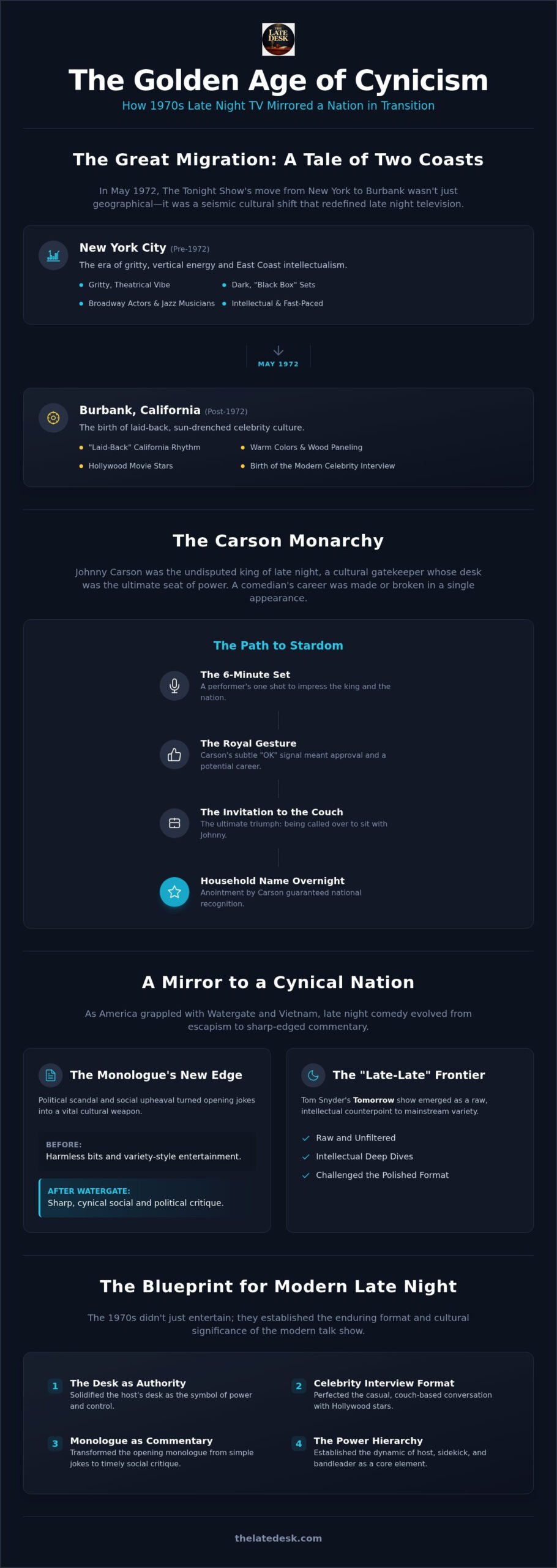
In May 1972, a fleet of trucks hauled the physical remnants of The Tonight Show across the country, signaling the end of an era. This “Burbank Shift” traded the gritty, vertical intensity of New York City for the horizontal, sun-soaked glamour of Southern California. For viewers at home, the transition was jarring yet seductive. The show moved from a city defined by the frantic pace of Broadway to one governed by the curated cool of Hollywood. This migration fundamentally reshaped 1970s late night tv culture, moving it away from the intellectual theater of the East Coast and toward the star-making machinery of the West. It ignited a lasting rivalry in the public consciousness, pitting the sophisticated grit of the Atlantic against the polished ease of the Pacific.
The visual evolution was stark. The 1960s sets often felt like theatrical black boxes, designed to highlight the performer under a single spotlight. In Burbank, the lights grew brighter and the colors warmer. The studio became a living room for the nation, complete with the textures of the era. This shift in scenery reflected a broader national desire for comfort following the turbulence of the late sixties. The show wasn’t just a broadcast anymore; it was an invitation into a world of palm trees and perpetual summer.
The Sunset of the Broadway Influence
When the show resided in Manhattan, the guest chair was frequently occupied by stage actors between performances or jazz musicians from local clubs. The move to Burbank changed the guest list’s DNA. Suddenly, movie stars who rarely traveled to New York became regular fixtures. This access to Hollywood royalty became a hallmark of 1970s late night tv culture, as the format prioritized the “couch” over the “stage.” The pacing slowed, adopting a more relaxed, “laid-back” California rhythm that felt more like an intimate party than a theatrical production. The Burbank Era was the birth of the modern celebrity interview.
The Architecture of the LA Studio
The visual language of the set underwent a radical makeover to match this new environment. Gone were the dark, moody stages that echoed the aesthetic of a jazz cellar. In their place came the iconic 1970s “rainbow” curtains and warm wood paneling. These choices weren’t accidental; they projected a sense of suburban comfort and high-end professional stability. Central to this new look was the architecture of the late night talk show desk, which became a formidable fortress of authority. While the 1960s NBC set felt like a temporary stage, the Burbank design felt like a permanent office. The desk anchored the host in a position of power, even as the “laid-back” studio design invited guests to let their guard down. This contrast between the host’s rigid authority and the guest’s casual proximity defined the decade’s unique television energy.
Johnny Carson’s Cultural Hegemony: The Desk as the Ultimate Seat of Power
By the mid-1970s, the television landscape had largely surrendered its late-night hours to a single man. While competitors attempted to chip away at the ratings, The Tonight Show with Johnny Carson functioned as a cultural monopoly. This era of 1970s late night tv culture was defined by a rigid, almost royal hierarchy. At the center sat Carson, the ultimate gatekeeper of American comedy. A young performer’s entire future could be decided in a six-minute set. If Johnny offered a subtle “OK” gesture or, in the rarest of triumphs, invited the comedian to sit on the couch, they were instantly anointed. To be ignored was to remain in the shadows of the club circuit. To be summoned was to become a household name by morning.
The power dynamics extended beyond the guest chair to the permanent fixtures of the stage. The relationship between Carson, his loyal sidekick Ed McMahon, and the flamboyant bandleader Doc Severinsen created a sense of professional intimacy that felt like a private club. McMahon provided the boisterous laughter that validated Johnny’s wit, while Severinsen’s brassy fanfares and outrageous outfits offered a visual counterpoint to Carson’s midwestern reserve. This trio formed a formidable front that dictated the tastes and trends of the decade. If you want to dive deeper into how this era shaped the industry, you might explore our archives on the legacy of mid-century broadcasting.
The Ritual of the Monologue
Every evening at 11:30, the monologue served as a national temperature check. It was the moment where the day’s headlines were distilled into digestible, cynical observations that resonated with a bruised American public. Carson possessed a unique ability to bridge the gap between the glitz of Hollywood and the sensibilities of Middle America. He used the evolution of the late night monologue to turn political scandal into shared catharsis. By mocking the powerful with a wink and a golf swing, he made the complexities of the 1970s feel manageable for millions of sleepy viewers.
The Guest Host Hierarchy
The throne was rarely vacant, but when Carson took his increasingly frequent vacations, the guest host chair became a high-stakes arena. Icons like Joan Rivers and Bob Newhart didn’t just fill time; they conducted public auditions for the future of the genre. There was a palpable professional tension inherent in these broadcasts. A guest host had to be talented enough to maintain the ratings but never so dominant that they outshone the King. This delicate balance turned guest hosting into a high-wire act where the prize was a potential permanent seat in the late-night pantheon. These substitute sessions were essential to 1970s late night tv culture, proving that while Carson was the sun, the stars orbiting him were equally vital to the ecosystem.
The Birth of Counter-Late-Night: Tom Snyder and the Saturday Night Revolution
While Johnny Carson held court at 11:30 PM, the hours following midnight remained a broadcast vacuum until the early 1970s. This era saw the settlement of the “Late-Late” frontier, a period where 1970s late night tv culture grew increasingly experimental and abrasive. It was a time when networks realized that the “Night Owl” demographic, consisting of college students, night-shift workers, and counter-culture figures, craved something more substantial than standard variety acts. This audience didn’t want a polished monologue; they wanted a conversation that felt as raw and unscripted as their own lives. The arrival of programs that challenged the status quo ensured that the television never truly went to sleep.
Tom Snyder and the Art of the Intimate Interview
Tom Snyder’s Tomorrow show, which debuted in 1973, stood as the intellectual, smoke-filled antithesis to the Carson aesthetic. Snyder eschewed the traditional late-night trappings; there was no studio audience, no house band, and no sidekick to cushion the blows. The visual style relied on tight, unforgiving close-ups that captured every bead of sweat and every plume of cigarette smoke. Snyder’s confrontational questioning turned the interview into a high-stakes psychological duel. His 1975 conversation with John Lennon, one of the musician’s final televised appearances, showcased a level of depth rarely seen on the small screen. By prioritizing substance over spectacle, Snyder functioned as the precursor to modern deep-dive podcasting and long-form media.
The Saturday Night Shift
The 1975 debut of Saturday Night Live fundamentally disrupted 1970s late night tv culture by dismantling the polite “variety show” standards of the previous decade. Lorne Michaels and his “Not Ready for Prime Time Players” introduced a brand of biting, topical satire that felt dangerous to the NBC hierarchy. There was a palpable tension between the network’s traditional programming and this new, chaotic energy that refused to play by the rules. The show didn’t just mock politicians; it mocked the very medium of television itself. SNL’s arrival marked the definitive end of the polite era of late-night TV. It replaced the safe, rehearsed comedy of the past with a live, unpredictable spirit that captured the cynical heart of the mid-seventies.
A Mirror to a Cynical Nation: Watergate, Vietnam, and the New Edge
1970s late night tv culture underwent a profound psychological shift as the decade progressed. The broad, theatrical slapstick of the mid-century began to feel hollow in the wake of the Vietnam War’s conclusion and the seismic shock of the Watergate scandal. Audiences were no longer satisfied with simple, sunny escapism. They sought a host who could acknowledge the absurdity of the evening news with a knowing glance and a sharp tongue. Consequently, the medium transformed into the national fireplace, a communal space where Americans gathered to process collective trauma through the lens of irony and shared frustration.
This period saw the rise of the “cynical host,” a figure who reflected the public’s growing distrust of established institutions. Comedy moved away from harmless character bits and toward biting political satire that felt both urgent and dangerous. The laughter wasn’t just for entertainment; it was a form of social survival. By mocking the very people who held the levers of power, late-night television provided a sense of agency to a population that felt increasingly disconnected from its leaders. This evolution solidified the era as the definitive turning point in 1970s late night tv culture, where the desk became a platform for social commentary as much as a stage for variety.
The Watergate Effect on the Monologue
Watergate fundamentally altered the DNA of the late-night monologue. Johnny Carson, who had previously maintained a carefully guarded neutral persona, began to treat the Presidency with a distinct lack of reverence. He navigated this political polarization with surgical precision. While he never explicitly took a partisan side, his relentless barbs at the “credibility gap” made topical humor the primary currency of the era. This shift turned the monologue into a vital tool for civic engagement, wrapped in the guise of a golf swing and a punchline. It taught the audience that no institution was too sacred to be skewered before the final commercial break.
Late Night as a Social Safety Valve
Beyond the immediate politics, late-night served as a vital safety valve for a nation under immense pressure. It had a unique capacity to humanize controversial figures, bringing them into the living room for a civil, if pointed, conversation. This cathartic laughter allowed the public to decompress after years of social upheaval. Understanding these shifts requires a look at the broader late night tv power dynamics, as networks had to balance this new edge with the demands of corporate advertisers. The result was a decade of television that felt more honest and immediate than anything that had come before. To explore more about how these industry shifts redefined entertainment, you can browse our collection of historical television articles.
Curating the Archive: Why the 1970s Remain the Definitive Era
The 1970s didn’t just produce memorable television; they established a structural grammar that continues to dictate how we consume late-night media today. While technology has shifted from analog tape to digital streaming, the foundational elements of 1970s late night tv culture remain remarkably intact. This was the decade where the format transitioned from a simple variety broadcast into a permanent cultural record. It captured the evolution of American sensibilities, preserving the transition from mid-century earnestness to a more complex, modern cynicism. Today, the appeal of 70s late-night clips in the digital age isn’t merely nostalgic. These snippets serve as essential artifacts of a nation learning to laugh at its own fractures. The decade proved that the talk show was more than a distraction; it was a mirror.
The Template for the Modern Host
Nearly every trope seen on screens in 2026 can be traced back to the specific innovations of this era. The physical arrangement of the desk, the strategic interplay with a house band, and the use of list-based comedy were all refined during this period. We’re still living in the shadow of this “Golden Age,” where the host acts as both a comedian and a trusted confidant. This legacy is explored in detail within the cinematic history of late night television, which traces the line from radio roots to the polished authority of the 70s. The modern monologue, regardless of its political leaning, still relies on the cadence and national temperature check established by Carson and his contemporaries. They didn’t just host shows; they built an institution.
Preserving the Narrative
The challenge of maintaining this legacy is significant, particularly due to the fragility of 1970s magnetic media. Many broadcasts were lost to the industry practice of “wiping” tapes for reuse or simply the natural decay of the material. This reality makes the work of online television archives for researchers vital for protecting our collective memory. As media historians, we don’t just report on the past; we interpret the human drama that occurred just off-camera. We encourage you to explore the “story behind the story” through our curated articles to discover the hidden layers of these iconic moments. The archives are more than just tapes; they are the blueprints of our cultural conversation. By preserving these narratives, we ensure that the voices of the 70s continue to inform the late-night landscape of the future.
Preserving the Midnight Legacy
The 1970s didn’t just provide a backdrop for entertainment; it forged a new language for the American night. From the sun-bleached studios of Burbank to the smoke-filled rooms of the Tomorrow show, the decade dismantled the polite variety format of the past. It replaced it with a sophisticated, often cynical dialogue that resonated with a nation seeking truth in the wake of Watergate. This transformation of 1970s late night tv culture ensured that the talk show became more than just a broadcast. It became a vital cultural record that still informs our media landscape today.
Understanding these shifts requires more than just watching old clips. It demands a look at the industry power dynamics and the human drama that occurred behind the curtains. Our curated narratives offer television history scholars a definitive guide to these transformative years. You can explore the full archives of late-night history at The Late Desk to discover expert analysis of Johnny Carson’s 30-year legacy and deep dives into the golden age. The stories behind the screen are waiting to be rediscovered. We invite you to lean in and discover the hidden layers of these iconic public moments.
Frequently Asked Questions
Why did Johnny Carson move The Tonight Show to Los Angeles in 1972?
Carson moved the production in May 1972 primarily to gain easier access to the burgeoning pool of Hollywood movie stars. While New York offered theater talent, the industry’s center of gravity was shifting toward film and television production in California. This relocation allowed for a more celebrity-dense guest list and a relaxed, sun-drenched aesthetic that resonated with a national audience seeking comfort during a turbulent decade.
How did the 1970s change the format of late-night talk shows?
The decade transformed the variety-heavy broadcast into a more focused, personality-driven vehicle for social commentary. Producers refined the structural grammar of the genre by cementing the desk-and-couch arrangement and prioritizing the host’s monologue as a vital cultural tool. This era also saw the birth of the “late-late” frontier, introducing more intimate, experimental formats that catered to the night-owl demographic and counter-culture audiences.
What was the significance of Tom Snyder’s “Tomorrow” show?
Debuting in 1973, Snyder’s program provided a raw, intellectual counterpoint to the polished variety of mainstream late-night. It lacked a studio audience and house band, relying instead on tight close-ups and confrontational long-form interviews. This stripped-down approach allowed for deep-dives into controversial subjects and figures, effectively serving as the precursor to modern podcasting and establishing a space for more serious discourse after midnight.
How did political events like Watergate affect 1970s late-night comedy?
Political scandals like Watergate fundamentally injected a sense of cynicism and biting satire into 1970s late night tv culture. Monologues transitioned from safe, lighthearted observations to sharp critiques of institutional power. Carson and his contemporaries began treating the Presidency with less reverence, using humor as a communal safety valve that helped the American public process national trauma and a growing distrust of government authority.
Who were the most influential late-night guests of the 1970s?
Influential guests included burgeoning comedians like Richard Pryor and Steve Martin, whose appearances on Carson’s couch could launch global careers overnight. Controversial figures such as Charles Manson and political icons like John Lennon also defined the decade’s edge through their interviews with Tom Snyder. These guests weren’t just entertainers; they were cultural lightning rods who used the platform to challenge social norms and engage with a cynical nation.
What happened to the “New York style” of late-night in the 1970s?
The gritty, theater-centric energy of Manhattan largely faded as the industry’s focus moved to the West Coast. While New York had prioritized Broadway talent and jazz musicians, the new California style favored movie stars and a “laid-back” studio atmosphere. However, this vacuum eventually allowed for the 1975 debut of Saturday Night Live, which reclaimed the New York aesthetic through raw, live comedy that mocked the very medium of television.
Why is the 1970s considered the “Golden Age” of late-night television?
This period is deemed the “Golden Age” because it established the definitive template for the modern talk show. 1970s late night tv culture balanced high-stakes industry power dynamics with a unique capacity for national catharsis. It was the decade where the medium matured from simple escapism into a sophisticated mirror of the American psyche, creating a professional hierarchy and a structural blueprint that persists in the broadcasting world today.
Can I still watch 1970s late-night TV episodes today?
Yes, though availability varies significantly due to historical “wiping” practices where tapes were erased for reuse. You can find curated clips and full episodes through official streaming platforms, digital archives, and physical media collections. Researchers often rely on specialized online television archives to access these artifacts, as they provide the necessary context to understand the human drama and industry shifts that defined this iconic era of broadcasting.