In 1982, the 12:30 AM time slot was little more than a broadcasting graveyard reserved for reruns and forgotten cinema. Then came a gap-toothed midwesterner who decided to treat the late-night airwaves like a high-concept art project. You’ve likely stumbled upon grainy YouTube clips of “Stupid Human Tricks” or “Larry Bud” Melman, yet these digital fragments often fail to capture the sheer subversion of the David Letterman NBC years. It’s easy to confuse this experimental era with the more polished CBS tenure that followed, but the 1980s at 30 Rock were a different beast entirely.
We’re stepping behind the heavy doors of Studio 6A to rediscover how Letterman and his creative architects, including Merrill Markoe and Paul Shaffer, dismantled the traditional talk show to build something revolutionary. You’ll learn how a decade of controlled chaos redefined the medium and why his eventual departure felt like a tectonic shift in the industry. This is a journey through the laboratory of late night, where the rules of television weren’t just broken; they were rewritten in real time.
Key Takeaways
- Learn why a critically acclaimed daytime failure served as the essential catalyst for the most experimental decade in broadcasting history.
- Examine the “anti-talk show” aesthetic of the David Letterman NBC years, where irony and deconstruction replaced the standard celebrity interview.
- Identify the key creative figures like Merrill Markoe who helped invent iconic segments that turned mundane observations into high-concept comedy.
- Understand the industry power dynamics behind the 1991 succession scandal and why NBC ultimately chose the safe path over the revolutionary one.
- Recognize the specific creative traits that separate the raw, unpredictable energy of Studio 6A from the later, more polished CBS era.
The Morning Failure that Birthed a Revolution (1980–1982)
In the summer of 1980, NBC believed they had found the future of daytime television in a gap-toothed, sarcastic weatherman from Indianapolis. They handed David Letterman ninety minutes of live morning airtime; a decision that, on paper, should have anchored the network’s early schedule for a decade. Instead, the show became a legendary catastrophe of mismatched demographics. Housewives looking for domestic tips were greeted by a host who seemed more interested in mocking the very concept of a morning show. It was a failure that, paradoxically, became the foundation for the David Letterman NBC years.
The David Letterman Show: A Daytime Anomaly
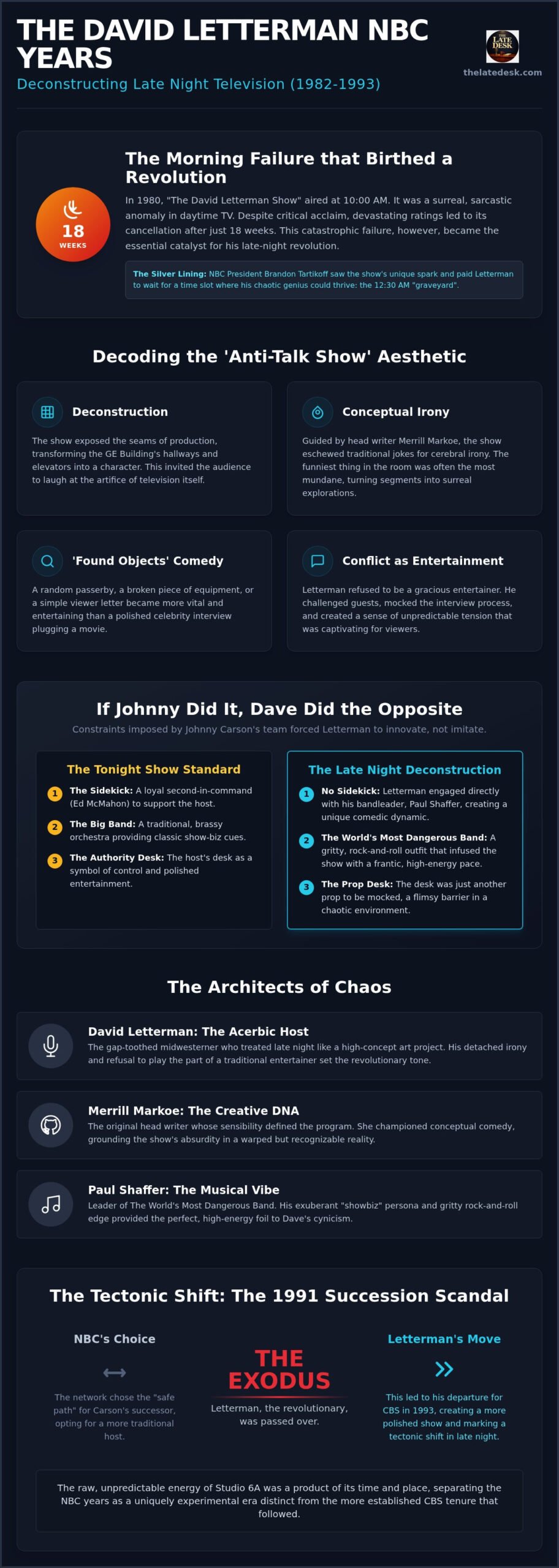
Imagine the confusion of 1980s audiences tuning in at 10:00 AM to find “Stupid Pet Tricks” instead of a soap opera. The show was surreal, unpredictable, and entirely out of place in the morning light. While critics adored the irony, the ratings were devastating. NBC cancelled the program after just eighteen weeks. However, the network’s president, Brandon Tartikoff, recognized a rare spark. Rather than letting a talent walk away, Tartikoff paid Letterman to stay off the air until a better time slot opened up. He knew this specific brand of comedy needed the cover of darkness to thrive.
The move to late night eventually brought Letterman to Studio 6A in the GE Building. It was a cramped, vertically oriented space that lacked the expansive grandeur of the West Coast stages. This physical limitation became a creative asset. The cold temperatures and nervous energy of the small room fueled a sense of isolation among the staff. It felt like a bunker where a revolutionary new language of television was being whispered into the microphones, shielded from the watchful eyes of conservative executives.
Finding the 12:30 AM Identity
The transition wasn’t immediate. The network had to navigate the exit of Tom Snyder and his “Tomorrow Show” to make room for the new vision. By 1982, Letterman finally secured the coveted slot immediately following The Tonight Show with Johnny Carson. The proximity to the King of Late Night was both a blessing and a burden. Carson’s lawyers famously dictated that Letterman couldn’t have a sidekick or a traditional band to avoid copying the master. This forced the production to innovate. They couldn’t be a clone, so they chose to be a deconstruction. The mandate was clear: if Johnny did it, Dave would do the opposite.
Decoding the ‘Anti-Talk Show’ Aesthetic
While traditional talk shows relied on the safety of the proscenium arch, the David Letterman NBC years thrived on the chaos of the corridors. The show transformed the GE Building itself into a character, often abandoning the desk to wander the hallways of 30 Rock with a handheld camera. This wasn’t merely a technical choice; it was a philosophical statement. By exposing the seams of the production, the show invited the audience to laugh at the artifice of television. The “Found Objects” comedy style meant that a random passerby or a broken elevator became more vital than a movie star plugging a summer blockbuster.
Merrill Markoe and the Creative Architecture
Behind this calculated anarchy was Merrill Markoe, the original head writer whose sensibility defined the program’s DNA. She eschewed traditional jokes in favor of conceptual irony, teaching a generation of viewers that the funniest thing in the room was often the most mundane. Markoe’s influence turned segments like “Viewer Mail” into surrealist explorations rather than simple fan interactions. Her work ensured the show remained a cerebral experiment, even when it appeared to be falling apart. It was her vision that grounded the show’s absurdity in a recognizable, if slightly warped, reality.
The World’s Most Dangerous Band
If Letterman provided the cynicism, Paul Shaffer provided the electricity. Transitioning from the early years of SNL, Shaffer formed the World’s Most Dangerous Band, a group that brought a gritty, rock-and-roll edge to the 12:30 AM slot. The chemistry between the two was a study in contrasts. Shaffer’s exuberant “showbiz” persona, complete with exaggerated musical cues and industry jargon, served as the perfect foil to Dave’s detached irony. The music didn’t just fill the gaps; it set a frantic, high-energy pace that made every broadcast feel like a live wire.
This deconstruction extended to the very furniture. The desk wasn’t a place of authority; it was a prop to be mocked. Guests weren’t always welcomed with open arms but were often challenged by a host who refused to play the part of the gracious entertainer. For those seeking to understand the deeper currents of this era, exploring historical television articles provides the necessary context to see how these small subversions changed the medium forever. The visual language, from the Dutch angles to the grainy footage of the New York streets, signaled that the old guard had been replaced by something much more unpredictable.
The 12:30 AM Laboratory: Iconic Segments and Surrealism
While the 11:30 PM hour belonged to the established order, the 12:30 AM slot became a dark room where the rules of television gravity seemed optional. During the David Letterman NBC years, the production team didn’t just book guests; they curated a collection of human anomalies. This was the era where “Stupid Pet Tricks,” originally a survival tactic from the failed morning show, morphed into a cultural phenomenon. By inviting ordinary people to showcase their dogs’ ability to eat a taco, Letterman wasn’t celebrating talent. He was celebrating the glorious, low-stakes absurdity of everyday life, proving that a pug in a costume was more compelling than a rehearsed anecdote from a starlet.
The “Top Ten List,” which debuted in September 1985, became the show’s most enduring legacy. Although it’s now remembered as a comedy staple, its origins were deeply satirical. It was a direct parody of the list-heavy, tabloid journalism popularized by USA Today. By ranking the “Top Ten Signs Your Roommate Is A Ghost,” the show mocked the public’s growing obsession with bite-sized, meaningless information. Similarly, “Viewer Mail” abandoned the tradition of host-audience warmth. Letterman treated fan inquiries with a mixture of bewilderment and feigned hostility, often using the letters as springboards for elaborate, pre-taped sketches that had nothing to do with the original question.
Elevating the Mundane: The ‘Small Town News’ Approach
Comedy in Studio 6A wasn’t found in punchlines, but in the bizarre corners of the local neighborhood. Letterman turned the surrounding blocks of Manhattan into an extended set, frequenting local businesses like Hello Deli and transforming their owners into reluctant celebrities. This “Small Town News” approach found humor in the hyper-specific and the mundane. Central to this was Calvert DeForest, known to viewers as Larry “Bud” Melman. DeForest was the ultimate comedic foil; he was a man who seemed entirely unaware of the cameras, delivering lines with a stiff, nervous energy that perfectly complemented Dave’s polished cynicism. It created an “insider” community where the audience was in on the joke, even if the guests weren’t.
Studio Experiments: The 360-Degree Show and Beyond
The relative obscurity of the late-night slot allowed for technical risks that would have been unthinkable an hour earlier. This led to legendary experimental episodes, such as the 1986 broadcast where the camera slowly rotated 360 degrees over the course of the hour. By the final segment, the audience was watching the show upside down. There were “Custom Made” episodes where viewers voted on everything from the host’s wardrobe to the guest list. These weren’t just gimmicks; they were aggressive deconstructions of the medium. NBC’s 12:30 AM slot was the only place on the dial where a major network would allow its star to literally turn the world on its head.
The Acerbic Interviewer: Conflict as Entertainment
For decades, the late-night guest chair was a place of sanctuary where celebrities were polished to a high shine by the graciousness of Johnny Carson. Then came the David Letterman NBC years, and the chair suddenly felt like an interrogation seat under a hot bulb. Letterman didn’t just interview his guests; he often seemed to be tolerating them. This shift from hospitality to skepticism transformed the talk show from a promotional tool into a high-stakes psychological drama. If a guest arrived with a rehearsed anecdote, Letterman would often dismantle it with a single, devastatingly dry observation. He wasn’t there to make them look good. He was there to see if they were real.
The Infamous Exchanges: Cher, Madonna, and MacLaine
The 1986 interview with Cher remains a watershed moment in broadcasting history. When she famously called Letterman an “asshole” on live television, it wasn’t a scripted bit of banter. It was a genuine reaction to a host who refused to play the Hollywood game of mutual admiration. These moments felt dangerous because they were unmanaged. While the 1994 Madonna appearance occurred shortly after the move to CBS, its confrontational DNA was forged during the decade at NBC. It was the logical conclusion of a format that prioritized friction over flattery. Shirley MacLaine once asked him what happened to the “nice young man” she used to know. The answer was simple: he had become the industry’s most effective lie detector.
The Art of the ‘Bad’ Guest
Some of the most memorable segments featured guests who leaned into the conflict. Charles Grodin became a recurring “professional” antagonist, appearing on the show to berate Letterman for his perceived lack of respect. These weren’t just interviews; they were avant-garde performances that blurred the line between reality and satire. Analyzing the power dynamics during these classic television guest interviews reveals a host who was constantly testing the boundaries of what was acceptable on network TV. Letterman’s skepticism toward the machinery of fame paved the way for the irony-drenched media landscape we inhabit today. He taught us that the most entertaining thing a celebrity could do was lose their composure.
Understanding these tensions requires a look at the broader industry shifts of the 1980s. To see how these interactions compared to the era’s other titans, read our full series on historical television articles.
The Succession Scandal and the CBS Exodus (1991–1993)
In May 1991, Johnny Carson stood before a stunned crowd at an NBC upfront presentation and announced his retirement. It was the shot heard ‘round the industry, signaling the end of a thirty-year reign. For the staff at Studio 6A, the path forward seemed obvious. David Letterman was the crown prince, the innovator who had spent a decade reinventing the medium in Carson’s shadow. Yet, in a pivot that would redefine television history, NBC executives chose the safe, dependable Jay Leno. This decision effectively ended the David Letterman NBC years, sparking a corporate civil war that played out in the headlines of every major newspaper.
The Battle for the 11:30 PM Desk
Internal politics at NBC had shifted significantly since General Electric’s acquisition of the network. The new corporate masters favored Leno’s accessibility over Letterman’s unpredictable, often abrasive brilliance. Despite Johnny Carson’s private support for Dave as his rightful heir, the network stood firm. This choice didn’t just hurt Letterman; it fractured the lineage of Tonight Show hosts, turning a peaceful transition into a decade-long grudge match. The story behind the story was one of spreadsheet-driven caution clashing with artistic legacy.
The Move to the Ed Sullivan Theater
Sensing an opportunity, super-agent Michael Ovitz orchestrated a high-stakes bidding war. CBS eventually won with a massive $14 million contract and the promise of a renovated Ed Sullivan Theater in New York. However, the exit was far from clean. NBC’s legal team launched a bitter offensive, claiming ownership of the show’s intellectual property. They argued that segments like the “Top Ten List” and “Stupid Pet Tricks” were network assets, not the host’s creations. This forced Letterman to evolve. On his final NBC broadcast in June 1993, the atmosphere was bittersweet; he was leaving the laboratory that had nurtured his genius to become a mainstream titan. The move to 11:35 PM required a broader appeal, but the foundation of his greatness remained rooted in those experimental years at 30 Rock.
Preserving the Legacy of Studio 6A
The decade spent in Studio 6A was more than a mere career chapter; it was the crucible where modern irony was forged. By deconstructing the very desk he sat behind, Letterman proved that the most compelling moments in television happen when the script is discarded. We’ve seen how a morning failure birthed a revolution and how a prickly interviewer turned friction into an art form. The David Letterman NBC years remain the definitive blueprint for any creator seeking to challenge the status quo. While the move to CBS brought larger audiences and a grander stage, the raw, experimental energy of the 12:30 AM slot can never be replicated. It stands as a testament to the power of creative risk in an industry often defined by caution. If you’re eager to uncover more behind-the-scenes stories from television’s most transformative eras, explore the full archives of late-night history at The Late Desk. Our expert historical analysis provides the curated narratives you won’t find in a simple highlight reel. Rediscover the moments that shaped our collective memory.
Frequently Asked Questions
Why did David Letterman leave NBC for CBS in 1993?
Letterman left because NBC chose Jay Leno to succeed Johnny Carson as host of The Tonight Show. He felt he had earned the position after a decade of service and innovation. When CBS offered a $14 million contract and the 11:35 PM time slot, he jumped at the chance to compete directly with Leno. It was a move driven by professional pride and the desire to inherit the legacy Carson had built.
Who was the original head writer for Late Night with David Letterman?
Merrill Markoe served as the original head writer and creative architect of the show. Her sensibility was the driving force behind the program’s surrealist and ironic tone. She is credited with inventing iconic segments like “Stupid Pet Tricks” and “Viewer Mail.” Markoe’s influence ensured that the early years remained focused on deconstructing the medium rather than following traditional talk show tropes, cementing the unique identity of the program.
What was the first guest on Late Night with David Letterman?
Bill Murray was the very first guest when the show premiered on February 1, 1982. He set the tone for the series by delivering an erratic, high-energy performance that included an aerobic dance routine to “Let’s Get Physical.” Murray’s presence signaled that the show would prioritize unpredictable entertainment over standard promotional interviews. He eventually became a recurring fixture, appearing on both the first and last episodes of Letterman’s late-night career.
Did Johnny Carson want David Letterman to take over The Tonight Show?
Yes, Johnny Carson privately favored Letterman as his successor. While Carson remained publicly neutral during the succession war, he frequently expressed his support for Dave through behind-the-scenes interactions and by appearing on Letterman’s show after his own retirement. Carson reportedly viewed Letterman as the true creative heir to the late-night throne. This sentiment made the network’s choice of Jay Leno particularly painful for the production team at Studio 6A.
What happened to the ‘Top Ten List’ when Letterman moved to CBS?
The “Top Ten List” moved to CBS with Letterman, but it underwent a slight name change to the “Late Show Top Ten List.” NBC initially claimed the segment was their intellectual property, leading to a legal dispute over the “ownership” of comedy bits. Eventually, the lawyers reached a compromise that allowed the segment to continue under the new title. This transition marked a significant moment in the David Letterman NBC years, highlighting the friction between corporate ownership and creative output.
How many years did David Letterman host Late Night on NBC?
Letterman hosted Late Night on NBC for eleven years, spanning from 1982 to 1993. During this decade, he produced over 1,800 episodes that fundamentally changed the landscape of American television. These years are often cited by critics as his most creatively fertile period. They were characterized by a raw, lower-budget aesthetic that favored experimental humor over the polished production values of his later tenure at CBS.
Why was David Letterman’s NBC show considered revolutionary?
The show was revolutionary because it rejected the “fake” friendliness of traditional broadcasting. During the David Letterman NBC years, the program functioned as an anti-talk show that mocked the very format it occupied. By using handheld cameras and treating celebrity guests with skepticism, Letterman dismantled the wall between the viewer and the host. It introduced a language of irony and meta-commentary that continues to influence modern digital media and late-night comedy today.