To the casual viewer, a grainy clip of Johnny Carson appearing on a social media feed feels like a complete historical record. In reality, that thirty second snippet is often a ghost, stripped of its context and separated from the production logs that give it meaning. You’ve likely spent hours chasing fragmented digital collections, only to find yourself lost between fan-uploaded highlights and unverified snippets. It’s frustrating to need a specific script or a guest log and find nothing but dead links. Finding reliable online television archives for researchers shouldn’t feel like a clandestine operation.
This guide serves as your definitive map to the hidden vaults of broadcasting history. It’s designed to help you distinguish between a casual upload and a verified historical asset. We’ll explore a curated list of high quality archives and share the exact techniques needed to find specific late night moments or verify historical television facts. From the Vanderbilt Television News Archive to the professional records of the major networks, you’re about to move past the surface level and into the professional record. We’ll show you how to turn archival fragments into a compelling narrative of the golden age.
Key Takeaways
- Uncover the reality of the mid-century “tape-wiping” crisis and learn why reconstructing early broadcasting history requires a detective’s eye.
- Identify the specific scholarly strengths of the Library of Congress and the UCLA Film & Television Archive to focus your search efforts.
- Distinguish between the open access of public media repositories and the restricted commercial vaults when utilizing online television archives for researchers.
- Master the technique of cross-referencing historical listings with production logs to pinpoint specific guest host appearances and lost moments.
- See how professional archivists turn raw data into compelling narrative through our case study on the industry-shifting Joan Rivers ban.
The Digital Sieve: Why Media History Archives Television is Essential for Modern Scholars
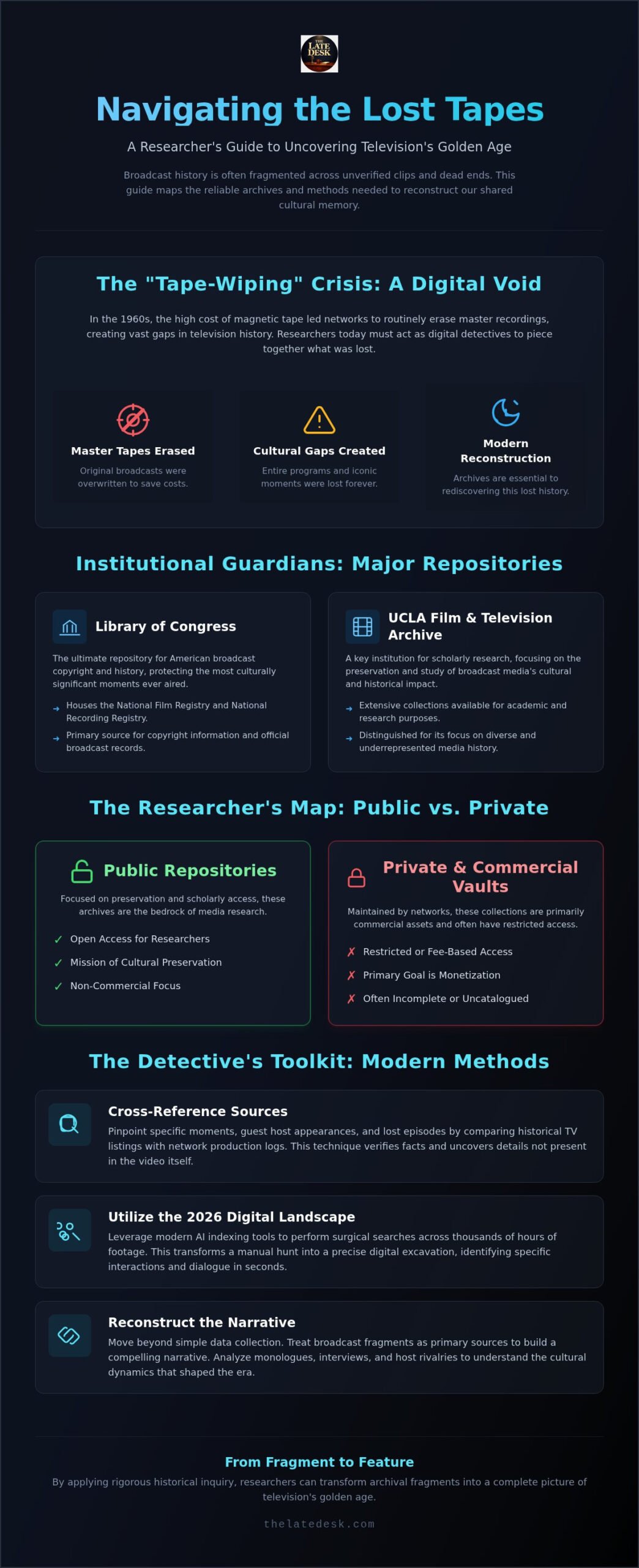
In the quiet corridors of network basements during the late 1960s, a silent catastrophe was unfolding. Technicians, pressured by the exorbitant cost of magnetic tape, routinely erased master recordings of legendary broadcasts to reuse the reels for the following day’s programming. This “tape-wiping” crisis nearly purged the cultural memory of an entire generation, leaving behind gaps in our history that no amount of nostalgia can fully bridge. Today, media history archives function as the primary custody of our collective cultural memory, acting as the final defense against total historical erasure. For the modern scholar, the challenge has shifted from a total lack of material to a struggle with the “digital sieve.” Online television archives for researchers have fundamentally transformed the field of media studies, turning what was once a desperate hunt for physical film cans into a sophisticated digital excavation.
The researcher’s role in this environment is more than simple data collection. It is an act of reconstruction. To study a mid-century broadcast is to attempt to capture the “live” experience of 20th-century television, a medium that was designed to be ephemeral. Digital accessibility has stripped away the barriers of geography, allowing a scholar in London to examine the grainy textures of a New York talk show from 1958. This shift over the last decade has moved the focus from surviving artifacts to the broader cultural narratives they represent.
The Cultural Weight of the Broadcast
Television has always functioned as a mirror to societal shifts, reflecting the anxieties and triumphs of the era in real time. Late-night monologues, for instance, provide a primary source for understanding the public consciousness of the mid-20th century. While network executives once dismissed these programs as “disposable” media, their preservation has become a modern historical priority. At The Late Desk, we advocate for a shift in perspective. We move from the surface-level enjoyment of fan nostalgia to the application of rigorous historical inquiry. By treating a 1974 monologue with the same academic weight as a legislative transcript, researchers can uncover the subtle power dynamics and host rivalries that shaped American culture.
Navigating the 2026 Digital Landscape
The transition from decaying film cans to high-definition digital repositories has accelerated, fundamentally changing how we interact with the past. In the current 2026 landscape, the role of AI in indexing and searching historical video footage allows scholars to pinpoint specific interactions across thousands of hours of tape with surgical precision. Even as independent researchers monitor the evolving access status of the Vanderbilt Television News Archive, the digital tools at their disposal have never been more robust. Media history archives television as the nexus of technology and cultural preservation. By utilizing online television archives for researchers, scholars can finally reconstruct the “live” experience of 20th-century television, capturing the atmosphere of a moment before it fades into the static of time.
Institutional Guardians: Navigating the Major Repositories of Broadcast History
Behind the imposing facade of the nation’s capital lies a collection that network executives once considered secondary to their quarterly earnings. While the commercial world focused on the next season, institutional guardians were quietly building the foundations of our collective memory. These repositories are the true gatekeepers of the past. For those utilizing online television archives for researchers, understanding the hierarchy of these institutions is the difference between finding a surface-level clip and uncovering a primary source. They offer a sanctuary for the “disposable” media that defined the 20th century, from the high-stakes drama of the nightly news to the loose, improvisational energy of a midnight talk show.
The Library of Congress and National Preservation
The Library of Congress stands as the ultimate repository for American broadcast copyright and history. Through the National Film Registry and National Recording Registry, it protects the most culturally significant moments ever aired. If you are tracing the history of late night television, these government-protected records offer a level of detail that commercial databases simply cannot match. Scholars can even access the “Paper Print Collection,” a fascinating archive of early television experiments that survived only because they were submitted as a series of still photographs for copyright protection. It’s a testament to the lengths researchers must go to reconstruct the early days of the medium.
The UCLA and Paley Center Models
Where the Library of Congress offers breadth, the UCLA Film & Television Archive provides academic depth. It is the second-largest repository of moving images in the United States, focusing heavily on the technical and creative evolution of the screen. In contrast, the Paley Center for Media bridges the gap between industry prestige and public access. While UCLA might hold the master reels, the Paley Center curates the “story” of the industry. For researchers searching guest host history or rare pilot episodes, these institutional catalogs are essential. They provide the context that fan-sites lack, offering a curated look at how the industry viewed itself in real time.
Since 1968, the Vanderbilt Television News Archive has remained the gold standard for researching news and cultural shifts. It captured the raw, unfiltered reality of the Vietnam War and the Watergate hearings when the networks themselves were still debating what to save. In the 2026 digital cloud, much of this material is accessible from a home office, yet the most sensitive production documents often still require a physical visit to the reading rooms. If you find the sheer volume of these catalogs overwhelming, our archival analysis at The Late Desk can help you navigate the nuances of these institutional vaults, turning raw data into a coherent historical narrative.
The Researcher’s Map: Comparing Public Media Archives and Private Collections
To map the terrain of broadcasting history, one must first recognize that not all vaults are built with the same intent. While the institutional giants discussed previously provide the structural backbone of media studies, the actual substance of a researcher’s work often depends on the divide between public service and private profit. Online television archives for researchers are rarely uniform. Some are curated to preserve the dignity of a national heritage, while others are guarded as high-value corporate assets. Navigating these disparate maps requires an understanding of the “why” behind the preservation, as the motive for saving a tape often dictates what a scholar is permitted to see.
Public media archives, such as the American Archive of Public Broadcasting (AAPB), offer a lens on American life that is fundamentally different from the polished output of New York or Burbank. These collections prioritize education, social issues, and local history, capturing the voices that the major networks frequently ignored. In contrast, the commercial vaults of NBC, CBS, and ABC function as the fortresses of the industry. They are the primary source for the high-gloss entertainment that defined the 20th century, yet they are often less accessible to the independent scholar. Access to these records is frequently filtered through the lens of late night tv power dynamics, where corporate legacies are protected as fiercely as the copyrights themselves.
Public vs. Commercial Content
The challenge for the modern scholar lies in finding the balance between “official” history and the “unofficial” record. Network archives are curated environments where the story of a show like the Tonight Show is often presented through its most successful moments. However, researching the internal friction or the guest host gaps requires looking beyond the network-approved highlight reel. Public archives provide the missing context, offering raw footage and unedited interviews that reveal the cultural climate surrounding these broadcasts. By utilizing online television archives for researchers across both sectors, you can begin to see the friction between the industry’s public face and its private reality.
The Internet Archive as a Research Tool
Standing outside the traditional institutional framework is the Internet Archive, often described as the “Wild West” of media history. Its Moving Image Archive has democratized access to rare, non-copyrighted, or “orphaned” media that would otherwise be lost to time. While it presents significant ethical and legal hurdles regarding fan-preserved content, it remains an indispensable resource for unearthing the ephemera of the golden age. The Internet Archive functions as a digital safety net for media that fell through institutional cracks. It allows researchers to find the “disposable” moments, like local commercials or test patterns, that provide the atmospheric texture of a specific era. Finally, the hunt often leads to private estate archives, where the personal papers of hosts like Johnny Carson offer a final, intimate layer of evidence that even the largest network vault cannot provide.
The Detective’s Toolkit: Methods for Unearthing Lost Late-Night Moments
For the media historian, the search for a specific broadcast often feels less like a library visit and more like a forensic investigation. The ephemeral nature of late-night television means that what was aired at 11:30 PM was frequently gone by sunrise, leaving scholars to piece together the past through a series of indirect clues. Utilizing online television archives for researchers requires a systematic approach to overcome the gaps left by the industry’s historical disregard for its own legacy. You aren’t just looking for a video file; you’re reconstructing a moment in time that was never intended to last beyond its initial broadcast.
- Step 1: Cross-reference TV Guide listings with digital archival holdings. Since these listings were printed weeks in advance, they represent the network’s intent. Discrepancies between the listing and the archive often point to a last-minute change or a lost segment.
- Step 2: Identify guest host gaps. In major series like the Tonight Show with Johnny Carson, a missing tape often coincides with a guest host appearance or a contract dispute, providing a roadmap for where the “missing” history actually lies.
- Step 3: Consult trade publications like Variety or Billboard. These archives provide the industry context, explaining the “why” behind a sudden cancellation or a controversial guest’s appearance.
- Step 4: Leverage digital finding aids. Modern repositories use complex metadata that allows you to search by guest, musical number, or even specific advertisers, moving far beyond simple keyword searches.
- Step 5: Verify “lost” episodes through network memos and production logs. If the footage doesn’t exist, a technical memo can often confirm the details of what was recorded and subsequently erased.
Searching the Carson Archives
Tracking the thirty year reign of Johnny Carson requires a specific methodology, particularly when dealing with the “lost” New York years from 1962 to 1972. During this era, NBC’s practice of recycling tapes was at its peak. To find these moments, researchers must look toward guest logs and personal collections of the guests themselves. Often, a guest’s estate will hold a private recording of their appearance that the network failed to preserve. The forensic challenge of recovering lost Johnny Carson episodes from this decade has transformed from a hobbyist’s dream into a high-stakes mission against chemical decay and magnetic tape degradation. Understanding the full succession of tonight show hosts and their respective archival footprints can help you identify which eras are most likely to yield surviving material. For a deeper understanding of why so many broadcasts from this period vanished entirely, our exploration of lost late night tv episodes reveals the calculated industrial policies behind the tape-wiping era. If you’re struggling to locate a specific broadcast, our detailed television history guides can help you decode these archival mysteries and find the story behind the static.
Scripts and Production Documents
A script is often more revealing than the final broadcast because it contains the jokes that were cut by censors and the stage directions that reveal the host’s true state of mind. Locating the personal papers of writers and showrunners is essential for understanding the internal friction of a production. Decoding the technical jargon of 1970s television production logs, such as “VTR” notations or “live-to-tape” edits, allows you to see exactly how a show was assembled. These documents provide the “insider” perspective that the camera lens often missed, turning a simple viewing into a rigorous historical inquiry.
From Fragment to Feature: How The Late Desk Reconstructs the Golden Age
A single line in a guest log or a thirty second clip on a social feed is rarely the whole truth. It’s merely a fragment of a much larger, more complex industrial drama. At The Late Desk, we believe that archival data shouldn’t sit dormant in a database; it should be used to build immersive narratives that capture the human friction of the broadcast booth. By utilizing online television archives for researchers, we move past the static of the past to find the emotional undercurrents that defined the era. We don’t just report that a broadcast happened. We investigate the tensions, the rivalries, and the cultural shifts that made that broadcast inevitable.
Consider our work on the infamous Joan Rivers ban. While a simple search of media history archives might show the date her own show premiered, it doesn’t capture the cold silence that descended on the NBC hallways or the internal memos that signaled Carson’s sense of betrayal. We reconstruct these moments by cross-referencing network records with personal accounts, turning a footnote in a television guide into a cinematic exploration of loyalty and power. This is the difference between a list of facts and a curated history. It requires an interpretive layer that turns raw data into a compelling story.
The Art of Historical Interpretation
Moving beyond the “what” to the “why” is the hallmark of a true historian. When we examine the legacy of an icon like Lucille Ball, we don’t look at a single interview. We build a narrative by layering scripts, production notes, and guest host logs to reveal the professional weight she carried as a pioneer. The Late Desk functions as a curator of this show business legacy. We ensure that the “disposable” media of the mid-century is treated with the reverence it deserves, contextualizing every fragment within the broader Golden Age narrative.
Joining the Conversation
Your own research journey begins with a single question. Whether you’re an aspiring media historian or a digital archivist, the tools we’ve discussed provide the foundation for your own discoveries. The future of The Late Desk involves even deeper explorations into the vaults, unearthing the stories that contemporary headlines missed. We invite you to join us in this preservation effort. By engaging with online television archives for researchers, you contribute to the ongoing survival of our collective memory. The archives are waiting, and the stories they hold are more relevant now than ever. Explore more stories from the Golden Age of Late Night at The Late Desk and help us turn the fragments of the past into the features of tomorrow.
Reclaiming the Narrative of the Golden Age
Reconstructing the history of broadcasting is an act of cultural restoration. By moving from the fragmented clips of social media to the robust holdings of institutional guardians, you’ve learned to bypass the “digital sieve” that once threatened to erase the mid-century record. Whether you’re cross-referencing TV Guide listings or decoding the technical jargon of a 1970s production log, the tools of the detective are now in your hands. Utilizing online television archives for researchers allows you to see past the polished corporate highlights and into the raw, human friction that defined the golden age.
We understand that raw data is merely the starting point. At The Late Desk, we specialize in the expert analysis of the industry power dynamics that shaped broadcasting, turning archival fragments into the definitive stories of our collective memory. We’re trusted by media historians and fans of classic television alike to bridge the gap between the vault and the viewer. The hunt for the “story behind the story” is a journey that never truly ends. Discover the stories hidden in the archives at The Late Desk and begin your own excavation of entertainment history. The static is clearing; it’s time to see what lies beneath.
Frequently Asked Questions
What are the best free online television archives for researchers?
The Internet Archive’s Moving Image Archive and the American Archive of Public Broadcasting stand as the premier free online television archives for researchers. While the former offers a sprawling, democratic collection of orphaned media and fan-preserved clips, the latter provides a curated look at the educational and social history of the United States. These platforms allow scholars to bypass commercial paywalls and explore the “disposable” media that defined the 20th century without the need for institutional credentials.
How do I find scripts for classic late-night TV shows?
Locating scripts requires a shift from digital video repositories to the special collections of academic libraries and guild archives. The Writers Guild Foundation Shavelson-Webb Library and the UCLA Library Special Collections hold extensive files of scripts, often containing the hand-written revisions of writers and producers. These documents are essential for understanding the internal friction and creative evolution of a broadcast before the cameras even started rolling, providing a layer of detail that the final tape often misses.
Are there specific archives for the Tonight Show with Johnny Carson?
The primary repository for the Carson era is the Carson Entertainment Group, which manages the commercial licensing of the 30-year library. However, for scholarly inquiry, the Library of Congress holds significant copyright deposits and recordings that provide a broader historical context. Researchers should also look toward the personal papers of Carson’s long-time associates, which are often housed in university archives. These records reveal the host rivalries and power dynamics that defined the show’s long reign.
Can I access network television archives (NBC, CBS, ABC) online?
Direct online access to the full commercial vaults of NBC, CBS, and ABC is generally restricted to industry professionals and licensing partners. Most scholars must navigate these collections through institutional intermediaries like the Paley Center for Media or the UCLA Film & Television Archive. These organizations provide searchable catalogs that allow you to identify specific broadcast dates and segments, even if the footage itself remains behind a corporate firewall for the general public.
What is the role of the Library of Congress in television preservation?
The Library of Congress acts as the ultimate guardian of American broadcasting history by serving as the nation’s primary copyright repository. Through the National Film Registry and the National Recording Registry, it identifies and preserves programs of enduring cultural significance. Its role is not merely storage; it is the active protection of early experiments and the “Paper Print Collection” that would have otherwise been lost to the tape-wiping crises of the mid-20th century.
How can I verify if a classic TV episode is officially “lost”?
Verifying the status of a “lost” episode involves cross-referencing commercial listings with network production logs and technical memos. If a program appears in a TV Guide listing but lacks a corresponding entry in the network’s master inventory, it was likely a victim of tape recycling. Specialized research communities and databases can also provide crowdsourced data on the survival status of specific broadcasts, helping you distinguish between a missing tape and one that is simply restricted.
Are there archives specifically for public media in the United States?
The American Archive of Public Broadcasting (AAPB) is the definitive resource for researching non-commercial television and radio. A collaboration between WGBH and the Library of Congress, it has digitized over 50,000 hours of public media dating back to the 1940s. These records provide an essential counter-narrative to the commercial output of the major networks. They focus on local history and social issues that were often ignored by the mainstream industry during the golden age.
What tools do researchers use to search historical television metadata?
Researchers utilize sophisticated digital finding aids and metadata search strategies provided by repositories like the Vanderbilt Television News Archive. These tools allow for surgical searches by guest name, musical performance, or specific news topics across decades of broadcasts. Utilizing online television archives for researchers often requires pairing these finding aids with digitized trade publications such as Variety to place specific broadcast dates within their original industry context and professional hierarchies.