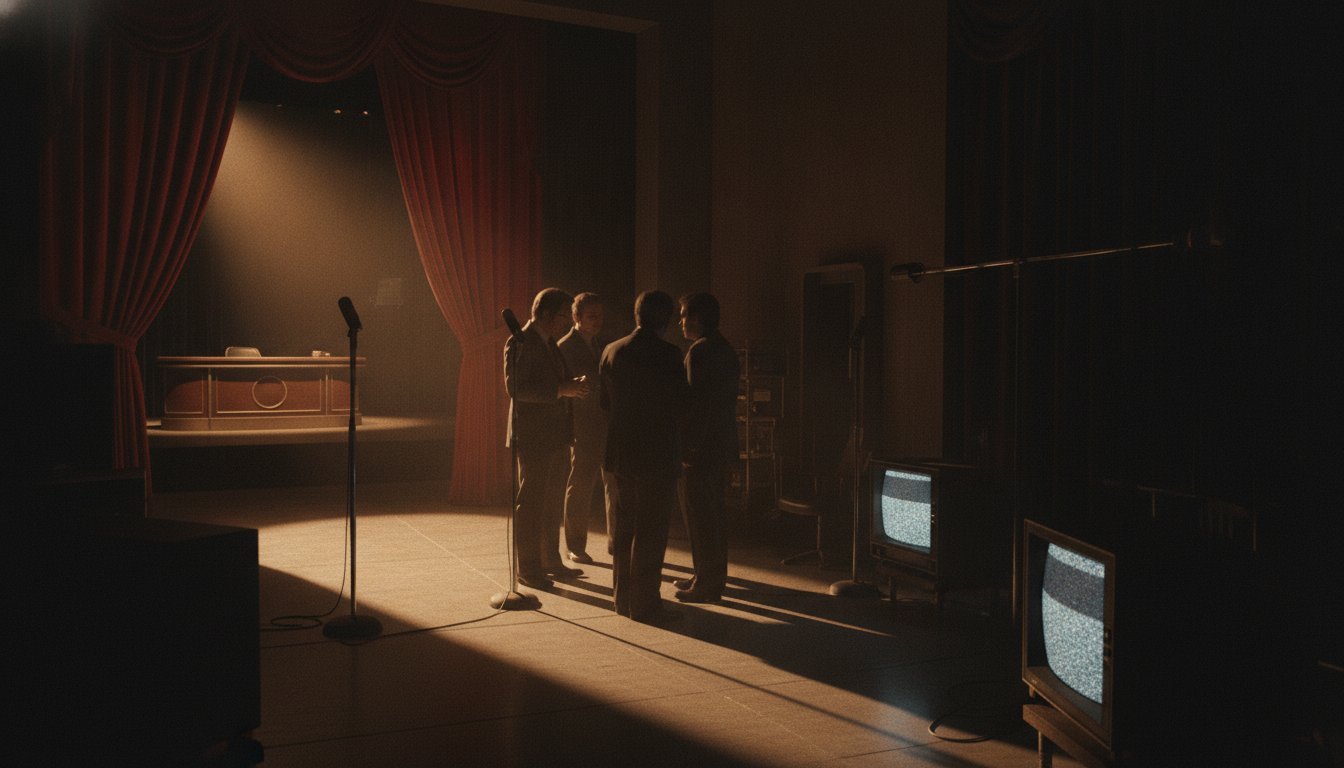
For thirty years, Johnny Carson didn’t just host the most powerful program in American television. He was American television, and the distance between his favor and his contempt could end a career overnight. The story most people know about Johnny Carson feuds begins and ends with Joan Rivers, whose 1986 departure to launch a rival late-night show on Fox famously earned her a permanent exile from 30 Rockefeller Plaza. But that narrative, compelling as it is, barely scratches the surface of how Carson actually operated.
You already sense there’s more to it. The headlines were always polished, the monologues always smooth, and the curtain between Burbank’s Studio One and the rest of the industry was drawn deliberately tight. What happened behind it was something far more calculated than personal grudges or wounded pride.
This piece goes beyond the familiar Rivers story to examine the full architecture of Carson’s legendary rivalries, including his lesser-known confrontations with figures like Wayne Newton, and the quiet blacklist mechanism that made a cold shoulder from Carson feel like a professional death sentence. What you’ll find is that these weren’t simply feuds. They were the operating system of a golden age.
Key Takeaways
- The Johnny Carson feuds were never merely personal grudges — they functioned as a deliberate power mechanism that could erase a performer’s access to national television overnight.
- Joan Rivers’ 1986 departure to Fox triggered a 26-year silence that reveals how Carson’s loyalty demands went far beyond professional courtesy into something closer to an unwritten oath.
- Carson’s conflicts extended well beyond Rivers, with figures like Wayne Newton and predecessor Jack Paar each colliding with the host in ways that exposed the hidden fault lines beneath late-night’s polished surface.
- Carson’s extreme introversion and the quiet influence of producer Fred de Cordova shaped a Tonight Show culture where the rules of engagement were enforced without ever being publicly spoken.
- The rivalries Carson cultivated didn’t end with his retirement — they became the inherited blueprint for the Late Night Wars of the 1990s, leaving Leno and Letterman to navigate a conflict they didn’t start.
The Silent Treatment: Understanding the Power of the Carson Banishment
To be exiled by Johnny Carson wasn’t simply to lose a booking. It was to be quietly erased from the most powerful distribution network in American entertainment. The Carson Banishment, as industry insiders understood it, wasn’t announced with a press release or delivered through a formal letter. It arrived as an absence: a phone call that stopped coming, a booking that never materialized, a name that somehow never appeared on the guest list again. In an era before cable fragmentation and digital platforms, that silence was deafening.
The Gatekeeper of the Golden Age
For three decades, NBC’s 11:30 PM time slot functioned less like a television program and more like a national audition stage with a single judge. The network’s monopoly over late-night was absolute in ways that are genuinely difficult to appreciate from a modern vantage point. Rival networks either didn’t compete seriously or failed quickly. That left Johnny Carson’s legendary Tonight Show career as the sole reliable gateway to the kind of national exposure that could transform a regional comedian into a household name overnight.
The industry developed its own shorthand for what happened when Carson approved of a performer. A “Carson OK” wasn’t a formal designation; it was the moment Carson leaned back in his chair, pointed at a guest, and told the audience, in effect, this one is worth your attention. That gesture, that pivot toward the desk, carried the weight of a network contract. Comics who received it saw their touring fees double. Those who didn’t received a subtler, more damaging signal.
The Mechanics of the Blacklist
What made the Johnny Carson feuds so structurally powerful was precisely how they were administered. There was no formal blacklist document, no meeting where names were struck from a ledger. Instead, the mechanism operated through the show’s booking infrastructure. Guest coordinators and talent scouts understood, through accumulated instinct and the occasional quiet word from producer Fred de Cordova, which names were simply not to be raised in conversation. The “no-fly” list existed in institutional memory rather than on paper.
The psychological toll on performers caught in this system was considerable. Being “un-booked” carried a particular cruelty: there was nothing to dispute, no decision to appeal, no conversation to be had. You couldn’t defend yourself against a silence. For deeper context on how this kind of network control shaped the entire business of late-night television, the Business of Laughter provides essential analysis of the structural forces at play.
What biography.com and similar sources have long characterized as Carson simply being “a private man” misses the point entirely. Privacy was the instrument, not the explanation. The detachment was deliberate, the warmth carefully rationed, and the gap between his affable on-screen persona and his off-screen coldness wasn’t a contradiction. It was the architecture of control.
The Ultimate Betrayal: The Joan Rivers Exile and the 26-Year Silence
Of all the Johnny Carson feuds that defined an era, none carried the emotional voltage of what unfolded in the spring of 1986. Joan Rivers, Carson’s most celebrated permanent guest host, accepted an offer to launch her own late-night program on the fledgling Fox network. She did not tell Carson first. That omission, more than the decision itself, is what sealed everything that followed.
The phone call Carson made after learning the news was brief. Rivers attempted an explanation, hoping to bridge the gap between her professional ambition and their personal history. Carson listened for a moment, then hung up. He never spoke to her again.
From Protege to Pariah
The relationship between Carson and Rivers had begun in 1965, when she appeared on the Tonight Show as a nervous, virtually unknown comedian. Carson leaned toward his desk and told the audience she was going to be a star, a moment that remains the gold standard for his ability to launch a career. Over the following two decades, she became the show’s most reliable and electrifying guest host, the only woman to regularly occupy Carson’s chair during his absences.
The industry’s unwritten code of loyalty in the 1980s network environment was absolute, and Carson enforced it with a rigor that bordered on the monarchical. There’s a dimension to his reaction that contemporary industry chronicles often underweight by simply focusing on the financial competition. The gender dynamics at play were impossible to ignore. Male performers who leveraged Tonight Show exposure into independent ventures rarely faced the same ferocity of consequence. Rivers was ambitious in a way that Carson’s world had no comfortable category for, and her ambition, directed outward rather than upward toward him, registered as something closer to treachery than competition.
The Silence That Lasted a Lifetime
Rivers never appeared on NBC’s late-night programming again during Carson’s tenure or in the years immediately following his 1992 retirement. The ban outlasted his career, outlasted his public life, and outlasted him entirely. Carson died in January 2005 without having acknowledged Rivers in any private memoir or public statement. The silence was total and, by any measure, deliberate.
It wasn’t until February 2014, nearly three decades after that final phone call, that Rivers returned to the Tonight Show, invited by Jimmy Fallon in the first weeks of his tenure. She was 80 years old. The moment was celebrated and bittersweet in equal measure, a reconciliation with a building rather than a man.
The Rivers ban remains the single most consequential personal rift in the history of late-night television, a rupture that reshaped careers and proved that the power Carson wielded could survive even his own absence from the chair. For readers who want to trace how that power transferred and mutated through the decades that followed, The Late Desk’s archive of late-night history maps the full inheritance.
Rivalries Beyond the Desk: Wayne Newton, Jack Paar, and the Quest for Dominance
The Joan Rivers exile was Carson’s most visible act of professional retribution, but it wasn’t his only one. Beneath the polished surface of Burbank’s Studio One, a more complex map of Johnny Carson feuds was being drawn, one that included a Las Vegas entertainer willing to confront him physically and a predecessor who never quite made peace with the throne he’d vacated. Together, these conflicts reveal something the Rivers narrative alone cannot: Carson’s need for dominance wasn’t reactive. It was constitutional.
Wayne Newton’s Physical Threat
The friction between Carson and Wayne Newton began the way most late-night tensions did: with a joke. Through the late 1970s and into the 1980s, Carson’s monologues periodically trafficked in insinuations about Newton’s sexuality and masculinity, the kind of softly coded humor that passed without legal consequence but landed with unmistakable intent. Newton, who had built an empire in Las Vegas on a carefully cultivated image of old-school masculine glamour, did not absorb the mockery quietly.
What followed was one of the few documented instances of a major celebrity physically confronting Carson on his own territory. Newton traveled to Burbank and, by multiple accounts, made clear in terms that required no interpretation that the jokes would stop. He wasn’t petitioning Carson’s producers or dispatching a lawyer’s letter. He was standing in the building, in person, making a direct and unambiguous case for his own dignity.
The jokes stopped. That outcome matters enormously in the context of how Carson’s world operated. The blacklist mechanism worked precisely because most performers lacked either the leverage or the temperament to challenge it. Newton had both. His Las Vegas residency made him financially independent of NBC’s approval in a way that a touring stand-up comedian simply wasn’t, and his willingness to escalate personally neutralized the detached, institutional quality that made Carson’s cold shoulder so effective against everyone else.
The Predecessor’s Resentment: Jack Paar
Carson’s relationship with Jack Paar, the Tonight Show’s host from 1957 to 1962, operated on an entirely different register. There was no physical confrontation, no single inciting incident. What existed instead was a long, low simmer of professional resentment that the television industry understood even when it wasn’t spoken aloud.
Paar had built the Tonight Show into a genuine cultural institution through emotional volatility and raw, confessional television that was genuinely unlike anything that had preceded it. His famous 1960 on-air walkout over a censored joke remains one of broadcasting’s most dramatic moments. When Carson succeeded him in 1962, he inherited the infrastructure Paar had constructed while systematically dismantling everything about the show’s emotional temperature. Carson’s cool, controlled persona was, in many ways, a direct and deliberate inversion of Paar’s combustibility. For a deeper understanding of how that transition reshaped the entire late-night form, the History of Late Night Television traces the full arc from radio roots through the golden age that Carson came to define.
Paar never fully reconciled himself to his successor’s dominance. The contrast in their styles wasn’t merely aesthetic; it was a statement about what late-night television should fundamentally be. Paar believed in the exposed nerve. Carson believed in the perfectly constructed mask. That the mask won, comprehensively and for thirty years, was a verdict Paar found difficult to accept gracefully.
Frank Sinatra, who maintained relationships with both men, occupied an interesting position in this dynamic. The Chairman of the Board understood power hierarchies instinctively, and he navigated the Carson-Paar rift with the practiced ease of someone who had survived far more dangerous industry politics. His continued presence on the Tonight Show during Carson’s tenure was, among other things, an implicit endorsement of the new order, a signal to the industry that the transition was permanent and that allegiance had migrated accordingly.
What connects Newton’s confrontation, Paar’s resentment, and the broader pattern of Johnny Carson feuds is a single, clarifying principle: Carson’s dominance required not just compliance but the absence of credible challenge. Newton was one of the very few who provided one and survived it intact. Paar provided another kind, quieter and longer-lasting, rooted not in a single confrontation but in the irreconcilable question of which man’s vision of late-night television history would ultimately endure.
Behind the Curtain: The Psychological Roots of Carson’s Conflicts
Every account of the Johnny Carson feuds eventually arrives at the same uncomfortable question: why did a man of such extraordinary social gifts choose, so consistently and so deliberately, to wound the people closest to him? The answer isn’t found in the feuds themselves. It’s found in the man who sat behind the desk, and in the production infrastructure that translated his private temperament into institutional policy.
The Introverted Icon
The central paradox of Johnny Carson’s personality was one that colleagues described with a kind of bewildered reverence for decades after his retirement. Here was the world’s most famous conversationalist, a man who could coax warmth from a nervous first-time guest or defuse a hostile audience with a single raised eyebrow, who genuinely could not make small talk at a dinner party. The ease was entirely performative. Remove the desk, the cameras, and the structured context of the interview, and what remained was a man who found sustained human connection genuinely exhausting.
His social anxiety was so acute that colleagues who had worked alongside him for years described the experience of encountering him in a hallway as unsettling. He didn’t know what to say. What many interpreted as arrogance or deliberate coldness was, in significant measure, the protective behavior of someone who found the unscripted world profoundly uncomfortable. The moment taping ended, Carson was gone. He didn’t linger on the studio floor, didn’t hold court in the green room, didn’t extend the warmth that had just illuminated 11 million living rooms. He left the building.
That flight wasn’t rudeness. It was survival. But for the performers left behind, it registered as dismissal, and over thirty years, it calcified into something that felt indistinguishable from contempt.
Fred de Cordova and the Production of Power
What Carson’s introversion required was a buffer, and in producer Fred de Cordova he found a remarkably effective one. De Cordova served as the Tonight Show’s institutional memory and its unspoken rule-keeper. He understood which guests were “Tonight Show material” not through any written criteria but through a finely calibrated reading of Carson’s moods, preferences, and silences. Talent coordinators didn’t need explicit instructions; a raised eyebrow from de Cordova during a pitch meeting communicated volumes.
The protocols governing guest behavior on set were equally unspoken and equally absolute. Guests who pushed too hard during commercial breaks, who attempted to extend a segment beyond its natural conclusion, or who made the mistake of treating Carson’s affability as an invitation to genuine friendship, learned quickly that the warmth had a hard boundary. The production team’s role was, in part, to insulate Carson from the friction of having to enforce those boundaries himself. The cold shoulder arrived through institutional channels rather than personal confrontation, which made it both more durable and more difficult to challenge.
Maintaining a thirty-year reign over late-night television required constant, low-level exclusion. The blacklist mechanism described earlier in this piece wasn’t an aberration; it was the natural byproduct of a man who found direct conflict intolerable but found unchallenged dominance essential. Exclusion was simply conflict management at a distance, administered by a production apparatus that had internalized its host’s psychology completely.
For readers drawn to the deeper architecture of how Carson’s personal temperament shaped an entire industry’s power structure, The Late Desk’s archive of late-night television history examines these dynamics across the full span of the golden age.
The Legacy of the Feud: How Carson Defined Late-Night Rivalry
Empires don’t simply end. They transfer. When Johnny Carson delivered his final monologue in May 1992, he didn’t just vacate a chair; he bequeathed an entire architecture of conflict to the people left behind. The feuds, the blacklist mechanisms, the carefully administered silences: none of it dissolved with his retirement. It mutated, and the late-night landscape of the 1990s was shaped as much by Carson’s inherited psychology as by any decision NBC made in a boardroom.
The Shadow of the King: Leno vs. Letterman
The fracture between Jay Leno and David Letterman didn’t originate in 1992. Its roots run directly through Carson’s own preferences. Carson had made no secret of his admiration for Letterman’s sensibility; the dry, subversive Late Night with David Letterman was, in temperament, far closer to Carson’s own controlled irony than Leno’s broad, crowd-pleasing warmth. When NBC bypassed Letterman and handed the Tonight Show to Leno, the industry understood immediately that the decision had been made against the grain of what Carson himself had signaled.
Letterman’s departure to CBS, and the bitter ratings war that followed, was the first major late-night conflict conducted entirely in public. That was the crucial difference. Carson’s Johnny Carson feuds had operated through institutional silence and the deliberate withdrawal of access. Leno and Letterman fought their battle in the open, through press releases, competing bookings, and the nightly scoreboard of Nielsen ratings. The monopoly era was finished. Without a single gatekeeper controlling national exposure, the weapons changed entirely.
The fragmentation of late-night power that followed, accelerating through cable, digital platforms, and the eventual proliferation of competing shows, made Carson’s centralized model of dominance structurally impossible to replicate. Nobody could be blacklisted from an industry that no longer had a single gate. That’s not a diminishment of what Carson built; it’s a measure of how completely his era was a product of its specific moment in broadcasting history.
Preserving the Narrative at The Late Desk
What makes the Carson era genuinely irreplaceable as a subject isn’t the glamour, though there was plenty of it. It’s the grit underneath: the institutional silences, the inherited loyalties, the feuds that reshaped careers without ever being formally acknowledged. These stories matter because they reveal how power actually operates inside industries that prefer to present themselves as pure meritocracies.
The Late Desk exists to hold that history with the care it deserves. If this piece has opened a door, there’s an entire archive waiting behind it. Join us as we continue to document the golden age of late night, one story at a time, because the full picture is always richer, and stranger, than the headlines ever suggested.
The Feuds That Forged an Era
The Johnny Carson feuds were never really about wounded pride or petty grudges. They were the operating mechanism of a monopoly, enforced through institutional silence, administered by a production apparatus that had absorbed its host’s psychology completely, and powerful enough to outlast the man himself.
Three things stand out across this full picture. First, the blacklist worked because the industry had no alternative gate. Second, Carson’s introversion wasn’t a flaw in the system; it was the system. Third, the conflicts he cultivated didn’t die with his retirement. They became the blueprint that Leno, Letterman, and every successor inherited whether they wanted to or not.
The headlines of the golden age were always polished. The story beneath them rarely was. That gap is exactly where the most revealing history lives, and it’s the history worth preserving.
If this piece has sharpened your curiosity about the forces that shaped late-night television, there’s far more waiting in the archive. Explore the full collection of expert historical analysis at The Late Desk and keep pulling on the threads. The full picture is always richer than the curtain call suggests.
Frequently Asked Questions About Johnny Carson Feuds
Why was Joan Rivers banned from the Tonight Show for so long?
Rivers was effectively banned because she accepted Fox’s offer to host her own late-night program in 1986 without telling Carson first. That omission, not the career move itself, was what Carson considered an unforgivable breach of loyalty. He made a single brief phone call after learning the news, then ended the relationship permanently. The ban outlasted his tenure, his retirement, and his life.
Rivers didn’t return to the Tonight Show until February 2014, when Jimmy Fallon invited her during his first weeks as host. She was 80 years old. The reconciliation was with a building and a franchise rather than with the man who had once launched her career from that same stage.
Did Johnny Carson ever reconcile with his rivals before he died?
By all available accounts, no. Carson died in January 2005 without publicly or privately acknowledging Joan Rivers, and there’s no documented evidence that he sought reconciliation with Wayne Newton or extended any meaningful olive branch to Jack Paar. His personality made sustained conflict resolution genuinely difficult; the same introversion that powered his blacklist mechanism also made him constitutionally resistant to the kind of direct conversation reconciliation requires.
What’s striking about the Johnny Carson feuds is precisely their permanence. These weren’t cooling disputes that softened with time. They calcified, and Carson appeared to prefer the clean finality of severance over the discomfort of repair.
Which other celebrities were on Johnny Carson’s ‘blacklist’?
The blacklist was never a formal document, which makes a definitive roster impossible to compile. What’s confirmed is that it operated through institutional memory rather than paperwork. Rivers is the most documented case. Beyond her, industry insiders have pointed to performers who made the mistake of publicly criticizing Carson or competing directly against NBC’s late-night dominance, though naming them specifically requires sourcing that remains largely anecdotal.
The mechanism’s power came precisely from its informality. Performers couldn’t dispute an absence, appeal a silence, or identify the exact moment they’d been removed from consideration. The list existed in the instincts of booking coordinators and the quiet guidance of producer Fred de Cordova, not in any archive a researcher could later access.
What did Wayne Newton do to Johnny Carson to start their feud?
The feud actually began with Carson, not Newton. Carson’s monologues through the late 1970s and early 1980s repeatedly trafficked in coded jokes about Newton’s masculinity and sexuality, the kind of humor that stopped short of outright accusation but landed with unmistakable intent. Newton, whose Las Vegas image depended heavily on a particular brand of masculine glamour, didn’t absorb the mockery quietly.
Newton traveled to Burbank and confronted Carson directly and in person, making clear the jokes would stop. They did. His financial independence from NBC’s approval, built on a Las Vegas residency that required no network endorsement, gave him leverage that touring comedians simply didn’t have. It remains one of the very few documented cases of a performer successfully challenging Carson’s authority on his own ground.
How did the feud between Jack Paar and Johnny Carson begin?
It wasn’t a single incident so much as a philosophical incompatibility that hardened into resentment over time. Paar had built the Tonight Show on emotional volatility and raw, confessional television. Carson succeeded him in 1962 and systematically replaced that combustibility with cool, controlled wit. His persona was, in many ways, a deliberate inversion of everything Paar had established.
Paar never fully accepted that Carson’s approach represented an improvement rather than a betrayal of what the show could be. The tension was less a feud in the conventional sense and more a long, unresolved argument about what late-night television was actually for. That Carson’s vision won, comprehensively and for thirty years, was a verdict Paar found genuinely difficult to accept.
Was there a real blacklist for guests on the Tonight Show?
Yes, in practice if not on paper. No formal document existed, but the effect was identical to one. Guest coordinators and talent scouts understood through accumulated instinct, and the occasional quiet signal from producer Fred de Cordova, which names simply weren’t to be raised during booking discussions. The “no-fly” list lived in institutional memory rather than any filing cabinet.
This informality was actually the mechanism’s greatest strength. A written blacklist could be leaked, disputed, or challenged legally. An unspoken one couldn’t. Performers caught in it had nothing to appeal and no decision to contest. Being un-booked left no fingerprints, which made it both more durable and more psychologically devastating than any formal ban could have been.
How did Fred de Cordova influence Johnny Carson’s feuds?
De Cordova served as the Tonight Show’s institutional memory and its unofficial rule-keeper. He translated Carson’s private temperament, his preferences, his silences, his cold shoulders, into production policy without Carson ever needing to articulate explicit instructions. A raised eyebrow from de Cordova during a pitch meeting communicated what a direct order never would.
His influence was most visible in how the blacklist operated. Carson’s deep introversion made direct confrontation genuinely uncomfortable for him, so de Cordova’s role was partly to insulate his host from the friction of enforcing his own standards personally. The cold shoulder arrived through institutional channels, which made it feel less like a personal decision and more like an impersonal verdict, and therefore far harder for any performer to dispute or reverse.