Picture the curtain at Studio 1, the sharp snap of a pencil, and the cool, detached professional who reigned over American living rooms for thirty years. While thousands of celebrities walked those few steps from the wings to the couch, only a select few managed to pierce Johnny Carson’s famous Midwestern reserve. You might assume that the most frequent visitors were naturally the Johnny Carson favorite guests, but the reality behind the scenes was far more nuanced and exclusive. It wasn’t just about who filled the seat; it was about who could hold the King’s gaze and keep him genuinely engaged once the applause faded.
You likely remember the roaring laughter of Don Rickles or the sharp wit of Joan Rivers, yet you’ve probably felt the frustration of reading vague lists that fail to explain why certain stars became staples of the show. We understand that identifying his true inner circle requires more than just counting appearances; it requires an insider’s look at the chemistry that defined the golden age of television. This guide promises to reveal the elite group of performers who earned Carson’s rarest praise and explain the unspoken “Carson Code” that governed his desk. You’ll discover the legendary comedians, the unexpected intellectuals, and the final guests who shared his most intimate professional moments.
Key Takeaways
- Learn the specific “Carson Standard” that required guests to balance sharp timing with a deep respect for the host’s professional boundaries.
- Discover why the Johnny Carson favorite guests were often those who could dismantle his cool exterior, such as the relentlessly irreverent Don Rickles.
- Gain insight into Carson’s private passions for science and the cosmos, which elevated Carl Sagan from a scientist to a cultural icon on the Tonight Show stage.
- Examine the evolution of the “combative” guest persona, pioneered by stars like Charles Grodin to create some of the show’s most memorable and ironic moments.
- Revisit the poignant final appearance of Bette Midler to understand why her performance was chosen to close the curtain on a thirty-year broadcasting legacy.
The Carson Standard: What Defined a ‘Favourite’ Guest?
Before the era of viral clips and social media metrics, there was a single, mahogany desk in Burbank that functioned as the absolute gatekeeper of American stardom. To appear on The Tonight Show Starring Johnny Carson was a milestone, but to be welcomed back repeatedly was an induction into a high-stakes fraternity. The “Carson Standard” was a demanding set of criteria that went beyond mere celebrity. It required a rare alchemy of intelligence, impeccable timing, and the specific ability to play off Johnny’s own rhythmic delivery. During the 1970s and 80s, this standard created a hierarchy in Hollywood that few other platforms could replicate.
While many performers appeared dozens of times, there was a sharp distinction between reliable bookings and true personal favorites. A reliable booking was an entertainer who filled a seat, kept the ratings steady, and provided professional, if predictable, banter. However, the Johnny Carson favorite guests were those for whom Johnny felt a deep, often unspoken professional respect. These were the individuals who could navigate his moods and meet him as equals in a conversation that felt both spontaneous and meticulously crafted. It wasn’t just about the laughter; it was about the mutual recognition of a shared craft.
The ‘OK’ Sign and the Power of the Desk
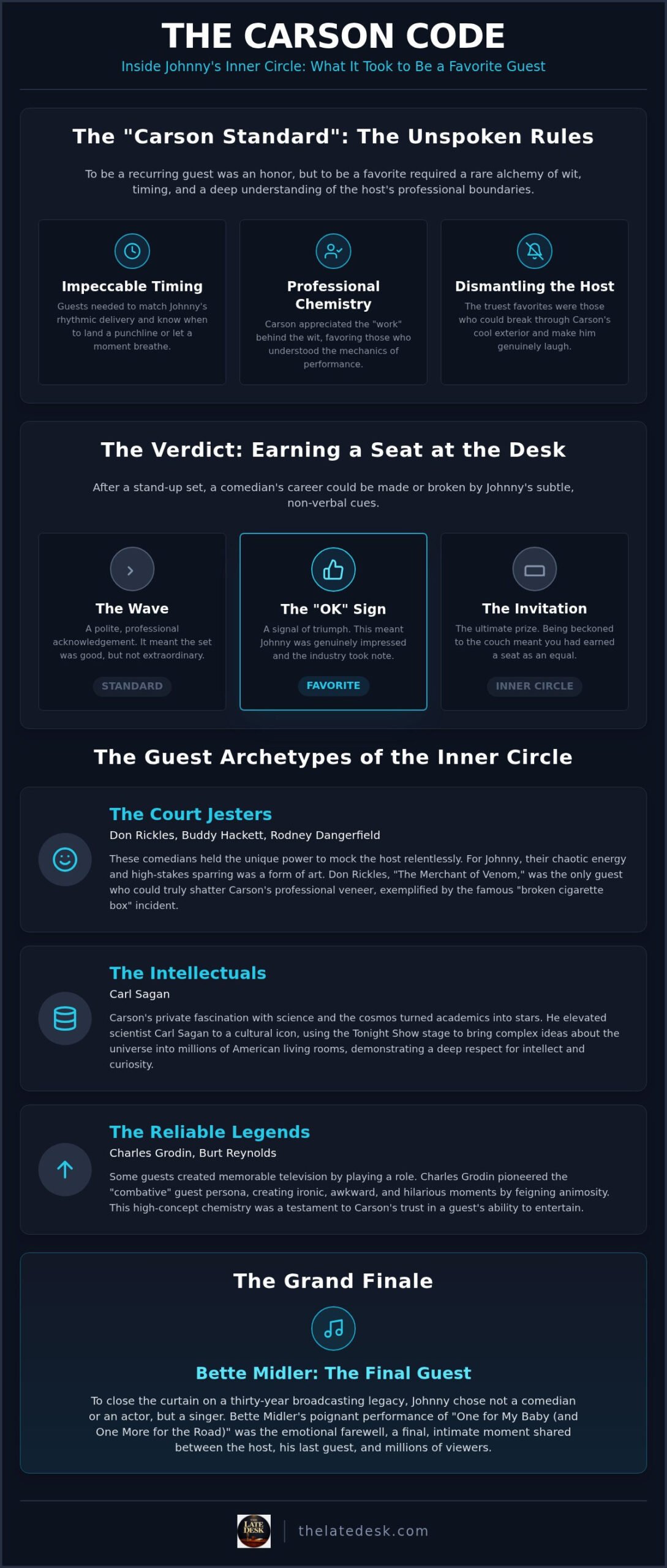
For a comedian standing on the famous “star” mark, the few minutes following a set were the most harrowing of their professional life. Carson communicated his verdict through a series of subtle, non-verbal cues that the industry studied like scripture. A simple wave was polite, but the “OK” sign, a circle formed by the thumb and forefinger, signaled a triumph. The ultimate prize, however, was the beckoning finger toward the couch. This gesture didn’t just mean the set was good; it meant the performer had earned a seat at the table. This ritual is a central theme in The Tonight Show with Johnny Carson: The 30-Year Reign of Late Night’s King, illustrating how the couch became the most valuable real estate in television.
The Professional Chemistry of the Golden Age
Johnny’s own history as a magician and radio personality gave him a technician’s eye for talent. He appreciated the “work” behind the wit. This background fostered an insider atmosphere where the host and guest operated on a higher frequency than the audience. He looked for guests who understood the mechanics of a joke but could also pivot when a bit went sideways. The “Carson Shorthand” is a sophisticated blend of professional timing and improvisational trust that allowed the host to fade into the background while the guest shone. It was this specific chemistry that cemented the status of the Johnny Carson favorite guests who defined the era.
The Kings of Comedy: Don Rickles, Buddy Hackett, and Rodney Dangerfield
While the “Carson Standard” demanded poise, Johnny had a profound weakness for those who could shatter his professional veneer with a single, well-timed insult. If the Tonight Show was a kingdom, these comedians were the court jesters who actually held more power than the knights. They didn’t just visit the set; they occupied it. For Johnny, the comedic sparring match was a form of high-stakes television art, a live wire act where the host’s laughter was the ultimate currency. This elite group formed the core of what many historians consider the Johnny Carson favorite guests, providing the show with its most combustible and memorable moments.
Don Rickles and the Art of the Insult
Don Rickles, the legendary “Merchant of Venom,” occupied a space in Johnny’s heart that was entirely his own. He was the only guest permitted to relentlessly mock the host without consequence. Their friendship was forged in the smoky clubs of Las Vegas and translated into a chaotic on-screen chemistry. Perhaps the most famous example of their bond was the 1976 “broken cigarette box” incident. After Rickles broke a wooden box on Johnny’s desk while guest-hosting, Carson famously marched across the hall to the “CPO Sharkey” set the next day, camera crew in tow, to confront him. This wasn’t just a bit. It was a glimpse into a genuine brotherhood that often saw them ranked among the Top 5 Johnny Carson Guests in terms of sheer impact. Rickles knew the unwritten rules: the more he attacked, the more Johnny felt respected as a peer.
Unpredictable Storytellers: Hackett and Dangerfield
If Rickles was the surgeon of the insult, Buddy Hackett was the master of the long-form, often ribald, anecdote. Johnny found Hackett “dangerous” for live television because he never knew quite where a story would end. Hackett’s unique rhythm and rubbery facial expressions forced Johnny to sit back and play the “straight man,” a role he relished when the payoff was guaranteed. Similarly, Rodney Dangerfield became a staple of the 1980s era. Johnny didn’t just book Rodney; he helped craft the “No Respect” persona into a national phenomenon. Carson, the former magician, admired the technical precision of Dangerfield’s one-liners.
The presence of these men transformed the studio into a private club where the rules of polite society were temporarily suspended. To understand the underlying mechanics of these appearances, one must look at The Business of Laughter: A Historical Analysis of Late Night TV Power Dynamics, which details how humor was used to negotiate status on the air. These were the Johnny Carson favorite guests because they made him work for his laughs, ensuring that the show never felt stagnant or safe. You can find more of these archival explorations in our deep dives into the Burbank era.
The Intellectuals: Carson’s Fascination with Science and Wit
While the public tuned in for the nightly monologue, Johnny’s private hours were often spent in the quiet solitude of a telescope. He was a dedicated amateur astronomer. This intellectual hunger shaped the guest list just as much as his love for a punchline. He sought out individuals who possessed sharp wit and specialized knowledge, creating a “high-low” balance that allowed the program to pivot from a slapstick sketch to a discussion on astrophysics within a single commercial break. This curiosity explains why many Johnny Carson favorite guests weren’t entertainers in the traditional sense, but thinkers and social commentators like the sharp-tongued Barbara Howar on The Tonight Show.
This intellectual vein also fostered a sophisticated, friendly rivalry with Dick Cavett. Cavett, a master of the talk-show format himself, represented a more cerebral approach to television that Johnny deeply respected. Their interactions were a chess match of vocabulary and cultural references. It was this willingness to engage with the “smartest room in the house” that separated Carson from his contemporaries. He didn’t just want to be amused; he wanted to be enlightened. He valued guests who could challenge his intellect while maintaining the show’s brisk, entertaining pace.
Carl Sagan and the Cosmic Connection
With 26 appearances over two decades, Carl Sagan became the show’s resident guide to the cosmos. Johnny was visibly star-struck by the professor, often leaning in with a genuine wonder that transcended his usual professional detachment. Their chemistry turned complex theories of planetary science into accessible, late-night lore. Sagan’s presence validated the Tonight Show as a place for serious thought, proving that a mass audience could be captivated by the “billions and billions” of the universe if the teacher was right. For many viewers, these interviews were their first introduction to the wonders of the natural world, presented through the lens of Carson’s own fascination.
Animal Encounters: Joan Embery and Jim Fowler
The intellectual curiosity extended into the natural world through perennial favorites like Joan Embery of the San Diego Zoo and Jim Fowler. While these segments often resulted in chaotic comedy, they remained a staple because of Carson’s masterful “straight man” reactions to unpredictable wild animals. Whether a marmoset was perched on his head or a cheetah was prowling his desk, Johnny’s ability to maintain his dignity while playing the foil became a comedic masterclass. These segments left a permanent legacy, establishing the animal encounter as a mandatory rite of passage for every late-night host who followed in his footsteps. These creatures, and the experts who brought them, were firmly among the Johnny Carson favorite guests because they provided the one thing he couldn’t script: total, unadulterated spontaneity.
The Reliable Legends: Burt Reynolds and Charles Grodin
In the high-stakes environment of live broadcasting, consistency was the rarest commodity of all. While some stars required meticulous preparation and pre-interviews, a small group of “Reliables” could walk onto the set with zero rehearsal and command the room for an entire hour if necessary. These performers were more than just entertainers; they were essential pillars of the show’s longevity. They bridged the gap between the variety-show roots of the 1960s and the cynical, ironic landscape of the 1990s, helping Johnny maintain his status as the undisputed King of Late Night through shifting cultural decades. This group represented the Johnny Carson favorite guests who functioned as a professional safety net, ensuring the show never suffered from a lack of energy or wit.
Charles Grodin’s Mock Feuds
Charles Grodin didn’t just appear on the show; he interrogated the very concept of the talk-show interview. He pioneered a “combative” persona that felt dangerously real to the uninitiated, often feigning offense at Johnny’s questions or acting as though he had been forced to appear against his will. This performance of hostility was a calculated risk that relied entirely on Carson’s ability to play the bewildered host. It was a “meta” experience that was decades ahead of its time, turning a standard promotional segment into a piece of avant-garde theater. To explore how this style evolved from earlier media, see The Cinematic History of Late Night Television: From Radio Roots to the Golden Age.
Burt Reynolds: The Ultimate A-Lister
Burt Reynolds represented the other side of the “Reliable” coin: the ultimate A-list movie star who remained “one of the guys” in the Burbank locker room. His relationship with Johnny was built on a foundation of genuine friendship and a shared love for physical comedy. The legendary 1972 incident where Reynolds doused Johnny with shaving cream remains a quintessential moment in television history. It wasn’t just a prank; it was a demonstration of the trust required for a guest to treat the host like a college roommate. Reynolds possessed a specific Midwestern charisma that mirrored Carson’s own, making their segments feel like an intimate conversation between peers. Having heavyweight stars who were also genuine friends allowed the show to feel grounded, even as the guests became more famous. If you want to understand the deeper mechanics of these legendary pairings, you can browse our full television archive for more insider perspectives.
The Grand Finale: Bette Midler and the End of an Era
As the lights began to dim on thirty years of broadcasting history, the selection of the final guests became a matter of intense cultural scrutiny. The penultimate broadcast on May 21, 1992, wasn’t just another booking; it was a curated farewell to the “Golden Age” itself. While the final night was reserved for Johnny alone to speak directly to his audience, this evening served as the true emotional climax of the series. By choosing Robin Williams and Bette Midler, the production staff highlighted the two pillars of the show: manic, improvisational energy and sophisticated, theatrical heart. These performers represented the peak of what the host valued in his collaborators.
Midler had long been considered one of the Johnny Carson favorite guests, but her performance that night elevated her to a unique status in the show’s hierarchy. She understood the professional timing required by the desk, yet she added a layer of vulnerability that Johnny rarely permitted on his set. As she sat close to the mahogany, the usual professional distance between the interviewer and the subject vanished, replaced by a palpable, shared history. It was a moment where the “King of Late Night” finally let the mask slip, showing a rare glimpse of the man behind the persona.
Bette Midler’s Penultimate Farewell
The atmosphere in the Burbank studio during that final week was heavy with the weight of an impending finale. Robin Williams provided the necessary levity, but it was Midler who provided the soul. When she began her rendition of “One for My Baby (and One More for the Road),” she wasn’t just singing a standard; she was serenading a man who had become a nightly fixture in American homes for three decades. The moment Midler sang to Carson as he sat behind his desk for one of the last times remains the definitive end of the “Golden Age,” a poignant closing of a chapter in American culture that will never be replicated.
Preserving the Legacy at The Late Desk
The elite circle of Johnny Carson favorite guests did more than just provide entertainment; they established the very DNA of the late-night format. From the scientific curiosity of Carl Sagan to the mock-hostility of Charles Grodin, these interactions created a blueprint that every successor has attempted to follow. These guests were the architects of a format that balanced high-brow intellect with low-brow laughs. To truly understand these dynamics, we invite you to explore the Online TV Archives for Researchers to find the historical context behind these legendary episodes. Follow The Late Desk for more deep dives into the archives of classic TV and the stories that defined the screen.
Preserving the Legacy of the King’s Inner Circle
The mahogany desk may be gone, but the blueprint left by the Johnny Carson favorite guests continues to shape how we understand celebrity and conversation today. We’ve explored how the “Carson Standard” prioritized timing and trust, allowing legends like Don Rickles and Bette Midler to transcend the typical interview format. Whether it was the intellectual depth of Carl Sagan or the mock-hostility of Charles Grodin, these performers didn’t just fill time. They created cultural touchstones that balanced the weight of the world with the lightness of late-night laughter.
Preserving this history requires more than just nostalgia; it demands a rigorous look at the archives. At The Late Desk, we provide expert analysis of over 4,000 Tonight Show episodes, dedicated to preserving the “Golden Age” of broadcasting for a new generation of researchers and fans. Step into the archives: Explore the complete history of Late Night at The Late Desk. Revisit the moments that defined a century and discover the story behind the curtain.
Frequently Asked Questions
Who was Johnny Carson’s all-time favourite guest?
While he never publicly crowned a single individual, Don Rickles is widely considered to be at the top of the list of Johnny Carson favorite guests due to their deep off-screen friendship. Their chemistry was built on a foundation of mutual respect that allowed Rickles to bypass the usual decorum of the show. This relationship was unique because it was one of the few times Johnny allowed his professional guard to drop completely for the cameras.
How many times did Don Rickles appear on The Tonight Show?
Don Rickles made more than 100 appearances over the course of Johnny’s thirty-year tenure. This frequency made him a staple of the Burbank era and a reliable source of high ratings for the network. Each visit was treated as a major television event, often involving unscripted moments that became part of the show’s permanent lore and solidified his status as a late-night icon.
Why did Johnny Carson like Charles Grodin so much?
Johnny was captivated by Charles Grodin because the actor challenged the very nature of the celebrity interview through a sophisticated, “meta” lens. Grodin developed a faux-hostile persona that played perfectly against Carson’s bewildered straight-man reactions. This subversion of the talk-show format was a refreshing change of pace for a host who had seen every traditional promotional routine thousands of times before.
Who was the last guest ever on Johnny Carson’s Tonight Show?
Bette Midler and Robin Williams were the final guests to appear on the penultimate episode on May 21, 1992. The actual final broadcast the following night featured no guests at all, as Johnny chose to spend the hour alone sharing memories with his audience. This final solo performance underscored the intimate bond he had built with American viewers over three decades of broadcasting.
Did Johnny Carson actually like the animals on the show?
Johnny had a genuine appreciation for the natural world, but he valued the unpredictable comedy of the segments even more. While experts like Joan Embery brought educational value, the segments remained Johnny Carson favorite guests moments because of the host’s masterful reactions. He knew that a marmoset climbing on his head or a panther prowling his desk was television gold that no writer could script.
What was the ‘Carson Couch’ and why was it important for guests?
The “Carson Couch” was the ultimate symbol of professional validation for any entertainer in the 1970s and 80s. Being invited to sit down after a performance meant that Johnny had personally approved of your work and timing. For a young comedian, those few steps from the star on the floor to the cushion next to the desk could launch a career and signal to the industry that a new star had arrived.
Which comedians got their start because of Johnny Carson?
Dozens of legendary careers began with a single appearance on the show, including those of Jerry Seinfeld, Jay Leno, and Roseanne Barr. Johnny acted as the industry’s most powerful talent scout, and a simple “OK” sign from his desk was often enough to secure a performer’s future. His endorsement was the most valuable currency in show business, providing a platform that no other program could match.
Are there archives where I can watch Johnny Carson’s favourite guest segments?
You can find curated analysis and historical deep dives into these legendary segments through our ongoing series of articles at The Late Desk. While full episodes are preserved in official television archives, we offer the “insider” perspective needed to understand the nuances of these interactions. We focus on the professional hierarchies and power dynamics that made these specific guest spots so significant in the history of the medium.