A young comedian stands behind the heavy curtain at Burbank’s Studio One, heart hammering against their ribs as the NBC orchestra strikes up the theme. For three decades, these six minutes were the most high-stakes audition in the world. You probably remember the iconic laughter and the colorful guests, but it is easy to forget that a single nod from the host could instantly alter a performer’s life. In an era before viral clips and fragmented audiences, the Johnny Carson kingmaker effect was the only currency that mattered in Hollywood.
It is a phenomenon that feels nearly impossible to replicate in our modern, decentralized media world. You will discover the specific mechanics behind the “OK” sign and the coveted “Couch” invitation, rituals that served as the ultimate industry validation. We are looking at six specific legends who walked onto that stage as nobodies and left as global icons. From the career-making sets to the darker reality of Carson’s absolute gatekeeping, this is an exploration of the single night that changed everything for the giants of comedy.
Key Takeaways
- Decode the specific physical gestures, such as the “OK” sign and the couch invitation, that served as the industry’s most valuable endorsement.
- Understand the unique media conditions that allowed the Johnny Carson kingmaker effect to command a nightly audience of 15 million viewers.
- Trace the specific moments that launched icons like Jerry Seinfeld and Roseanne Barr from obscurity to household names in six minutes.
- Examine the darker side of this influence, including the career-ending bans and the high price of crossing the industry’s most powerful host.
- Discover why the 1992 retirement of Carson marked the permanent end of the singular late-night arbiter and the rise of a fragmented comedy landscape.
The Throne at Studio 6B: Why Carson Became Late Night’s Ultimate Arbiter
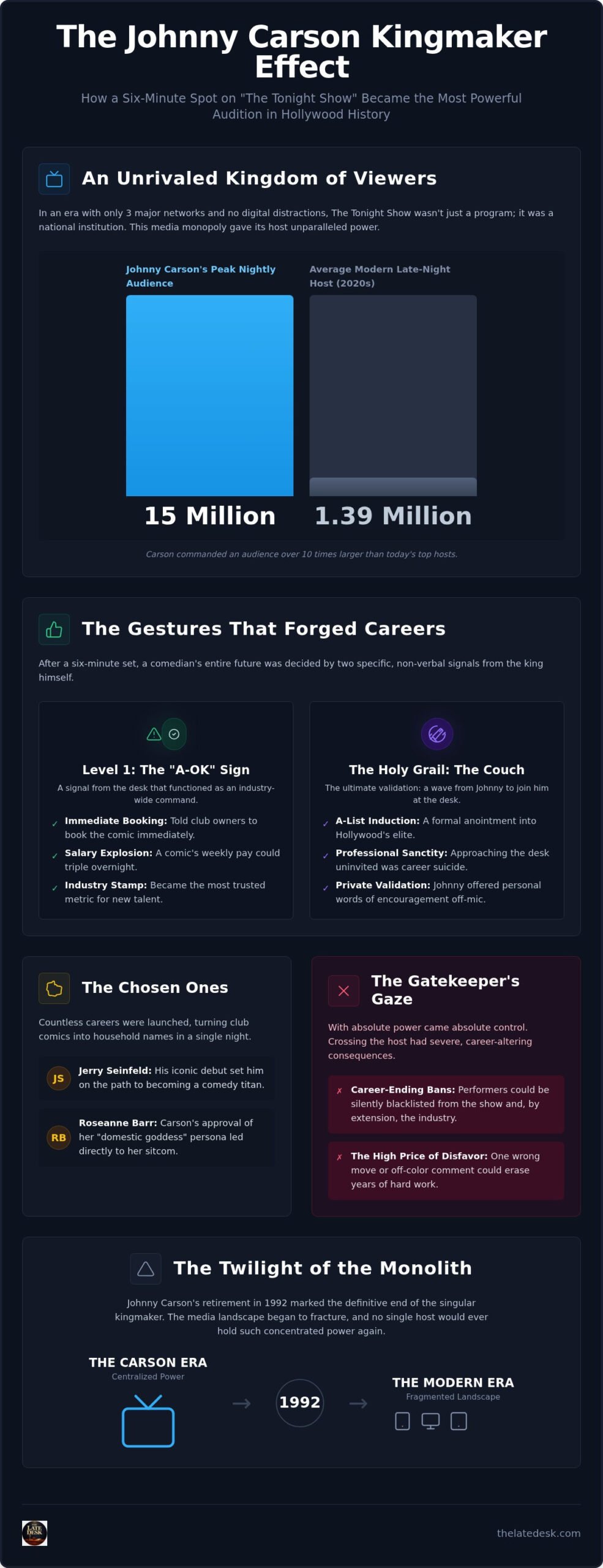
To understand the weight of the crown, one must first understand the size of the kingdom. In the 1970s, the American media landscape was a monolith composed of just three major networks and a complete absence of digital distraction. There were no viral clips to chase and no social media algorithms to manipulate. Instead, there was 11:30 PM on NBC. During his peak, Johnny Carson commanded a nightly audience of over 15 million viewers. This is a staggering figure when compared to the 1.39 million viewers averaged by modern hosts like Jimmy Fallon in 2026. This wasn’t just a television program; it was a national town square. For a comedian, an appearance on the Tonight Show was the only legitimate path to a sustainable career. The title of Johnny Carson kingmaker was not a hyperbolic nickname. It was a cold, professional reality in an industry that had only one door.
The Cultural Monopoly of NBC
Because NBC held an absolute grip on the late-night slot, Carson functioned as the supreme arbiter of American taste. He was the ultimate gatekeeper in a pre-cable world, possessing the power to decide which voices were heard and which remained in the shadows of the club circuit. Johnny Carson’s cultural impact was so absolute that industry insiders often spoke of the “Carson Effect.” We define the Carson Effect as the immediate 24-hour transformation of a guest’s career, where a single six-minute set could lead to sold-out theater tours and multi-picture development deals by the following afternoon. Without the internet to decentralize fame, Carson was the only sun in the comedy solar system.
The Silent Approval of Ed McMahon
While Johnny held the scepter, Ed McMahon served as the essential barometer for the room. Ed was the “first audience,” and his hearty, recognizable laughter provided a crucial layer of validation for the millions watching at home. The chemistry between the two men signaled to the public exactly when a new star was being born. When Ed leaned in and shared a genuine moment of amusement with a guest, it signaled that Carson was truly engaged. This subtle interplay often dictated the energy of the entire interview. It proved that the sidekick’s laughter was the final seal of approval on the king’s judgment, making the set feel like a warm invitation into an exclusive club.
The Ritual of the Couch: Understanding the Mechanics of the Kingmaker Gesture
For a stand-up comedian in the 1970s and 80s, the six minutes spent on the Tonight Show stage were the most concentrated period of professional pressure imaginable. Every syllable was calibrated to elicit a response from a host who had seen it all. As the final punchline landed, a heavy, electric silence often filled the studio. This was the “walk-over,” those agonizing seconds where the performer bowed to the audience while stealing a desperate glance toward the desk. They weren’t looking for applause from the crowd. They were looking for a sign from the Johnny Carson kingmaker, whose desk remained the most important six feet of real estate in the industry.
The ‘OK’ Sign from the Desk
A polite nod from the host was common, a standard courtesy extended to anyone who didn’t actively bomb. But the “A-OK” signal, where Johnny formed a circle with his thumb and forefinger, was a seismic event. This gesture functioned as a high-frequency signal to talent scouts and club owners across the nation. It told them to book this person immediately before their price tripled. A single Carson-approved set could instantly elevate a comedian’s club salary from a few hundred dollars a week to thousands by the following Monday. By paving the way for countless others, Johnny’s subtle hand movements became the most trusted metric for comedic talent in the history of broadcasting.
The Holy Grail: Sitting Next to Johnny
The ultimate validation was the invitation to the couch. It was an unspoken but ironclad rule of the show that you never approached the desk unless Johnny specifically waved you over. To do so uninvited was considered a professional death sentence. When that wave finally happened, it served as a formal induction into the Hollywood A-list. During the subsequent commercial break, the real magic occurred in the shadows. Off-mic and away from the cameras, Johnny would often offer intimate, brief words of encouragement. These private validations carried more weight for the comedian than the public praise. It was a moment of grace that signaled they had survived the gatekeeper and were now part of the inner circle. For those interested in the deeper mechanics of these legendary nights, our historical archive offers a rare look into the production notes that shaped these interactions.
The psychological tension of this ritual cannot be overstated. It was a binary outcome: either you were welcomed into the fold or you were politely ushered back behind the curtain. There was no middle ground in Johnny’s world. This ritualized validation ensured that the Johnny Carson kingmaker status remained unchallenged, as the entire industry waited for his silent verdict every night at midnight.
The Chosen Ones: Legendary Careers Forged in the Tonight Show Spotlight
The “Carson Bump” was never a mere industry myth; it was a measurable, economic force that dictated the survival of comedy clubs across America. When a performer received the host’s blessing, the financial repercussions were immediate and profound. Booking agents, who previously ignored desperate calls from unknown managers, would find their phone lines jammed with offers the morning after a broadcast. For the six legends who navigated this gauntlet, that single night served as the dividing line between obscurity and immortality. This was the Johnny Carson kingmaker effect in its most potent form, a singular moment where the gatekeeper decided who would become a household name.
The Jerry Seinfeld Debut
In May 1981, a young comedian from Brooklyn arrived with a meticulously crafted set about the mundane frustrations of daily life. The observational style was a perfect match for Carson’s own sensibilities. As the set concluded, the host didn’t just offer a polite nod; he delivered the “OK” sign and the wave to the couch. This validation is a cornerstone moment in the history of late night television. Beyond the immediate fame, Carson’s approval gave Seinfeld something far more valuable: leverage. This early endorsement provided the professional capital Seinfeld needed to eventually demand total creative control over his future projects, a rarity in the network television landscape of the time.
Roseanne Barr and the Blue-Collar Shift
While many guests leaned into polished, high-energy personas, Roseanne Barr’s 1985 debut introduced a radical new archetype. Her “domestic goddess” character was a gritty, relatable subversion of the traditional sitcom housewife. Carson was visibly delighted by her sharp, weary delivery, and his public anointment of her act signaled a major shift in the industry. By welcoming her to the couch, the Johnny Carson kingmaker mechanism effectively introduced a new brand of blue-collar humor to middle America. It transformed her from a struggling club comic into a cultural icon overnight, paving the way for her eventual dominance of the prime-time ratings.
The hierarchy of the show also included an elite tier of performers who moved beyond the role of guest. Jay Leno and David Letterman were nurtured as “permanent guest hosts,” a status that functioned as the ultimate induction into the industry’s inner circle. This role was the final stage of grooming for the heirs apparent. It allowed them to build a direct relationship with the audience while operating under the king’s protection. The transition from a six-minute stand-up set to sitting in the host’s chair was the clearest evidence of Carson’s power to shape the future of the medium. Whether it was the sudden surge in ticket sales for a newcomer or the long-term grooming of a successor, the influence radiating from Studio 6B remained the industry’s only true north.
The Gatekeeper’s Gaze: The Silent Bans and High Stakes of Crossing Carson
While the “OK” sign from the desk was a ticket to the A-list, the true measure of the Johnny Carson kingmaker influence was found in the silence that followed a falling out. The power to create a star is inseparable from the power to erase one. For decades, the comedy industry operated under a shadow of quiet apprehension. Performers knew that the same man who could double their booking fee with a single gesture could also ensure they never worked on a national stage again. This wasn’t a matter of formal contracts or public firings. It was a subtle, efficient system of omission that turned yesterday’s favorites into today’s ghosts.
The Joan Rivers Tonight Show Ban
The most enduring legend of the Carson era is the 1986 exile of Joan Rivers. For years, Rivers was the heir apparent, the permanent guest host who held the fort during Johnny’s frequent vacations. However, when she accepted an offer to headline her own program on the fledgling FOX network without personally notifying her mentor, the response was absolute. Carson didn’t just feel slighted; he felt betrayed. He never spoke to her again, and she was effectively blacklisted from the Tonight Show for the rest of his tenure. This wasn’t just a personal spat. It was a public demonstration of the stakes involved in the late-night hierarchy. For a deeper look into how this fallout changed the industry, see our Joan Rivers Tonight Show ban analysis.
The Gary Shandling Rivalry
The transition from a protégé to a competitor was always a delicate dance, and Gary Shandling’s trajectory proved just how quickly the kingmaker’s favor could cool. As Shandling moved from guest hosting to developing his own projects, the relationship shifted from mentorship to a cold, professional distance. The emotional toll of losing that internal validation was significant. It forced performers to choose between the safety of the king’s umbrella and the risky independence of their own platforms. This tension eventually fueled the network wars of the 1990s, but the seeds were sown in the quiet power plays at Studio 6B. To explore more about these hidden industry shifts, visit our collection of historical TV insights.
The “Silent Ban” was the most feared weapon in the host’s arsenal. Comedians would simply stop being booked without explanation. There weren’t any memos or phone calls. A manager would call the booking office, and the answer would simply be a polite, firm “no.” This gatekeeping kept the industry in check, ensuring that every performer who stepped onto that stage knew exactly who held the reins. High standards were non-negotiable, and Carson’s famous temper, though rarely seen by the public, was a well-known factor behind the scenes. It ensured that the Johnny Carson kingmaker status remained a position of both ultimate reward and ultimate risk.
The Twilight of the Monolith: Why the Kingmaker Era Ended with Johnny’s Retirement
May 22, 1992, was more than a television finale. It was the moment the comedy industry lost its central sun. When Johnny Carson stepped away from the desk, the singular, gravity-defying power of the Johnny Carson kingmaker era effectively dissolved. The landscape that followed was defined by a brutal, public battle for the throne between Jay Leno and David Letterman. While both men were formidable, the conflict itself split the national audience. For the first time in thirty years, there wasn’t one definitive place to go to be “made.” The crown was no longer a single object, but a fractured prize shared between competing networks.
The Fragmentation of the 90s
The proliferation of cable channels like HBO and Comedy Central in the 1990s signaled the permanent end of the three-network monopoly. No single host could command the 15 million nightly viewers that Carson once drew. In the fragmented world of 2026, where ABC’s Jimmy Kimmel Live! leads the pack with just 2.73 million total viewers, the idea of a central gatekeeper feels like a relic of a lost civilization. The shift moved from a curated induction on the Tonight Show to the pursuit of viral clips on social media. You can read more about this transition in our The Tonight Show with Johnny Carson legacy pillar. Fame is now decentralized. It’s driven by algorithms rather than a nod from a desk.
Preserving the Carson Archives
Because that era was so unique, the preservation of the Carson archives has become essential for modern comedians and cultural scholars. These tapes are more than just entertainment. They’re a blueprint of how the Johnny Carson kingmaker influence was once concentrated and wielded. The Late Desk serves as a digital gatekeeper for this historical era, interpreting the “story behind the story” that contemporary headlines missed. We don’t just report the facts. We act as curators of a collective memory that continues to influence every late-night desk today. Carson’s shadow remains long. It reminds us of a time when a single night could change the world for a lucky few.
The Lasting Echo of the Kingmaker’s Desk
The era of a single host dictating the national comedic conscience has passed, yet the influence of Studio 6B continues to resonate through every monologue and guest segment today. We’ve seen how a simple gesture could launch the career of a Jerry Seinfeld or solidify the archetype of a Roseanne Barr, provided they successfully navigated the gatekeeper’s high standards. The Johnny Carson kingmaker phenomenon was a product of a specific, centralized media moment that we’re unlikely to witness again. It was a time when the stakes were absolute and the rewards were immortal.
Understanding these power dynamics requires more than just nostalgia. It demands a commitment to historical accuracy and a deep-dive analysis into the mechanics of the industry. At The Late Desk, we are dedicated to preserving classic television history by uncovering the “story behind the story” that shaped the golden age. If you’re ready to peel back the curtain on the legends who defined the medium, explore more hidden stories from the Golden Age of Late Night at The Late Desk. The archives are waiting to be rediscovered.
Frequently Asked Questions
What does ‘kingmaker’ mean in the context of Johnny Carson?
The term describes Carson’s unique ability to transform an unknown comedian into a national star in a single evening. Because he controlled the only significant late-night stage in a three-network world, his approval functioned as the industry’s most valuable currency. This Johnny Carson kingmaker status meant that a guest didn’t just get exposure; they received a career-defining endorsement that opened every door in Hollywood.
What was the ‘OK’ sign Johnny Carson gave comedians?
The “OK” sign was a specific hand gesture where Carson formed a circle with his thumb and forefinger from behind the desk. It served as a silent, high-level signal of excellence to both the performer and the industry at large. While most guests received a polite nod, the “OK” sign was a rare distinction that signaled to talent bookers nationwide that this comedian was ready for the A-list.
Which comedians did Johnny Carson actually discover?
Carson provided the first major national platform for a generation of comedy icons, including Jerry Seinfeld, Roseanne Barr, and Jay Leno. He also championed the early careers of Steve Martin, Garry Shandling, and Ellen DeGeneres. While many of these performers had worked in clubs for years, it was their appearance on the Tonight Show that transitioned them from local acts into household names.
Why did Johnny Carson ban Joan Rivers from The Tonight Show?
The ban was the direct result of Carson’s feeling of professional betrayal when Rivers accepted a competing show on the FOX network in 1986. Rivers had served as his primary guest host, yet she didn’t personally call Carson to inform him of her move. Carson never spoke to her again, and she remained barred from the Tonight Show for the duration of his thirty-year reign.
Did Johnny Carson ever invite a comedian to the couch on their first appearance?
Yes, but it was an exceptionally rare honor reserved for the most impressive debuts. Comedians like Roseanne Barr and Steven Wright achieved this feat, which signaled that Carson was personally invested in their talent. Most performers waited years or multiple appearances before being granted the “couch” moment, making a first-night invitation the ultimate industry achievement for any aspiring star.
How much did a comedian’s salary increase after being on Carson?
A successful set could see a comedian’s weekly club salary jump from a few hundred dollars to several thousand overnight. Booking agents from the era report that a single appearance with the “OK” sign could triple a performer’s fee by the following Monday morning. This immediate financial transformation was the most tangible evidence of the Johnny Carson kingmaker effect in action during the golden age.
Who was the last comedian Johnny Carson ‘made’ before retiring?
Drew Carey is widely cited as the final comedian to receive the full “kingmaker” treatment before Carson’s 1992 retirement. Following a stellar set in November 1991, Carey was called to the couch and received high praise from the host. This single night transformed Carey from a regional comic into one of the most bankable stars in television history, leading directly to his own sitcom.
Can a late-night host still be a kingmaker today?
No single host possesses that level of concentrated power in the modern, fragmented media landscape. With audiences split across streaming, social media, and various cable channels, the gatekeeper model has been replaced by decentralized discovery. While a guest spot on a top-rated program remains prestigious, it no longer guarantees the immediate, universal stardom once controlled by Carson. Today, the algorithm has replaced the host as the primary arbiter of fame.