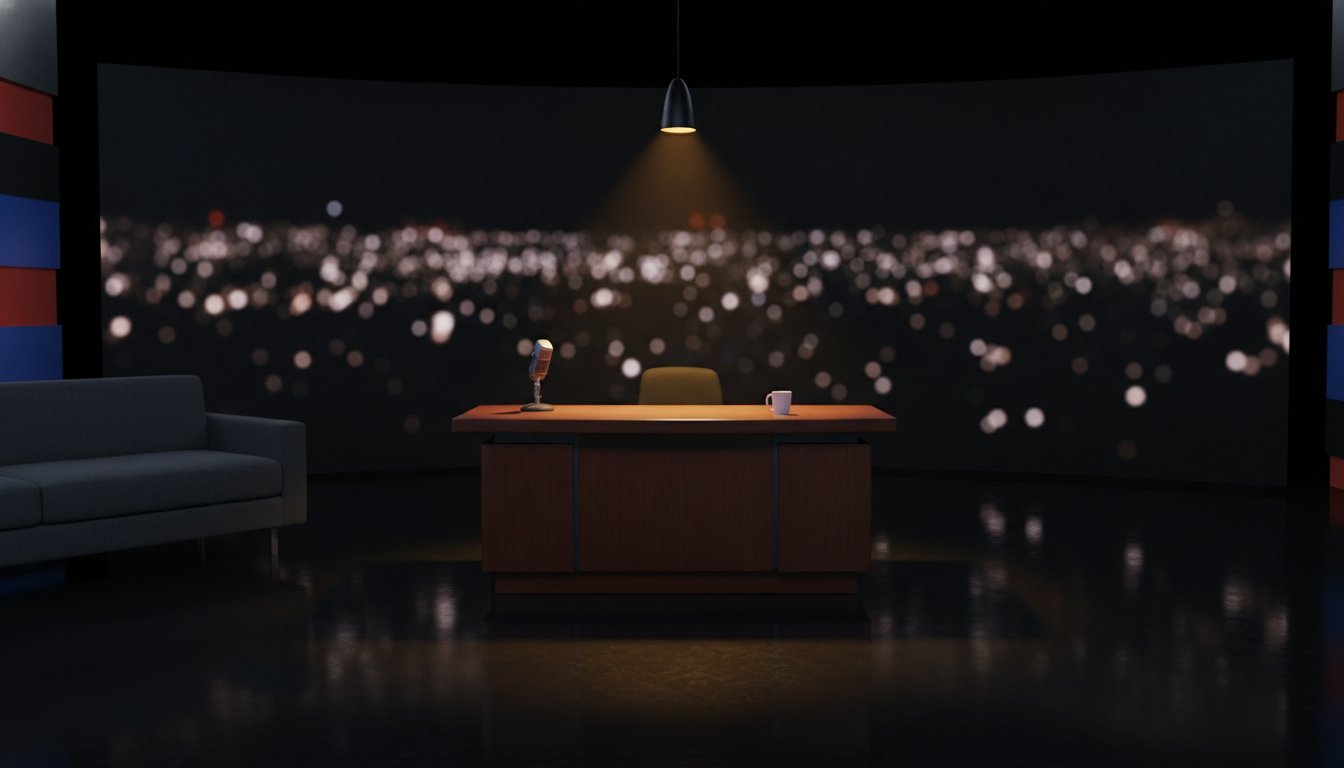
Why does a standard piece of office furniture, something usually reserved for accountants or civil servants, carry more weight than the A-list celebrities sitting just three feet away? It’s easy to overlook the mahogany or glass barrier that separates the host from the guest, but that physical distance is the most calculated piece of architecture in broadcasting. You’ve likely spent years watching these programs without realizing that the history of the late night talk show desk is actually a study in psychological warfare and carefully constructed authority. It isn’t just a place to rest a coffee mug; it’s a proscenium arch that grants a host the presidential stature required to anchor the national conversation.
You recognize the silhouette of the desk as a symbol of stability, a familiar landmark in the shifting landscape of entertainment. We’ll show you exactly how this simple set piece became the most powerful tool in television history. This article reveals the specific hosts who refined the format, the set design secrets hidden in plain sight, and the underlying power dynamics that ensure the desk remains the throne of late night. From Steve Allen’s early experiments to Johnny Carson’s polished reign, you’re about to see the story behind the story of the furniture that shaped an era.
Key Takeaways
- Discover how the transition from radio consoles to NBC studios transformed a functional necessity into a television icon.
- Uncover the psychological armor provided by the history of the late night talk show desk and why it’s essential for maintaining host authority.
- Examine the Carson Geography and the specific set design secrets that turned Johnny Carson’s desk into a national symbol of stability.
- Analyze why experimental no-desk formats failed and why audiences consistently reject hosts who try to sit on the couch.
- Understand why the desk remains the anchor of late night in the digital age, providing a permanent brand for viral clips.
From Radio Consoles to NBC Studios: The Birth of the Talk Show Desk
In the flickering infancy of the 1950s, television was less an art form and more a series of technical hurdles. Hosts didn’t step onto a stage so much as they stepped into a laboratory. For those early pioneers, the desk wasn’t a choice; it was a requirement. The bulky RCA microphones and the sprawling, hand-printed teleprompter scripts of the era demanded a flat, sturdy surface to keep the chaos of live production out of the viewer’s sight. This functional necessity laid the groundwork for the history of the late night talk show desk, turning a simple piece of carpentry into the most recognizable boundary in entertainment history. It established a clear division of labor where the host worked, while the guest performed.
The early desk served as a hidden storage unit for several essential components:
- Heavy ribbon microphones that required stable mounting to avoid interference
- Cigarette trays and lighters, which were ubiquitous in early live broadcasts
- Handwritten “blue cards” containing guest bios and interview questions
- Physical switches used to signal the control room or trigger the orchestra
The Radio Roots of Late Night Furniture
Long before the cameras rolled, the broadcast console was the host’s cockpit. In the radio era, the console was a dense array of knobs and sliders that provided a physical anchor for the performer. When stars like Steve Allen moved to the visual medium, they felt suddenly, awkwardly exposed. Without the console, there was nothing to hide the nervous tapping of a foot or the shuffling of notes. The radio-to-desk transition serves as the pivotal moment in talk show architecture, transforming a technician’s workstation into a symbol of cultural command. It offered the psychological comfort of an “anchor” position, allowing the host to remain the fixed point in a spinning room of live guests and orchestra cues.
Steve Allen and the First Living Room Set
By 1954, NBC had codified this arrangement with the launch of The Tonight Show. Steve Allen didn’t just want a studio; he wanted an extension of the American living room. This era of set design favored warmth, utilizing a couch-and-chair arrangement to the right of the host to simulate a domestic visit. This specific geography created a structural boundary between the host’s professional workspace and the guest’s social space. It was a brilliant bit of staging that allowed the host to remain the “man in charge” while the celebrity guest played the role of the visiting neighbor. This 1954 revolution didn’t just fill time; it established the standard for the history of the late night talk show desk for the next seventy years. Understanding the full scope of this transformation requires tracing the evolution of the late night monologue from its radio roots to the polished television rituals we recognize today. For a deeper look at these early transitions, explore The Cinematic History of Late Night Television.
The Psychological Shield: Why the Desk Defines the Host’s Authority
When an unpredictable guest enters the studio, the atmosphere shifts from scripted entertainment to a high-stakes social experiment. Throughout the history of the late night talk show desk, this barrier has functioned as more than just a place to set a coffee mug; it is a piece of psychological armor. By shielding the host’s lower body, the desk eliminates the vulnerability of exposed legs and fidgeting feet, allowing the performer to maintain a facade of total composure. It creates a fortress from which the host can lob jokes or conduct pointed interviews, ensuring that even the most chaotic guest remains on the “outside” of the seat of power.
This arrangement creates what industry insiders call the “Presidential” effect. Much like the Resolute Desk in the Oval Office, the late night desk communicates institutional weight and unshakeable trust. When a host sits behind several hundred pounds of polished mahogany, they aren’t just a comedian; they are the moderator of the American evening. The physical geography of the set reinforces this hierarchy. The host’s chair is often positioned slightly higher than the guest’s couch, ensuring that the host is always the one looking down, however subtly, upon their visitor. This framing, combined with the massive “monarch’s” desk, ensures the audience never forgets who owns the room.
The distinction between being “behind the desk” and “in front of the desk” is the most critical divide in a host’s nightly routine. During the monologue, the host stands exposed in front of the desk, playing the role of the vulnerable jester who must earn the audience’s favor. The moment they retreat to the chair, the persona shifts. They become the judge and the curator. This transition marks the end of the performance and the beginning of the authority, a ritual that has been perfected over decades of broadcasting. If you are curious about how these subtle cues influence the industry, you might enjoy exploring our deeper look at Late Night TV Power Dynamics.
The Host as the Mediator of the News
By mirroring the physical setup of a news anchor, late night hosts borrow the gravitas of journalists like Walter Cronkite. This visual shorthand allows them to pivot from silly sketches to serious commentary without losing the audience’s respect. The desk acts as a literal shield during tense moments. If a guest becomes aggressive or erratic, the host can lean forward into their workspace, using the desk to reclaim the center of gravity. Conversely, the act of a host “leaving the desk” to greet a guest or participate in a segment is seen as a major concession of power, a symbolic gesture of high respect rarely granted to anyone but the most elite legends.
Guest Geography: The Couch and the Hierarchy
The decision to place the guest couch to the host’s right is a product of traditional stage blocking, ensuring the host is always the first thing the viewer’s eye tracks from left to right. This creates a clear “inner circle” for the primary guest, while subsequent visitors are pushed further down the couch, literally and figuratively moving toward the periphery of the host’s attention. This seating chart is a silent indicator of celebrity status, where every inch of distance from the desk represents a decrease in the guest’s perceived importance. It’s a fascinating study in social ranking that continues to define the history of the late night talk show desk in the modern era.
The Carson Standard: Establishing the Desk-and-Couch Geography
Carson didn’t just host a show; he presided over a nightly ritual that defined the American experience for three decades. While the early pioneers established the necessity of the desk, Johnny Carson turned it into a cultural law. In the hallowed halls of Studio 6B and later in the sprawling Burbank sets, he perfected the “Carson Geography,” a precise arrangement of furniture that dictated the flow of energy in the room. This wasn’t merely a set; it was a “National Fireplace” where a divided country gathered to find common ground in the glow of the television screen. The history of the late night talk show desk reached its zenith here, as the furniture became synonymous with the man himself.
The genius of Carson’s presentation lay in the “Pencil and Mug” aesthetic. He understood that pure authority can be alienating, so he used relatable props to humanize his position. He famously toyed with pencils that were sharpened at both ends, a specific detail designed to ensure he never looked for the “right” side on camera. His mug, always within reach, became a silent character in the nightly drama. These small, tactile objects allowed him to maintain his stature while appearing as a relatable figure who might be sitting in your own den. It was a masterclass in using set design to balance the professional with the personal.
The Physical Evolution of Carson’s Desks
As the show matured, the desk underwent its own transformation to reflect the changing times. The early New York years featured wood-grain laminates that felt functional and modern for the early sixties. However, as the production moved to Los Angeles in 1972, the design shifted toward the sophisticated, heavy mahogany that defined the 1980s. This physical evolution mirrored Carson’s own journey from a nimble broadcaster to the undisputed king of the medium, a transformation deeply intertwined with the broader shifts in 1970s late night TV culture that reshaped the industry’s center of gravity. For a deeper look at this era, explore our retrospective on The Tonight Show with Johnny Carson.
The Sidekick’s Role in the Desk Hierarchy
The desk required a counterweight to remain balanced, and Ed McMahon provided the necessary gravitational pull. His placement was a calculated study in comedic timing and spatial awareness. By sitting at a slight distance, Ed remained outside the host’s primary “power bubble,” allowing him to act as the audience’s representative on stage. He was the one who could laugh at the jokes or react to the guests from a position of relative equality with the viewer. The sidekick functioned as the bridge between the desk’s authority and the audience’s living room. This distance ensured that while the host remained the ultimate arbiter of the show, the room never felt cold or inaccessible.

Breaking the Fourth Wall: Iconic Attempts to Abolish the Desk
Despite the desk’s dominance, the history of the late night talk show desk is littered with the remnants of failed experiments to remove it. Producers often fall into the trap of believing that removing the barrier will create a more intimate connection with the audience. They call it the “living room” format. However, when the desk disappears, the host’s authority often vanishes with it. Without the mahogany anchor, the star is forced to compete for attention on equal footing with the guest, often appearing as a visitor on their own set. It turns out that viewers don’t want their hosts to be just another friend on the couch; they want a leader who can control the room.
David Letterman understood this tension better than anyone. He didn’t abolish the desk; he subverted it. His “Chaos Desk” became a prop for destruction, a place where he could drop heavy objects or hide bizarre mechanical gadgets. It was anti-comedy at its finest, proving that the only way to survive the desk’s rigid tradition was to treat it with a healthy dose of irony. More recently, James Corden attempted a hybrid approach by moving his desk to the side, prioritizing a communal guest experience. While it served his musical-theater sensibilities, it remains polarizing for traditionalists who feel the host’s command is diluted when they aren’t the fixed center of the set.
The Arsenio Hall and Chevy Chase Experiments
Arsenio Hall famously ditched the desk for a more casual, high-energy “party” atmosphere. It worked for him because his brand was built on being the cool alternative to the establishment. Contrast this with the disastrous 1993 Chevy Chase Show. Chase looked uncomfortable and adrift without the physical support of a desk, often appearing lost during interviews. The experiment was a case study in how removing the furniture can lead to host discomfort, as they have nowhere to hide their notes or rest their hands. Without that structural boundary, the host frequently looks like a guest on their own show, a fatal blow to the illusion of control.
Why the Desk Always Returns
The desk remains the ultimate psychological safety net. It’s where the host retreats after a monologue, signaling a transition from performance to conversation. It’s also a practical necessity for segment transitions and prop-based comedy. For a broader perspective on how these sets shaped society, you can read about The Cultural Impact of Late Night TV. Ultimately, the desk is the one piece of furniture that ensures the host is never truly alone on stage. If you want to delve into more behind-the-scenes stories, explore our historical archives today.
The Future of the Furniture: Why the Desk Remains Late Night’s Anchor
While the delivery systems have shifted from cathode-ray tubes to high-definition streams, the physical center of the late-night studio remains remarkably static. It’s a curious paradox. In an era defined by rapid technological disruption, the leading figures of the medium, Stephen Colbert, Jimmy Fallon, and Jimmy Kimmel, all continue to broadcast from behind a fortress of wood and glass. The history of the late night talk show desk hasn’t ended; it has simply adapted to a world where the television set is no longer the primary screen. The “Desk-and-Cityscape” backdrop survives because it provides a necessary sense of place and permanence in a digital landscape that often feels ephemeral. It’s the unchanging heart of an ever-evolving medium.
Modern hosts cling to the Carson-era geography because it works. The arrangement of the desk, the host, and the guest creates a visual triangle that the human eye finds inherently satisfying. This structure provides a sense of continuity for an audience that has grown up with these visual cues, offering a familiar comfort even as the jokes and the guests change. The desk remains the anchor because it is the only piece of furniture capable of carrying the weight of a show’s legacy while providing the host with the physical tools needed to manage the nightly chaos of live-to-tape production.
Framing for the Smartphone Screen
In the 21st century, the desk has found a new purpose as a “brandable” frame for social media clips. As viewers increasingly consume late-night content through smartphone screens, the desk provides a stable center for cropped vertical video. When a segment goes viral on TikTok or Instagram, the presence of the desk acts as a silent watermark of professional quality. It separates the legitimate host from the sea of amateur creators, signaling to the viewer that they are watching a curated, high-stakes piece of media. The desk-top branding, from the host’s signature mug to the specific grain of the wood, ensures that the show’s identity remains intact, regardless of the platform where it is viewed.
Preserving the Legacy at The Late Desk
At The Late Desk, we view these pieces of furniture not as mere props, but as physical artifacts of our collective media history. Our mission involves documenting the “lost” sets of television’s past, ensuring that the architectural evolution of these spaces is preserved for future generations of historians and fans. We believe that the story of the desk is the story of the host’s relationship with the public. By archiving these narratives, we offer a window into the professional hierarchies and emotional undercurrents that shaped the golden age of broadcasting. If you’re ready to dive deeper into these hidden chapters of television history, explore our media history archives for more untold stories.
Beyond the Mahogany: The Enduring Legacy of the Desk
The mahogany fortress at the center of the stage is far more than a stylistic choice; it’s the structural heartbeat of a seventy-year tradition. We’ve seen how a technical necessity for housing radio microphones evolved into a psychological shield that defines the very concept of broadcasting authority. While many hosts have attempted to dismantle this barrier in favor of modern intimacy, the desk consistently returns. It’s the only anchor capable of grounding a host in the midst of live-television chaos. By studying the history of the late night talk show desk, we uncover the hidden architecture that transformed simple interviews into national events.
At The Late Desk, we’re dedicated to preserving classic TV history through expert analysis of television archives and in-depth narratives on media power dynamics. We invite you to lean in and explore the “story behind the story” that shaped the golden age of entertainment. Discover more behind-the-scenes stories from television’s Golden Age at The Late Desk. There’s always a new layer of the archive waiting to be revealed, and we’re here to guide you through every historic frame.
Frequently Asked Questions
Why do late night hosts sit behind a desk while guests sit on a couch?
The desk establishes a professional hierarchy that defines the host as the “owner” of the space. While the couch signals a visitor’s status, the desk acts as a symbolic throne of authority. This visual shorthand ensures the audience knows who is moderating the conversation. It creates a clear boundary between the host’s workspace and the guest’s social area, a dynamic that has remained central to the history of the late night talk show desk since its inception.
Who was the first late night host to use a desk?
Steve Allen is widely credited with codifying the desk-and-couch configuration when he launched The Tonight Show in 1954. While earlier broadcasters often used tables to support heavy equipment, Allen was the first to turn the desk into a permanent stage prop. He realized that a desk provided a sense of stability and “office” authority that helped ground the show’s more chaotic comedic segments.
What is the psychological reason for the talk show desk?
The desk functions as a piece of psychological armor that protects the host from the vulnerability of being fully exposed to the camera. By shielding the host’s lower body, it hides nervous tells like foot tapping or leg shifting. This physical barrier allows the performer to maintain a facade of total composure and “presidential” stature, even when dealing with unpredictable or aggressive celebrity guests.
Have any late night shows successfully removed the desk?
Success without a desk is the exception rather than the rule. Arsenio Hall famously ditched the furniture in 1989 to create a high-energy “party” atmosphere that resonated with a younger demographic. However, most hosts who try this format, such as Chevy Chase in 1993, find themselves looking uncomfortable and adrift. Without that physical anchor, a host often appears as a guest on their own set, leading to a loss of perceived command.
Why is the guest always seated to the host’s right?
This seating arrangement is a product of traditional stage blocking and Western reading patterns. Since audiences naturally scan a stage from left to right, placing the host on the left ensures they are the first person the viewer sees. The guest sits to the host’s right so the host can “lead” the eye toward them, keeping the host in the primary position of power throughout the broadcast.
What happened to Johnny Carson’s original Tonight Show desk?
Several versions of Carson’s desk exist, but his final mahogany desk from 1992 is held by the Smithsonian Institution in Washington, D.C. It is treated as a major artifact in the history of the late night talk show desk, representing the three-decade reign of the medium’s most influential figure. Other earlier versions have appeared in museum exhibits or were retained by NBC as part of their historical archives.
Why do talk show desks always have a mug on them?
The mug is a calculated “humanizing” prop designed to soften the host’s institutional authority. A massive mahogany desk can feel cold or intimidating, but a coffee mug is a relatable household object that suggests a casual, domestic conversation. It bridges the gap between the host’s professional “office” and the viewer’s own living room, making the broadcast feel more like a friendly visit than a formal interview.
How has the design of the late night desk changed over time?
Design has evolved from the functional, technical consoles of the 1950s to the sophisticated mahogany and glass structures of the modern era. Early sets favored wood-grain laminates to simulate a mid-century den, while current sets often use sleeker materials that reflect a high-tech, urban aesthetic. Despite these aesthetic shifts, the core “L-shaped” geography remains untouched because it is the most effective way to manage the host-guest power dynamic. A comprehensive reference on the evolution of the late night monologue and talk show format reveals how these design choices were always intertwined with the broader development of the genre’s rituals and conventions.