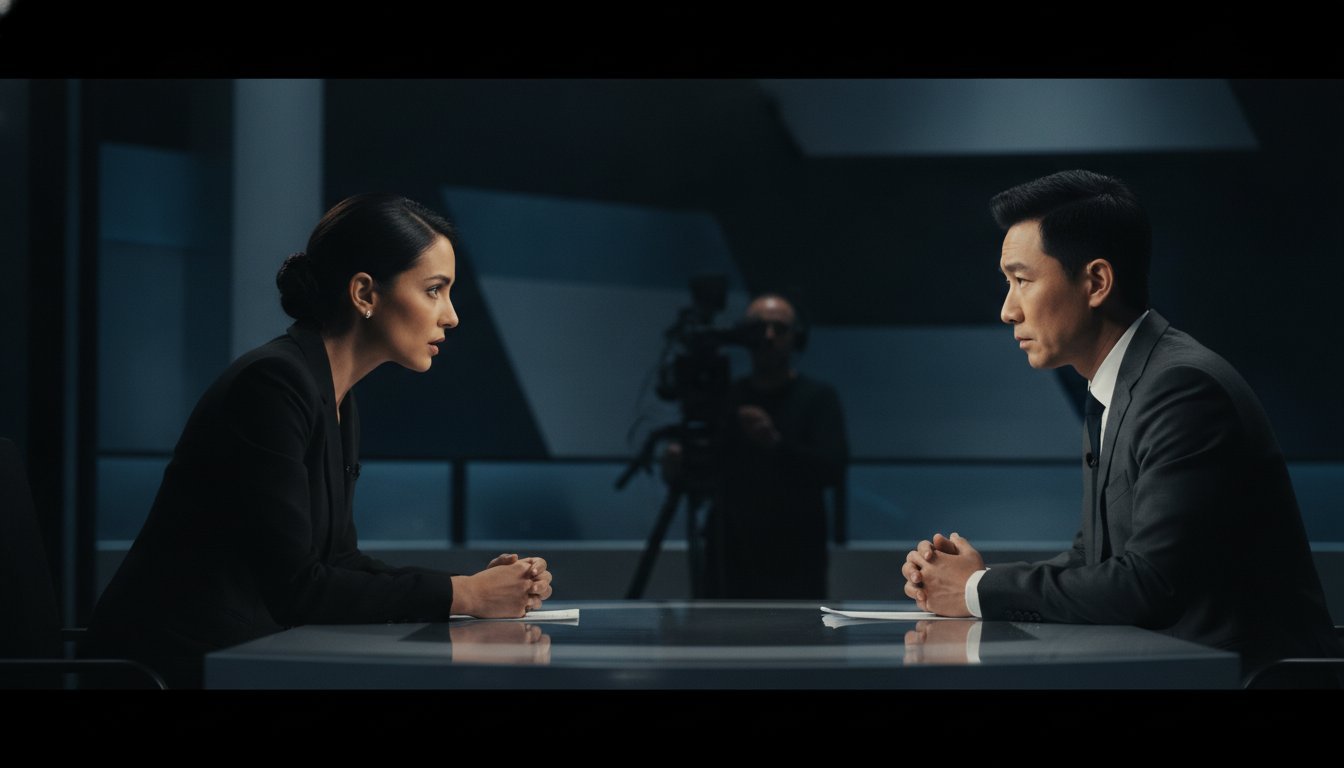
The modern viral clip is a carefully choreographed illusion, yet there was a time when the glow of the television screen illuminated something far more dangerous: the unscripted collision of two egos in real time. You likely feel the exhaustion of contemporary media, where late-night appearances are often reduced to PR-approved anecdotes and rehearsed parlor games. It’s a far cry from the era when a single interview could derail a career or redefine a legacy overnight. These unforgettable talk show guest moments weren’t just entertainment; they were high-stakes power struggles that played out before millions of unsuspecting viewers.
In this exploration, you’ll discover the cultural mechanics and hidden power dynamics that fueled the most iconic appearances in broadcasting history. We’re going beyond the grainy footage to reveal the behind-the-scenes fallout of famous on-air clashes and the professional risks that hosts like Johnny Carson took every time the cameras rolled. You’ll learn how the very architecture of the late-night format was forged through these volatile accidents. This deep dive provides the context necessary to understand how a few minutes of live television could change the cultural conversation forever. By peeling back the layers of these historic broadcasts, we can finally appreciate the fragile art of the classic interview.
Key Takeaways
- Discover how the technical limitations and social tensions of early broadcasting created a “live high-wire” environment that modern, scripted segments simply cannot replicate.
- Trace the evolution of televised intellectual combat through the lens of the Dick Cavett Show, where high-brow rivalries were treated with the gravity of a theatrical performance.
- Deconstruct the architecture of unforgettable talk show guest moments to understand how master hosts like Johnny Carson transformed unscripted accidents into permanent cultural landmarks.
- Recognize the historical power of the late-night desk as a cultural town square, capable of shifting national social norms through singular, high-stakes interviews.
- Gain a deeper level of media literacy by learning to distinguish between the fleeting nature of today’s viral bits and the enduring archival weight of legendary broadcast history.
The Live Television High-Wire: Why Early Talk Shows Bred Unpredictability
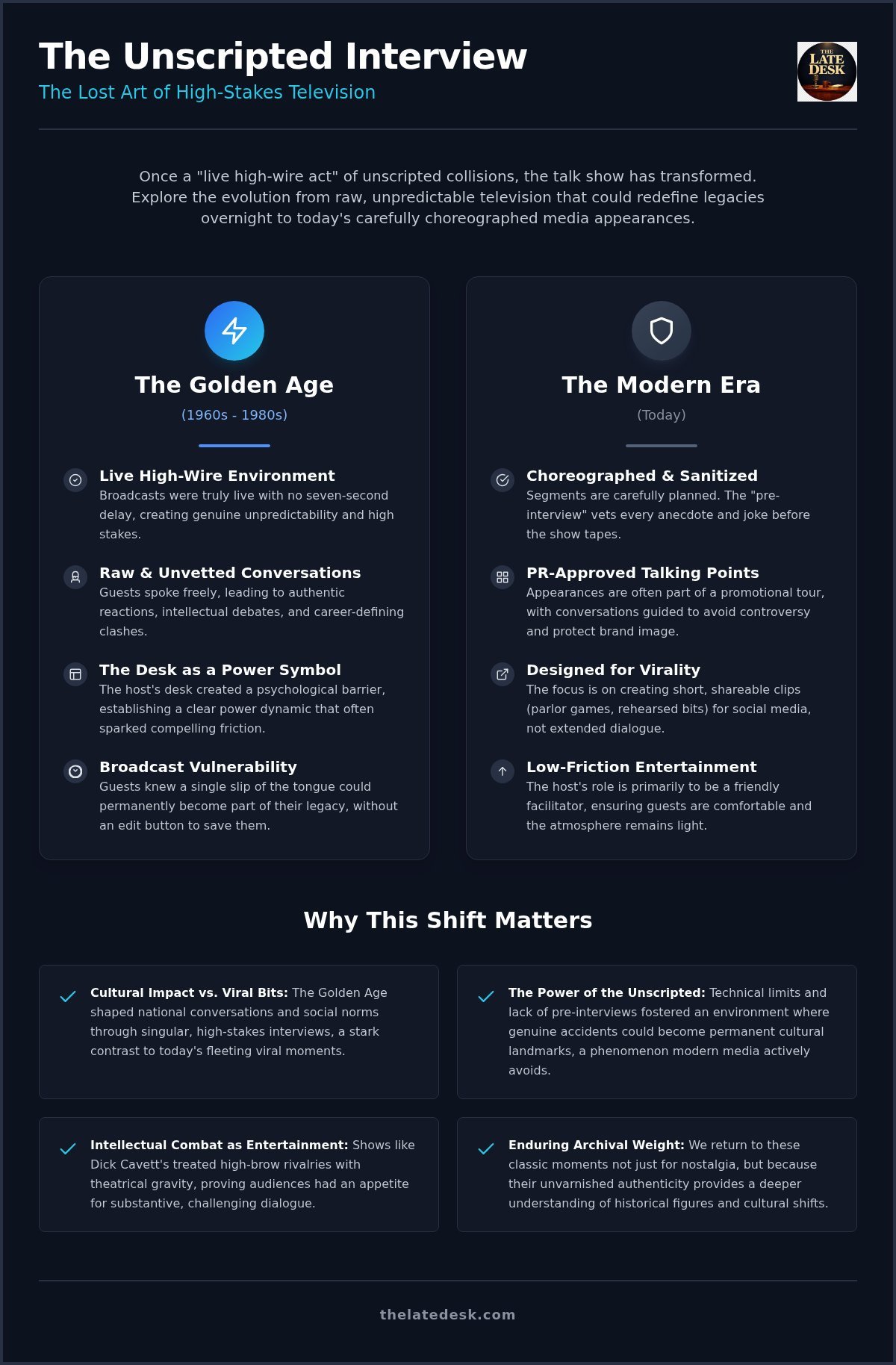
The early decades of late-night broadcasting were defined by a specific, electric tension known as the “Live High-Wire.” Unlike the sanitized, PR-driven segments of the present day, the 1960s through the 1980s operated on a foundation of genuine unpredictability. Today’s viewers are accustomed to the “pre-interview,” a process where every anecdote is vetted and every punchline is rehearsed before the cameras even roll. In the Golden Age, however, the conversation was often a raw discovery. This lack of a safety net is what produced so many unforgettable talk show guest moments; it was the result of a medium that hadn’t yet learned how to fully control its subjects.
Central to this volatility was the absence of a “seven-second delay.” In the early eras, what happened in the studio hit the airwaves instantly. This technical reality meant every guest was a potential liability, capable of uttering a profanity or sparking a scandal that could jeopardize a network’s license. These unforgettable talk show guest moments were rarely planned; they were the byproduct of a system that prioritized live reactions over polished branding. The physical space of the set added to this pressure. The “Desk” functioned as more than just furniture; it was a psychological barrier that established a clear hierarchy. The host sat behind a wooden fortress, while the guest remained exposed on a couch, a dynamic that often sparked defensive or aggressive behavior from the era’s biggest stars.
The Transition from Radio to the Desk
This unique atmosphere didn’t emerge in a vacuum. Early pioneers like Steve Allen were instrumental in moving the medium away from the rigid structures of the past. Allen brought the chaotic, improvisational energy of radio to the small screen, essentially inventing the late-night template on the fly. As the format shifted from “variety” performances to pure “conversation,” the potential for friction increased. You can explore this evolution in detail through The Cinematic History of Late Night Television, which traces how these radio roots eventually grew into the sophisticated desk-and-couch setup we recognize today.
The Psychological Toll of the Spotlight
By the 1970s, the cultural landscape had shifted, and guests felt increasingly emboldened to challenge the status quo. The live studio audience became a “third party” in the room, acting as a jury that could turn on a host or a guest in an instant. This era solidified the concept of the history of late-night television as a high-stakes arena of public perception. Broadcast vulnerability is the guest’s awareness that their reputation is being forged in real-time. It’s the silent realization that, in the absence of an edit button, a single slip of the tongue could become a permanent part of their legacy.
Clashes of the Titans: When Intellectual Rivalries Boiled Over on Air
While many viewers tuned in for lighthearted banter, the Dick Cavett Show offered something far more combustible: the intellectual bloodsport. Cavett’s set was the premier arena for high-brow conflict, where the guests weren’t just promoting films but defending their worldviews. This environment birthed some of the most unforgettable talk show guest moments in history, as the host often stepped back to let the friction ignite. It was a departure from the variety show format, favoring a cerebral intensity that modern television rarely attempts.
The “Host as Referee” dynamic was a delicate balance. Cavett used his sharp, Yale-educated wit to maintain control of a set that frequently threatened to dissolve into chaos. Unlike the polished mediators of today, he wasn’t afraid to let the silence hang or the insults fly, provided the conversation remained substantive. This era proved that audiences had a profound appetite for seeing their icons challenged in real time, a shift that forced networks to reconsider the value of the “difficult” guest.
The Story Behind the Mailer-Vidal Feud
In 1971, Norman Mailer and Gore Vidal engaged in what remains the benchmark for televised intellectual combat. The tension was fueled by a backstage physical altercation where Mailer reportedly headbutted Vidal in the green room before the cameras even started rolling. On air, the verbal jousting was equally sharp. When Mailer grew increasingly belligerent and dismissive of the host, Cavett delivered his legendary line: “Why don’t you fold it five ways and put it where the moon don’t shine?” The exchange remains one of the most unforgettable talk show guest moments ever captured, proving that even the most sophisticated guests could succumb to the pressure of the spotlight.
Jack Paar and the Birth of Late Night Conflict
Long before Cavett, Jack Paar established the precedent for emotional volatility on the small screen. His 1960 walk-off, triggered by the network’s censorship of a “water closet” joke, remains a foundational moment when the host himself became the spectacle. Paar’s willingness to prioritize his personal principles over the broadcast schedule set the stage for every on-air incident that followed. You can trace this evolution of personality-driven broadcasting in The Lineage of Laughter, which details how Paar’s reign reshaped the industry’s expectations of its stars. For those seeking the deep context behind these classic TV scandals, exploring The Late Desk archives reveals how these power struggles continue to influence our modern media literacy.
The Carson Touch: How Johnny Transformed Minor Mishaps into Cultural Landmarks
While Dick Cavett curated intellectual combat, Johnny Carson mastered a different, perhaps more difficult art: the “Carson Save.” This was the specific skill of taking a guest’s awkward silence, a failed joke, or a technical glitch and repurposing it into a moment of comedic brilliance. Carson understood that his audience didn’t just want to see stars succeed; they wanted to see how a professional handled a disaster. These unforgettable talk show guest moments were rarely about the guest’s prepared material. Instead, they were about Carson’s ability to pivot, using the “Desk” as a sanctuary from which he could dissect the absurdity of the situation in real time.
The most famous example of this occurred on April 27, 1965, during the Ed Ames tomahawk incident. When Ames threw the weapon and it landed squarely in the target’s crotch, the studio audience erupted into the longest recorded laugh in television history. Carson didn’t rush to fill the air with chatter. He simply waited, his face a mask of weary disbelief, before delivering the perfect punchline about Ames’s aim. This was the pinnacle of the “Civilian Guest” phenomenon as well. Carson often found that “real” people, like the legendary Myrtle Young and her collection of potato chips, provided a better foil for his wit than any Hollywood star. By treating a crushed chip with the same gravity as a political scandal, he transformed minor mishaps into permanent cultural landmarks.
Technical Mastery of the Reaction Shot
Carson’s genius wasn’t just in his timing; it was in his collaboration with the control room. His directors used tight close-ups to heighten guest awkwardness, capturing every bead of sweat or darting eye. The “Double Take” became Carson’s most effective comedic tool, a silent communication with the viewers at home that bypassed the guest entirely. Carson’s 30-year reign was built on his ability to be the “audience’s surrogate,” reacting exactly as we would if we were trapped on that couch with a difficult subject. This technical precision ensured that even when a segment was failing, the show was winning. What made this reign even more remarkable was the network of famous talk show host friendships Carson cultivated behind the scenes, with allies like Bob Newhart and Don Rickles helping to shape the industry’s culture far from the cameras.
The Power of the Tonight Show Endorsement
The stakes of an appearance with Johnny were higher than any other platform in media history. A simple “OK” sign from the desk or an invitation to “the chair” could make or break a career in under six minutes. You can explore the full weight of this influence in our analysis of The Tonight Show with Johnny Carson, which details his unchallenged sovereignty over the genre. This immense power created an environment where guests would take extreme risks to be remembered. While Carson usually maintained decorum, the precedent he set for high-impact guest spots eventually paved the way for more chaotic, unforgettable talk show guest moments in later decades, such as the Drew Barrymore flashing incident on Letterman, where the guest hijacked the host’s authority entirely.
Beyond the Laughs: Pivotal Moments That Challenged Social Norms
The talk show desk has often functioned as a secular pulpit, a place where the trivialities of show business were momentarily suspended to address the shifting tides of national consciousness. In these unforgettable talk show guest moments, the host’s role evolved from entertainer to witness, transforming the studio into a town square for the television age. When Magic Johnson sat across from Arsenio Hall in 1991, the atmosphere was thick with a specific kind of gravity. While other hosts might’ve approached the subject of HIV with clinical distance, Hall’s platform provided a sense of intimacy and cultural relevance that allowed the conversation to transcend the typical late-night bit. It was a moment that humanized a global crisis, proving the format could handle the weight of real-world stakes when the right voices were involved.
These broadcasts did more than just reflect culture; they enforced its hierarchies. The “unwritten rules” of the industry were often invisible until someone broke them, revealing the professional scaffolding that held the “Golden Age” together. Whether it was a guest challenging the host’s authority or a legend stepping into a role previously reserved for men, these instances provided a rare glimpse into the power struggles occurring behind the scenes. To see the complete record of these cultural shifts, visit The Late Desk archives for an insider’s view of television history.
The Joan Rivers Ban and Industry Power
The rigid nature of late-night loyalty was never more apparent than in the case of Joan Rivers. Her decision to launch a competing show was viewed by Johnny Carson as a personal betrayal, resulting in a 26-year exile from NBC. This wasn’t just a professional disagreement; it was a demonstration of the absolute sovereignty held by the “King of Late Night.” You can explore the mechanics of this fallout in our Late Night TV Power Dynamics analysis. The ban highlighted a gendered power structure where a female guest’s ambition was often met with institutional resistance, turning her absence into one of the most enduring, unforgettable talk show guest moments in broadcasting history. Understanding this episode requires appreciating how the private bonds and loyalties among the era’s titans — the kind of famous talk show host friendships that shaped TV history — could be weaponized just as powerfully as any public rivalry.
Lucille Ball: The Queen Rules Late Night
Long before the industry grappled with these public bans, Lucille Ball was quietly dismantling the barriers of the desk itself. Her appearances weren’t merely promotional stops. She commanded the room with the authority of an industry titan who had already conquered the medium. When she stepped into the role of Lucille Ball as Tonight Show Guest Host, the usual “audition” feel of a replacement spot was replaced by a sense of royal succession. She didn’t just sit on the couch; she owned the desk. Her presence proved that the glass ceiling of late night could be cracked by a figure with enough cultural capital, long before the networks were ready to make it a permanent reality.
Curating the Archive: Why We Return to These Golden Age Narratives
The digital age has fundamentally altered how we consume media, yet there remains a profound distinction between a “viral moment” and a “legendary” one. A viral clip is often ephemeral, a product of the algorithm designed for a short, intense lifecycle. Conversely, unforgettable talk show guest moments from the Golden Age possess a historical weight that transcends the screen. They aren’t just accidents of timing; they’re artifacts of a vulnerable era that modern television, with its layers of PR protection, can no longer replicate. As we look toward the media landscape of 2026, there’s an increasing hunger for this unfiltered past. Viewers aren’t just seeking nostalgia; they’re looking for the human friction that’s been polished away by contemporary production standards.
The Late Desk serves as the essential bridge between this modern curiosity and the hard facts of broadcasting history. By interpreting these moments through a lens of power dynamics and professional legacy, we move beyond the “clip show” mentality. We treat the archives as a living record of how we once communicated, argued, and found common ground in the glow of the cathode-ray tube. These narratives remind us that the most impactful television doesn’t come from a script, but from the high-stakes vulnerability of a live broadcast.
The Hunt for Missing Media
While the industry now treats every frame as a permanent asset, the broadcasters of the 1960s often viewed their output as entirely disposable. This perspective led to the tragedy of “wiped tapes,” where thousands of hours of broadcasts were erased to reuse expensive magnetic media. Today, the work of reconstructing these unforgettable talk show guest moments falls to a dedicated community of scholars and archivists who piece together history from fan recordings and private collections. For those interested in the technical and ethical challenges of this work, our guide to Online TV Archives for Researchers provides a roadmap for navigating the digital vaults of the past.
Conclusion: The Lasting Legacy of the Guest
The “Art of the Chat” remains the core of late-night appeal because it’s fundamentally about the unpredictable nature of human drama. Whether it’s a comedian’s breakthrough or a titan’s downfall, the magic happens in the space between the questions. We invite you to continue your journey through the archives of The Late Desk, where every interview is a doorway into a forgotten world. In the end, the Golden Age wasn’t defined by the lights or the sets, but by the courage of individuals to step into the spotlight without a safety net.
Preserving the Fragility of the Late-Night Desk
The era of the unscripted interview remains a testament to the power of live broadcast vulnerability. We’ve traced how these unforgettable talk show guest moments emerged not from rehearsal, but from the volatile intersection of celebrity ego and host intuition. From intellectual jousting on Cavett’s stage to Johnny Carson’s technical mastery, these broadcasts established a cultural benchmark that today’s viral clips rarely meet. They remind us that true television history is made when the safety net is removed and human drama unfolds in its rawest form.
As media historians, we recognize that the “story behind the story” is as vital as the footage itself. Whether it’s uncovering the nuances of the Joan Rivers ban or analyzing Carson’s thirty-year reign, our mission is to ensure these legacies aren’t lost to time. We invite you to Explore the Deep Archives of Late Night History at The Late Desk to discover the hidden layers of the golden age. The archives are waiting for those who appreciate the sophisticated art of the classic interview.
Frequently Asked Questions
What is considered the most famous talk show guest moment of all time?
Many historians point to Jack Paar’s 1960 walk-off as the moment that established the talk show’s capacity for high-stakes drama. After the network censored a joke, Paar left the set mid-broadcast, leaving a stunned audience and a vacant desk. While later clips like the Ed Ames tomahawk throw gained more visual fame, Paar’s exit proved that the host’s personal principles could override the broadcast schedule itself.
Why was Joan Rivers banned from The Tonight Show for so many years?
The ban was the result of a perceived breach of industry loyalty. When Joan Rivers accepted a deal to host her own show on Fox in 1986, she didn’t inform Johnny Carson before the public announcement. Carson, who had mentored her for years, viewed this as a personal betrayal. This professional exile lasted twenty-six years, illustrating the rigid hierarchies that defined the power dynamics of the era.
How did Johnny Carson handle guests who were difficult or boring?
Carson mastered the art of the reaction shot to navigate difficult interviews. Instead of confronting a boring guest, he would use a silent, wide-eyed look at the camera to signal his shared frustration with the audience. This technique turned the guest’s failure into a comedic victory for the host. He effectively became the surrogate for the viewer, making the awkwardness the most entertaining part of the segment.
Are there any “lost” talk show moments that were never recorded?
Thousands of hours of early late-night history were lost due to the industry practice of wiping tapes to reuse expensive magnetic media. Many of the most unforgettable talk show guest moments from the 1950s and early 60s exist only in the memories of those who saw them live. Scholars now work to reconstruct these narratives from secondary sources, fan recordings, and private collections to preserve the medium’s legacy.
What was the significance of the Norman Mailer and Gore Vidal feud?
The 1971 clash between Norman Mailer and Gore Vidal remains the benchmark for televised intellectual combat. It proved that audiences were captivated by high-brow conflict and raw ego, even when the conversation turned physically aggressive backstage. This moment shifted how networks booked guests, demonstrating that a difficult or combative interview could generate more cultural capital than a standard, polite promotional appearance designed solely for publicity.
How has the role of the talk show guest changed since the 1970s?
The talk show guest has transitioned from an unscripted conversationalist to a highly rehearsed brand ambassador. In the 1970s, guests were encouraged to be provocative and authentic, often engaging in long-form debates that could derail a career. Today’s appearances are typically built around pre-interviews and pre-approved bits, removing the element of broadcast vulnerability that once made the medium feel like a high-stakes high-wire act.
Who was the first woman to guest host The Tonight Show?
Lucille Ball was the first woman to take the reins as a guest host for The Tonight Show in the 1960s. Her appearance was a landmark event that challenged the male-dominated hierarchy of late-night television. Unlike other guest hosts who were often viewed as substitutes, Ball’s legendary status gave her the authority to own the desk, proving that the format could support a female lead long before networks were ready.
Why do we find classic talk show scandals so fascinating today?
We find these classic unforgettable talk show guest moments fascinating because they offer a glimpse into a media landscape that wasn’t yet sanitized by modern PR. There’s a profound nostalgia for the Golden Age where public figures took genuine risks on live television. These scandals serve as historical documentation of a time when the Art of the Chat was still a dangerous, unpredictable, and deeply human drama.