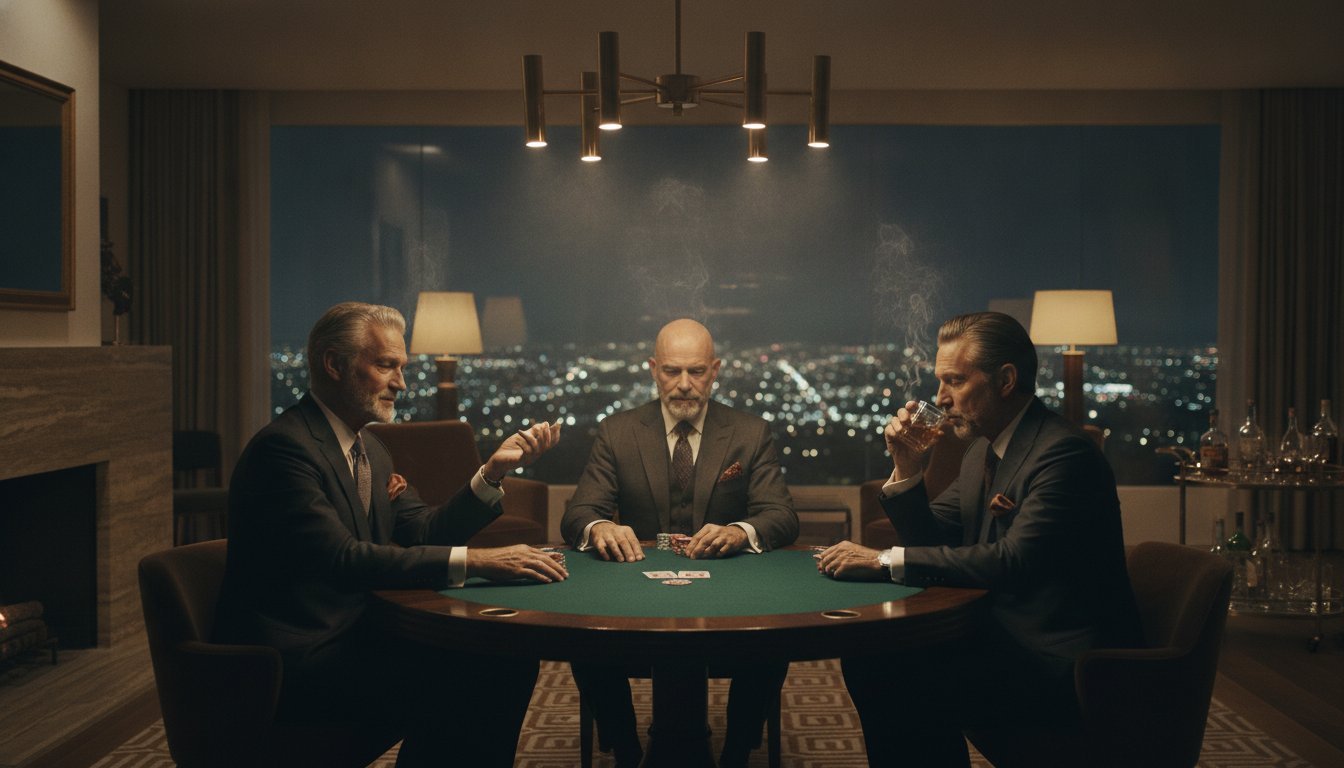
Imagine a smoke-filled living room in Bel Air where the most powerful men in television are trading chips and insults far from the reach of network cameras. Behind the stage-managed rivalries of the 11:30 slot, a small circle of titans like Johnny Carson, Bob Newhart, and Don Rickles were building a bond that redefined the industry. It’s easy to believe that the Golden Age was defined solely by cutthroat competition for ratings and guest lists. You’ve likely heard the rumors of icy silences and backstage feuds that supposedly dominated the era. While the public thrived on the drama of late-night wars, the truth often lay in the quiet, professional alliances that happened after the monologue ended.
In this curated archive entry, you will discover the private alliances and legendary bonds that fueled the Golden Age of late-night television. We are moving past oversimplified lists to examine how famous talk show host friendships actually functioned as the secret currency of industry survival. You will gain a sophisticated perspective on the power dynamics between legends like Carson and Rivers; you will also learn why a single poker game could be more influential than a network meeting. From rare anecdotes to deep-dive narratives, we are pulling back the curtain on the five relationships that truly shaped the desk.
Key Takeaways
- Understand how professional isolation in late-night led hosts to form private alliances that functioned as vital safety nets for their careers.
- Explore the evolution of famous talk show host friendships; specifically, look at how Johnny Carson’s mentorship of Joan Rivers transformed the landscape of guest-hosting.
- Step inside the legendary Bel Air poker games to see how the camaraderie between Carson, Bob Newhart, and Don Rickles influenced the industry’s power dynamics.
- Learn why supposed rivals like Merv Griffin and Mike Douglas maintained a mutual respect that often defied the sensationalist headlines of the era.
- Discover how preserving these intimate human narratives offers a more accurate historical record than network archives alone.
The Invisible Bond: Why Host Friendships Mattered in the Golden Age
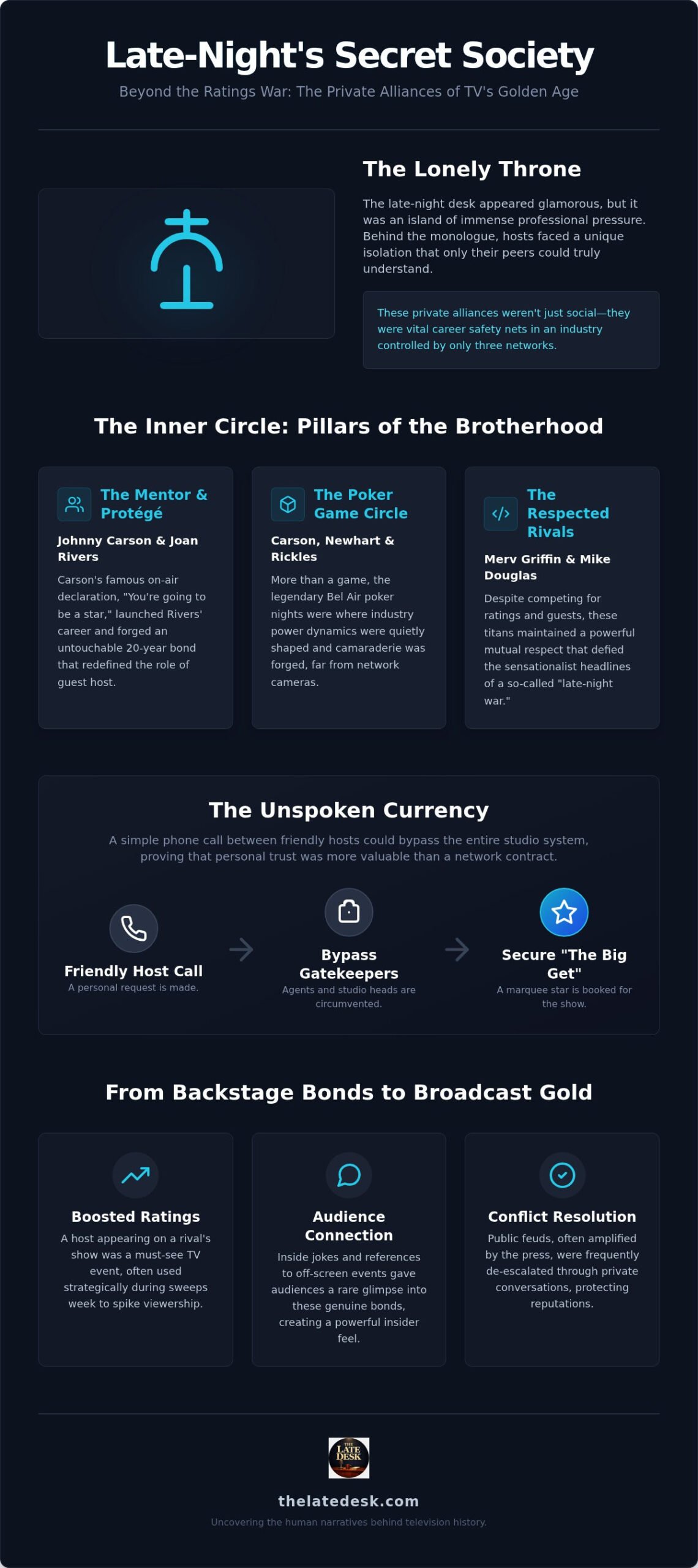
To the casual viewer, the late-night desk appeared as a throne of effortless charm and coastal glamour. In reality, it was often a lonely island of professional pressure where the host stood as the only person in the studio who truly felt the weight of the silence following a failed joke. During the Golden Age of television, this isolation created a unique necessity for famous talk show host friendships. These weren’t merely social connections; they were survival mechanisms in an era where only three networks controlled the cultural conversation. While the modern landscape is fragmented across a thousand digital niches, the hosts of the 1960s and 70s lived in a much smaller, more intimate world.
There’s a sharp distinction between on-screen chemistry and the off-screen alliances that kept the industry’s gears turning. On camera, hosts might trade playful barbs about ratings or wardrobe choices. Behind the scenes, however, they were often each other’s only confidants. They understood the peculiar exhaustion of the 11:30 slot in a way that spouses, producers, or even writers never could. This shared experience fostered a level of trust that allowed for a “safety net” when it came to the lifeblood of any talk show: the guest list.
The Currency of Camaraderie
A host’s social circle directly influenced the vitality of their broadcast. If a marquee star was hesitant to appear on a program, a simple phone call between friendly hosts could often bypass the gatekeepers of the studio system. The Tonight Show served as the central hub of this ecosystem; it was the sun around which all other variety and talk programs orbited. The Late-Night Brotherhood was a strategic industry alliance that protected the prestige of the format. This camaraderie meant that even when hosts were technically competitors, they worked together to ensure that the “big get” stayed within their trusted network of peers.
When Personal Bonds Met Public Ratings
The public’s fascination with these famous talk show host friendships often translated into significant viewership spikes. When one host sat in the guest chair of another, it wasn’t just a promotional stop; it was an event that humanized the titans of the industry. These appearances eased the tension of the “network wars,” signaling to the audience that there was a level of mutual respect beneath the competitive surface.
- Subtle Cues: An inside joke or a specific reference to a private dinner often signaled to the insider audience that a deep bond existed.
- Booking Leverage: Friends would often trade guests or appear on each other’s shows during sweeps week to bolster numbers.
- Conflict Resolution: Public feuds were frequently de-escalated through private conversations before they could damage a host’s reputation.
Ultimately, these alliances proved that even in the cutthroat world of television, the most enduring currency wasn’t just a high Nielsen rating. It was the quiet, steady support of the only other person in the world who knew what it felt like to sit behind that desk.
Johnny Carson and Joan Rivers: A Mentorship Built on Mutual Brilliance
On February 17, 1965, a struggling comedian walked onto the stage of The Tonight Show with nothing left to lose. By the end of the segment, Johnny Carson turned to the camera and uttered the words that would change her life: “You’re going to be a star.” This moment didn’t just launch a career; it forged one of the most influential famous talk show host friendships in the history of the medium. For two decades, Rivers was Carson’s protégé, his confidante, and eventually, his primary successor at the desk. Their bond was built on a shared language of comedy that few others could speak, creating a partnership that felt untouchable for nearly twenty years.
The Discovery of a Legend
The chemistry between the two was immediate and electric. Rivers possessed a sharp, self-deprecating wit that perfectly complemented Carson’s masterful timing. Their interactions remain among the most unforgettable talk show guest moments because they felt less like rehearsed interviews and more like private conversations between intellectual equals. By 1983, Rivers was named the permanent guest host, a position of unprecedented trust. She was the only person Carson trusted to hold the fort in his absence, making her the unofficial queen of late-night long before she had a show of her own.
The Fallout and the Ban
In 1986, the bond shattered in a single afternoon. When Rivers signed a deal with the fledgling Fox network to host her own show, she didn’t call Carson to ask for his blessing before the news broke. To Johnny, this wasn’t just a strategic business move; it was a profound personal betrayal. This rupture offers a chilling look into the late night tv power dynamics of the era, where loyalty was the only currency that mattered more than ratings. Carson never spoke to her again, famously hanging up the phone when she finally did call to explain. He banned her from the show for life, a silence that endured through his retirement in 1992 and until his death in 2005.
The legacy of their relationship serves as a stark reminder that in the Golden Age, the line between professional mentorship and personal devotion was razor-thin. While their fallout became a headline, the brilliance they shared on screen remains a testament to what happens when two masters of the craft truly click. For more deep dives into these complex relationships, you can explore our curated television archives to see the footage that defined an era.
The Poker Game Circle: Johnny Carson, Bob Newhart, and Don Rickles
While the cameras captured the polished banter of the 11:30 slot, the real power dynamics of the industry were often negotiated over a felt-covered table in Bel Air. Johnny Carson was famously protective of his privacy, yet he maintained an inner circle that functioned as a fortress against the isolation of his immense fame. At the heart of this group were Bob Newhart and Don Rickles, creating one of the most enduring famous talk show host friendships in television history. These poker games weren’t merely social gatherings; they were the industry’s true boardroom, where the “King of Late Night” could finally drop the mask of the host and simply be a peer among masters.
The Vegas-to-Burbank Pipeline
The roots of this bond were planted in the grueling Las Vegas circuit, where these men spent weeks performing two shows a night in smoke-filled showrooms. This shared experience created a unique language of comedy that bound the trio together, protecting them from the unique pressures of the spotlight. For Carson, Rickles was more than just a guest; he was a trusted confidant who could penetrate the host’s icy exterior with a single, perfectly timed insult. This “Rat Pack” influence on late-night social structures ensured that the camaraderie felt on screen was rooted in decades of shared history and mutual defense.
Legendary Crossovers
The strength of these personal bonds frequently spilled over into the studio, creating moments that defined the Tonight Show with Johnny Carson. Perhaps the most famous incident occurred in 1968 when Don Rickles accidentally broke Carson’s wooden cigarette box during a guest appearance. The following night, Carson “interrupted” Rickles while he was filming his own sitcom on a nearby set, demanding an apology in a segment that felt dangerously unscripted. It was the kind of high-wire act that only true friends could pull off without career-ending fallout. Similarly, Bob Newhart’s status as a frequent guest host was a direct result of this trust. He was the only person who could reliably make Carson lose his composure, proving that famous talk show host friendships were often the secret ingredient that made the Golden Age feel so intimately human.
Rivalry or Camaraderie? The Surprising Bonds of Late-Night Competitors
While the 1990s are often remembered for the brutal “Late Night Wars” between Jay Leno and David Letterman, the preceding decades were governed by a far more civilized code of conduct. To the external observer, the competition between networks appeared absolute. Behind the scenes, however, the landscape was defined by a series of famous talk show host friendships that functioned as a stabilizing force for the industry. While the networks fought for every percentage point in the Nielsen ratings, the men behind the desks often operated under a “Gentleman’s Agreement” that prioritized professional courtesy over cutthroat guest poaching. This wasn’t merely about politeness; it was a strategic way to maintain the dignity of the medium during its most influential era.
These alliances were particularly vital when it came to network contract negotiations. Hosts like Merv Griffin, Mike Douglas, and Dick Cavett were known to compare notes on salary structures and studio perks. By sharing this “insider” information, they ensured that the networks couldn’t play one host against another to suppress their market value. It was a private form of collective bargaining that allowed the stars to retain power in an industry traditionally dominated by executive suits. They understood that a rising tide lifted all boats, and a healthy late-night ecosystem benefited everyone involved.
The Merv Griffin Connection
Merv Griffin occupied a unique position as a “host’s host.” His syndicated program allowed him a level of creative freedom that network hosts often envied, yet he maintained a deep respect for his peers. Despite the ratings battle, Griffin and Johnny Carson shared a mutual professional courtesy that was rare for the time. This respect was evident in how they managed shared legends of the era. For instance, the legacy of Lucille Ball as Tonight Show guest host was a point of pride that resonated across all shows, as Griffin often celebrated the same icons that Carson championed. Merv’s ability to turn guests into lifelong friends made his show a safe harbor for stars, a trait that his competitors respected rather than resented.
The Legacy of the Late-Night Handshake
The eventual transition from this era of friendly competition to the high-stakes hostility of the 90s marked the end of a specific cultural chapter. As the industry became more fragmented and the financial stakes grew into the billions, the “Host Fraternity” began to dissolve. The shift in industry culture changed famous talk show host friendships from a standard professional practice into a rare anomaly. Today, the late-night handshake has largely been replaced by digital metrics and viral clips. The decline of the Host Fraternity signaled a move away from the shared stewardship of television history toward a more isolated and individualistic era of entertainment. If you want to understand how these dynamics evolved, you can browse our full collection of historical television articles to see more of the stories that defined the desk.
Uncovering the Human Side of TV History with The Late Desk
For the television scholar, the broadcast tapes are only half the story. The real mechanics of the Golden Age lived in the unrecorded moments between segments and the private phone calls between offices. Preserving the narratives of famous talk show host friendships is vital because these bonds provided the stability that allowed the medium to flourish. Without understanding these personal alliances, our view of the history of late night television remains flat and two-dimensional. The Late Desk exists to fill these archival gaps. We move beyond the public monologue to uncover the private loyalties that built an empire.
The Story Behind the Desk
It’s tempting to view the legends of late-night as static figures on a screen. They were individuals managing a high-stakes industry that offered little room for error. We provide an insider perspective that restores the human texture to classic media. By analyzing how a host’s personal life influenced their professional decisions, we offer a more sophisticated view of entertainment history. It is the curiosity of a biographer blended with the precision of a cultural historian. Historical context is the lens through which we must view modern media. It reveals that today’s digital rivalries are often echoes of the sophisticated power plays of the 1970s. We curate the stories that network archives often miss, focusing on the emotional undercurrents of show business.
Join the Archive
The stories we’ve explored here, from the poker games in Bel Air to the fallout between mentors and protégés, are only the beginning. We invite you to step deeper into our curated collection of deep-dive historical features. Our upcoming explorations will tackle the complexities of late night television guest scandals and the business maneuvers that networks tried to keep hidden. As the definitive guide for classic TV fans, The Late Desk ensures that the human side of famous talk show host friendships is never lost to the passage of time. Sign up to join our community of archivists. Help us keep the memory of the Golden Age alive.
Preserving the Legacy of the Late-Night Brotherhood
The smoke-filled poker rooms and private mentorships of the Golden Age did more than just pass the time; they functioned as the bedrock of the industry. From the tragic fallout of Carson and Rivers to the quiet respect shared between syndicated rivals, these famous talk show host friendships reveal a human side of television that the cameras never captured. These alliances were the hidden currency that allowed the Golden Age to thrive despite the immense pressure of the 11:30 slot. Understanding these bonds is essential for anyone looking to see the desk as more than just a piece of furniture.
To truly understand the power dynamics that built the desk, you need a guide who looks past the monologue. We offer expert analysis of TV power dynamics and curated historical narratives that bring these legends to life. Our in-depth biographies of late-night legends provide the context that modern archives often miss. Explore the Golden Age archives at The Late Desk and step back in time with us. Rediscover the stories that defined a generation of entertainment and shaped the future of the medium.
Frequently Asked Questions
Who was Johnny Carson’s closest friend in the industry?
While he was notoriously private, his closest industry bond was likely with Don Rickles. They shared a deep personal trust that allowed Rickles to mock Carson on air in ways no one else could. Their friendship spanned decades and was rooted in mutual respect for their respective comedic crafts. It’s a relationship that survived the intense scrutiny of the Hollywood spotlight for years.
Did Joan Rivers and Johnny Carson ever reconcile before his death?
No, the two never spoke again after Rivers accepted her own late-night show in 1986. Despite Rivers’ attempts to reach out over the years, Carson remained steadfast in his silence until his passing in 2005. This remains one of the most famous talk show host friendships to end in a permanent, public rupture that was never repaired by either party during their lifetimes.
Why did Johnny Carson ban so many guests and hosts?
Carson viewed loyalty as the primary currency of his professional world. He often issued bans to individuals he perceived as disloyal, such as those who moved to rival networks or guests who appeared on competing shows without his blessing. For Carson, the Tonight Show desk was a sanctum. It required absolute allegiance from anyone who hoped to stay in his influential inner circle.
Were Merv Griffin and Johnny Carson actually rivals?
They were professional competitors in the ratings, but they maintained a respectful distance rather than an active feud. Unlike the aggressive Late Night Wars of the 1990s, the 1970s era was defined by a Gentleman’s Agreement. They understood that maintaining the prestige of the talk show format was more important than any single network skirmish. They didn’t let ratings destroy their professional courtesy.
How did Bob Newhart become a frequent guest host for Carson?
Newhart’s frequent stints as guest host were a direct result of his membership in Carson’s private social circle. Johnny trusted Newhart’s low-key, intellectual comedic style to maintain the show’s quality during his many absences. This trust was forged during their private time together at poker games. It made Newhart a reliable steward of the desk for many years during the 1970s and 80s.
What was the ‘Poker Game’ circle in late-night TV history?
The Poker Game circle was an elite, private group of entertainers who met regularly at Johnny Carson’s home. Members included Bob Newhart, Don Rickles, and occasionally other titans of the era. These gatherings served as a safe space where the most powerful men in television could drop their public personas. They could speak freely without the fear of network executives listening to their conversations.
Which talk show hosts had the longest-running professional friendship?
Dick Cavett maintained some of the most enduring famous talk show host friendships, spanning several decades of broadcasting history. His intellectual approach allowed him to build lasting bonds with peers like Jack Paar and even Merv Griffin. These relationships survived network shifts and changing television trends. It proved that professional respect could outlast contract cycles and the fickle nature of modern network ratings.
How did host friendships influence celebrity guest bookings?
Personal alliances between hosts often functioned as an informal booking network. If a host was friends with a peer, they’d share tips on which guests were particularly engaging or even trade appearances to help boost ratings during sweeps weeks. These behind-the-scenes connections ensured that the most coveted stars remained within a small, trusted circle. It kept high-profile guests away from less friendly network competitors.