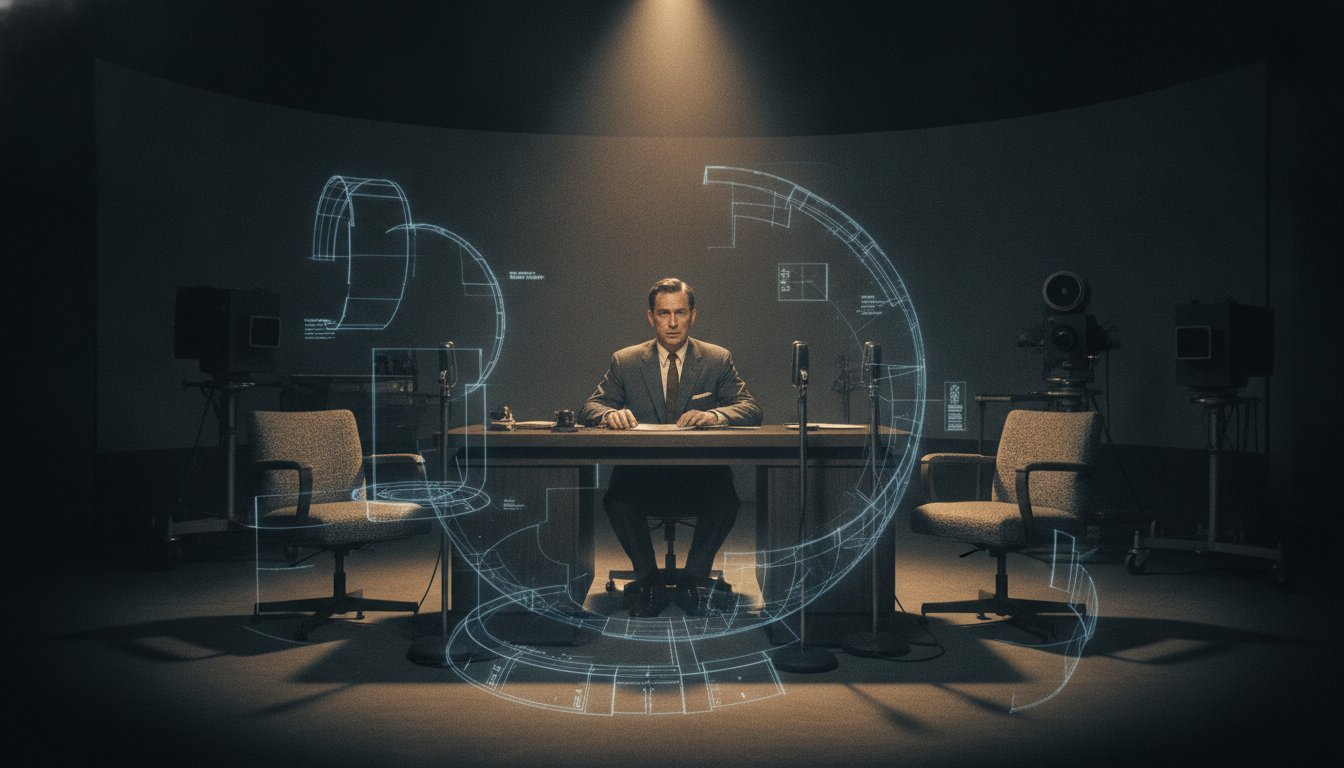
Before Johnny Carson became the king of late-night, another man sat behind the desk. He was a different breed of host—volatile, intellectual, and dangerously unpredictable. He didn’t just read jokes; he bled emotion onto the screen, turning a fledgling talk show into a national obsession. This is the Jack Paar Tonight Show history, the story of a mercurial architect who tore up the rulebook and invented the very format we still watch today. He transformed a struggling variety program into a cultural powerhouse through raw emotion, legendary controversy, and a revolutionary new kind of television intimacy.
Forget the polished performers and slick monologues you know. Jack Paar’s reign was a nightly psychodrama, a window into a brilliant and troubled mind. He weaponized his own vulnerability, making millions of viewers feel less like an audience and more like his personal confidants. To understand late-night television, you must first understand the man who built its foundation, piece by piece, on a stage he often threatened to burn down.
The 1957 Resurrection: How Jack Paar Saved the Tonight Show
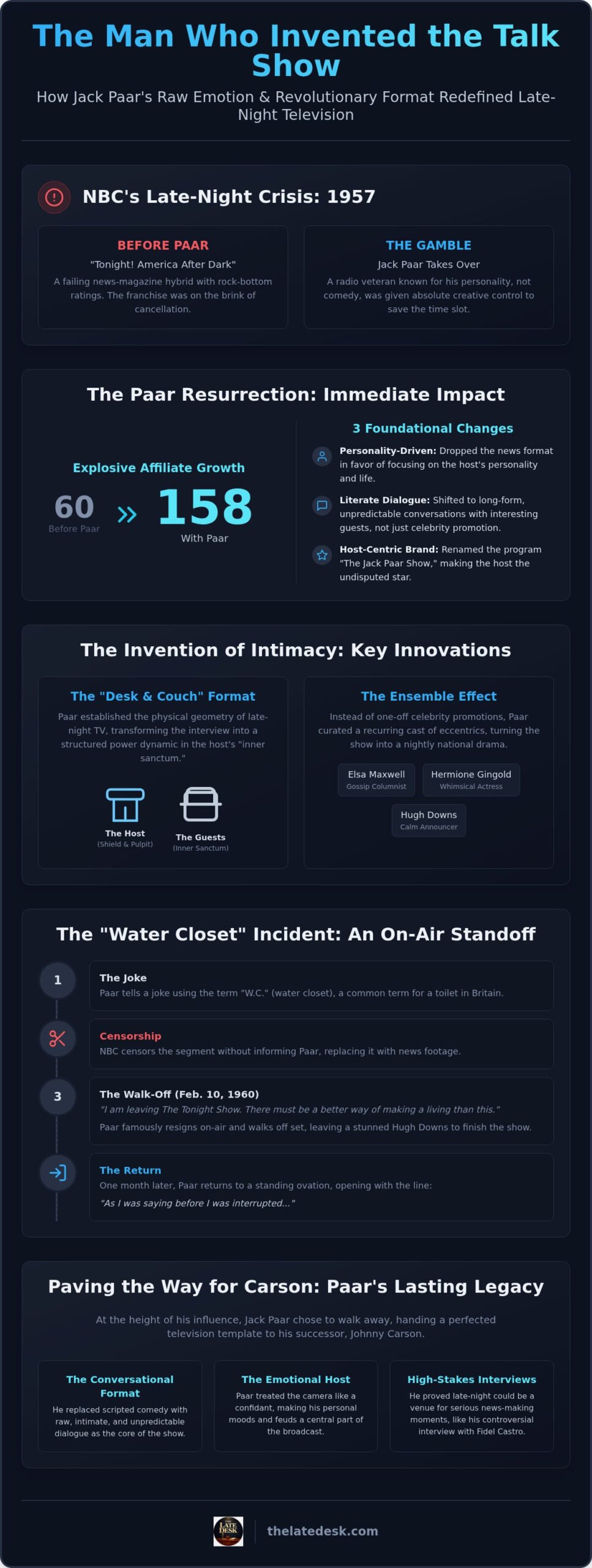
By 1957, NBC’s late-night slot was a wasteland. After the departure of its first host, Steve Allen, the network had experimented with a news-magazine format called Tonight! America After Dark. It was a colossal failure. The show was dry, disjointed, and hemorrhaging viewers. Advertisers were fleeing, and the entire 11:15 PM to 1:00 AM block was on the verge of being handed back to local affiliates. NBC was desperate for a savior.
They found one in a man who, on paper, made little sense. Jack Paar was a veteran of radio, known for his wit and intelligence, but he lacked the vaudevillian energy of a traditional TV star. He wasn’t a comedian in the slapstick mold of Allen. He was a conversationalist, a storyteller, a man who seemed more suited for a quiet study than a television studio. Yet, it was this very quality that made him the perfect gamble. NBC gave him the keys to the kingdom, rebranding the show as Tonight Starring Jack Paar. The name change was significant; it signaled a fundamental shift. The show was no longer about a concept—it was about a personality.
Inheriting a Ghost Town: The NBC Landscape in 1957
The failure of Tonight! America After Dark had left a deep scar on the network. The magazine-style show, with its rotating cast of hosts and news-style segments, had proven that audiences weren’t looking for a late-night version of the Today show. They wanted a companion, a personality to wind down the day with. The ratings were abysmal, and the affiliate stations were losing faith. Paar understood the network’s desperation and used it as leverage. He demanded—and received—near-total creative control. He would decide the guests, shape the conversations, and set the tone. It was a power move that would define the rest of his career.
Defining the "Paar Era" Persona
From his first broadcast on July 29, 1957, it was clear that Paar was different. He possessed a sophisticated, slightly neurotic charm that was utterly captivating. His monologue wasn’t a string of one-liners; it was a personal diary. He talked about his life, his frustrations with the network, his feud with a newspaper columnist, or a funny thing his daughter said. He wasn’t performing for the audience; he was talking to them. This created an "insider" feeling, a sense that viewers were part of a special club. This powerful dynamic, the idea that the host is a trusted friend, remains a core element of late-night television to this day.
The Invention of Intimacy: Structural Innovations of the Paar Show
Jack Paar didn’t just change the tone of late-night; he changed its physical shape and structure. Steve Allen’s show was an extension of the variety stage, filled with sketches, musical numbers, and grand productions. Paar dismantled that. He threw out the stage and brought in a desk and a couch. This simple act of set design was a revolution.
This new configuration wasn’t just furniture; it was a statement. It transformed the show from a performance into a conversation. The focus shifted from rehearsed bits to spontaneous chat. Paar prioritized genuine interaction, letting conversations wander into unexpected, often deeply personal, territory. He also perfected the art of the "character guest." He didn’t just book A-list movie stars; he invited eccentric intellectuals, witty authors, and colorful personalities like Zsa Zsa Gabor and Oscar Levant. These guests weren’t there to plug a project; they were there to be themselves. Viewers felt like they were eavesdropping on the most interesting cocktail party in New York, and Paar was their witty, magnetic host.
The Psychology of the Desk
The physical layout of Paar’s set created a new language for television. The desk became his command center, a place from which he could direct the flow of conversation, share a personal story, or deliver a scathing critique. It established a clear but intimate hierarchy. His sidekick, the unflappable Hugh Downs, sat next to him, acting as an anchor of calm amidst Paar’s emotional storms. The couch, positioned opposite the desk, was the guest’s space. To be invited to that couch was to be invited into Paar’s inner circle. Paar used the desk as both a shield to protect his vulnerability and a pulpit from which to preach his unique worldview.
The "Paar Regulars" and the Ensemble Effect
Paar cultivated a rotating cast of "regulars" who became stars in their own right. Figures like the cantankerous society columnist Elsa Maxwell and the delightfully eccentric British actress Hermione Gingold became familiar faces. Their recurring appearances created an ensemble feeling, like a family of witty misfits. Paar masterfully blended these celebrity conversations with human interest stories, often featuring ordinary people with extraordinary tales. This blend of high-brow wit and down-to-earth storytelling grounded the show in a powerful emotional reality. It marked the definitive transition from performance-based television to the personality-based television that has dominated the airwaves ever since.
The "Water Closet" Incident and the 1960 Resignation
Jack Paar’s emotional intensity was his greatest asset, but it was also his biggest liability. On Thursday, February 11, 1960, it led to one of the most dramatic moments in television history. The night before, Paar had told a joke that network censors deemed too risqué for broadcast. The joke involved an English woman who mistook a "W.C." (water closet) for a "Wayside Chapel." It was mild by today’s standards, but in 1960, it was enough to make the NBC executives panic.
Without telling Paar, they cut the four-minute segment from the tape before it aired. When Paar learned of the censorship the next day, he was incandescent with rage. He felt betrayed and humiliated. That night, he walked onto the Tonight Show stage not with a monologue, but with a resignation. He calmly told the story of the censored joke, then, with his voice cracking, he delivered a stunning ultimatum to the network and the nation: "I am leaving the Tonight Show." He stood up, said "There must be a better way of making a living than this," and walked off the set, leaving a stunned Hugh Downs to finish the broadcast. The country was in shock.
Chronology of a Crisis: February 11, 1960
The event unfolded with the speed and intensity of a political crisis.
- The Joke: During the taping on February 10th, Paar told the "W.C." story, which got a huge laugh from the studio audience.
- The Edit: An NBC executive, watching a closed-circuit feed, ordered the segment to be removed from the broadcast tape.
- The Discovery: Paar arrived at the studio on February 11th to prepare for that night’s show and was informed of the cut. He saw it as a profound breach of trust and an attack on his creative freedom.
- The Speech: Live on air, he addressed the audience directly. His verbatim speech included the now-famous lines: "I was called in to see a man today and he said, ‘It’s been cut.’ I said, ‘Why?’ He said, ‘It’s of doubtful taste.’ … I’m leaving the ‘Tonight Show.’ There must be a better way of making a living than this… You have been peeking in on me all the time. I have been asked to explain and I have done it to the best of my ability. It’s been a great strain." And with that, he was gone.
The Triumphant Return and the Power Shift
The public outcry was immediate and immense. Newspapers were flooded with letters. NBC was inundated with angry phone calls. Viewers didn’t just like Jack Paar; they felt a fierce loyalty to him. They saw the network’s censorship as an attack on their friend. The network, realizing it had made a catastrophic mistake, scrambled to get him back. After a nearly month-long hiatus filled with guest hosts, Paar agreed to return. On March 7, 1960, he walked back onto the stage to a thunderous ovation. He approached the microphone, smiled wryly, and delivered one of the most famous lines in television history: "As I was saying before I was interrupted…" The moment was electric. It was more than a comeback; it was a coronation. Jack Paar had taken on the network and won, proving for the first time that a late-night host’s personality could be more powerful than the corporation that employed him.
Controversy and Charisma: Jack Paar’s Most Memorable Moments
The walk-off was the most famous event in Paar’s tenure, but his five years on the Tonight Show were filled with moments that pushed the boundaries of television. His show was a nightly tightrope walk between brilliant conversation and emotional breakdown, and that’s what made it so compelling. This was the core of the Jack Paar Tonight Show history: unpredictability was the only thing you could predict.
Nowhere was this clearer than in his 1959 interview with Fidel Castro. At the height of the Cold War, Paar flew to Cuba and filmed a surprisingly humanizing interview with the revolutionary leader, presenting him to American audiences not as a monster, but as a complex man. The move was incredibly risky, earning him condemnation from political hardliners but also cementing his reputation as a broadcast journalist who valued curiosity over convention. He also engaged in legendary feuds with newspaper columnists like Dorothy Kilgallen and Ed Sullivan, using his monologue as a weapon to settle scores in public. He wept openly on air while telling a story about his daughter, introduced a young Bill Cosby to a national audience, and provided a platform for avant-garde acts like the Muppets long before they were household names.
Political Theatre at Midnight
The Castro interview was a watershed moment. It blurred the lines between entertainment and hard news, demonstrating that a late-night talk show could be a serious forum for political discourse. Paar often defended guests who were being targeted by the lingering sentiments of the McCarthy era, using his platform to champion free speech. He understood that television, even late at night, was a powerful political tool. He wasn’t afraid to be controversial, believing that an interesting conversation was always worth the risk.
The Emotional Host: Breaking the Fourth Wall
Paar’s emotional volatility became his trademark. His tendency to cry on air was initially shocking to 1950s audiences, who were used to stoic, unflappable television personalities. But his tears resonated. They signaled an authenticity that was rare in the manufactured world of television. Viewers felt that they were seeing the real Jack Paar, unvarnished and unfiltered. His temper, his feuds, and his emotional honesty weren’t bugs; they were features. They made the show feel live, dangerous, and, above all, real. In a way, his temper became a promotional tool—you never knew when Jack might get upset, and you didn’t want to miss it when he did.
The Legacy: Handing the Reins to Johnny Carson
On March 29, 1962, at the absolute peak of his fame and influence, Jack Paar hosted his final Tonight Show. He was emotionally and physically exhausted from the nightly strain of carrying the show. He wanted to move on to a weekly primetime program with a less grueling schedule. His departure left a massive void at the heart of NBC. The search for a successor was one of the most high-stakes decisions in television history. The network needed someone who could retain Paar’s audience without trying to replicate his inimitable style.
The logical—and perhaps only—choice was a young, cool-headed comedian named Johnny Carson. Where Paar was a "hot" host, burning with emotion and intensity, Carson was "cool." He was witty, detached, and masterful at making the guest the star of the show. He was the perfect antidote to Paar’s five years of nightly drama. Carson inherited the format that Paar had perfected: the desk, the couch, the celebrity chat, and the opening monologue. He just did it with a Midwestern calm that was the polar opposite of Paar’s East Coast neurosis. For a deeper look into the evolution of the genre, explore The Cinematic History of Late Night Television, which contextualizes Paar’s groundbreaking contributions.
The Passing of the Torch
After Paar’s tearful farewell, a period of guest hosts filled the gap until Carson’s official debut in October 1962. Carson was smart enough to know he couldn’t be Jack Paar. Instead, he took the blueprint Paar had created and built a more durable, consistent, and less personally taxing empire upon it. The transition from Paar to Carson is widely regarded as the most successful and important succession in television history. Paar built the house, and Carson lived in it for 30 years, renovating and redecorating but never tearing down the foundation.
Jack Paar’s Permanent Mark on Media History
Though Carson’s long shadow has often obscured his predecessor’s legacy, Jack Paar remains the true father of the modern talk show. He invented the "celebrity as human" interview style, proving that audiences were more interested in a star’s personality than their performance. He established the host as an auteur, a central creative force with a deep personal connection to the audience. The lineage of the mercurial, intellectual, and sometimes difficult host—from Dick Cavett to David Letterman to Conan O’Brien—starts with Jack Paar. He didn’t just host a show; he created a genre. He was the original, the prototype, the man who proved that late-night television could be smart, emotional, and essential viewing. Today, that same drive to create essential and impactful media continues in various forms; for example, you can explore Sale of Christian books and media resources to see how digital platforms are now used to share spiritual messages and educational tools.
Frequently Asked Questions
Here are answers to some of the most common questions about the Jack Paar Tonight Show history.
- Why did Jack Paar walk off the Tonight Show in 1960?
Jack Paar walked off the show on February 11, 1960, to protest NBC’s censorship. The network had cut a joke he told the previous night—known as the "Water Closet" joke—without his permission, which he saw as a major breach of trust and creative freedom. - What was the "Water Closet" joke that caused the controversy?
The joke was a story about an English woman looking for a "W.C." (a British term for a toilet, or "water closet") who mistakenly thinks it’s a "Wayside Chapel." The humor came from the misunderstanding over the initials, which network censors in 1960 deemed too risque for broadcast. - How long did Jack Paar host the Tonight Show?
Jack Paar hosted Tonight Starring Jack Paar for nearly five years, from July 29, 1957, to March 29, 1962. - Who replaced Jack Paar on the Tonight Show?
Johnny Carson replaced Jack Paar as the host of the Tonight Show, officially taking over on October 1, 1962. There was a period of several months between their tenures that was filled by various guest hosts. - Did Jack Paar and Johnny Carson get along?
Yes, they had a respectful and friendly relationship. Paar was a guest on Carson’s Tonight Show multiple times after his retirement. While their hosting styles were very different, there was no public animosity between them. - Where can I watch old episodes of Tonight Starring Jack Paar in 2026?
Finding complete episodes is difficult, as much of the live and videotaped content from that era was not preserved. However, clips and some full episodes are often available on platforms like YouTube, the Internet Archive, and through specialty DVD releases or television archives like the Paley Center for Media. If you’re visiting the Paley Center in Los Angeles to explore the Paar archives with your family, FUN WITH KIDS IN LA® is a helpful resource for finding other kid-friendly things to do nearby. - What happened to Jack Paar after he left the Tonight Show?
After leaving the Tonight Show, he hosted a weekly primetime variety program on NBC called The Jack Paar Program from 1962 to 1965. Afterward, he largely retired from television, making only occasional appearances before his death in 2004. - Was Jack Paar the first host of the Tonight Show?
No, Steve Allen was the first host of the Tonight Show, from 1954 to 1957. Jack Paar was the second host and is credited with rescuing the show from cancellation and creating the modern talk show format.