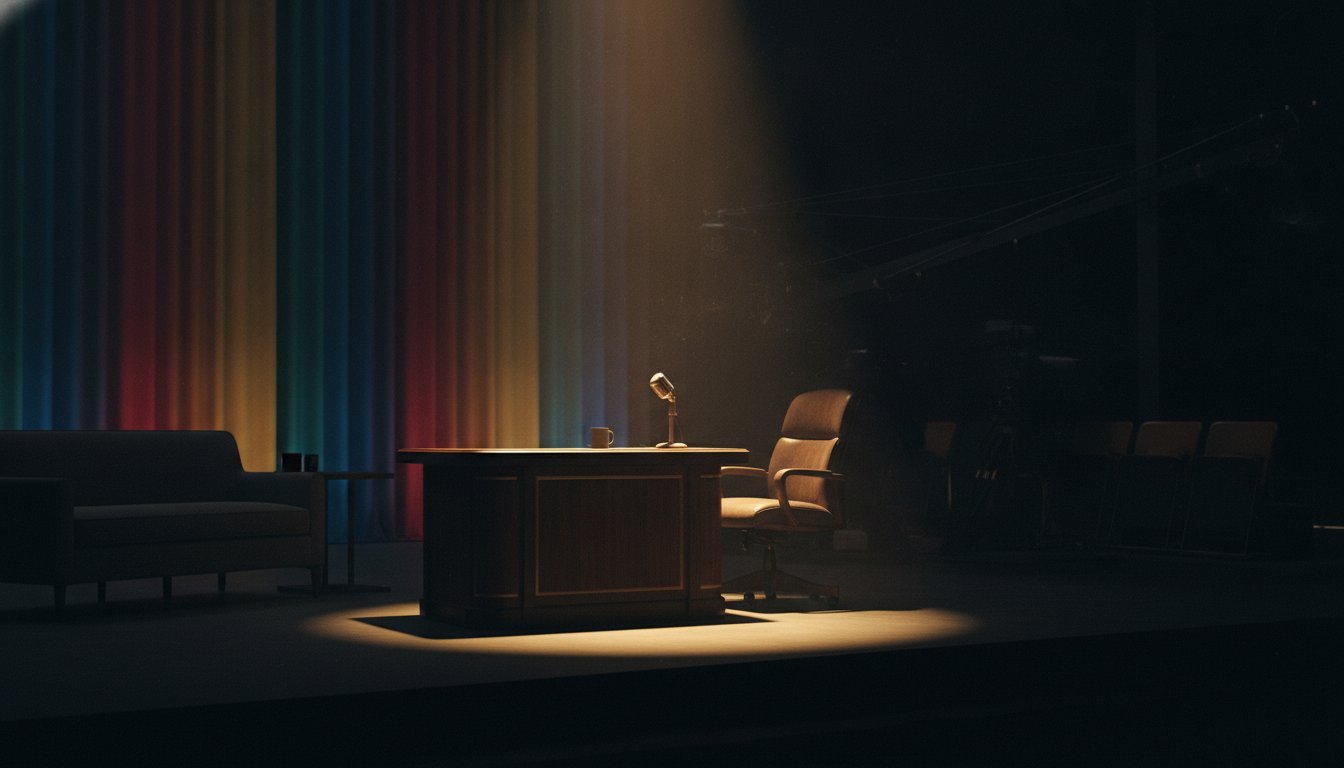
When you ask for Johnny Carson’s last words, the answer isn’t a single quote. It’s a story told in three distinct acts: a final, heartfelt monologue to a nation, a silent wave to a stunned audience, and a quiet, private farewell years later, far from the cameras that defined his life.
For 30 years, Johnny Carson was more than a TV host; he was a national institution, the man who tucked America into bed each night. His departure from The Tonight Show in 1992 wasn’t just the end of a program—it was the end of an era. But the words he spoke that night were only the beginning of his final chapter.
To truly understand Johnny Carson’s last words, we have to look beyond that famous final broadcast and explore the deliberate silence that followed, the surprising final appearance he made, and the dignified privacy he maintained until his very last breath.
‘I Bid You a Very Heartfelt Goodnight’: The 1992 Finale
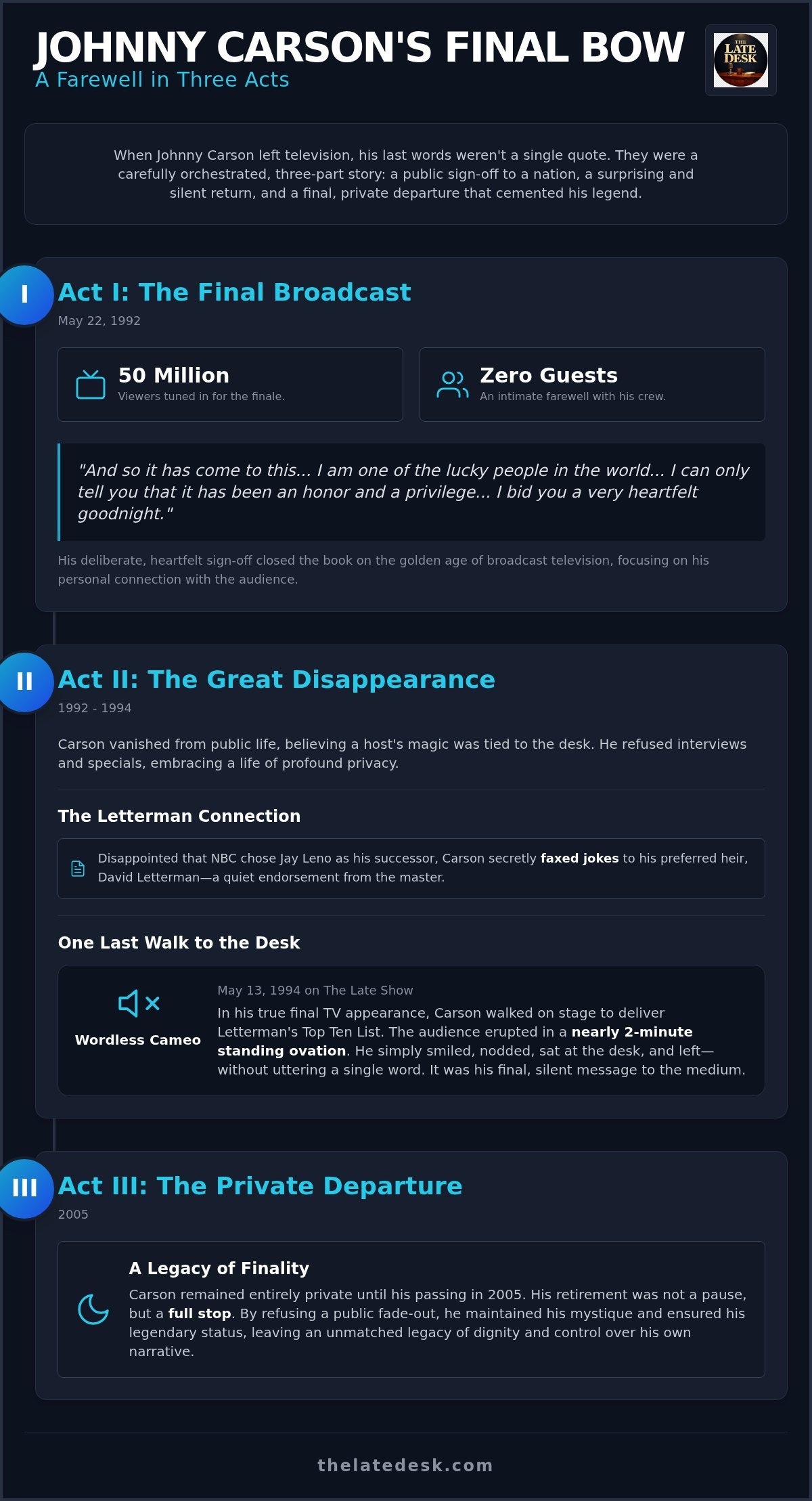
May 22, 1992. The air in NBC’s Studio One in Burbank was thick with a strange mix of celebration and grief. For three decades, this was Johnny’s house, but tonight, the party was ending. Unlike the star-studded penultimate episode featuring Bette Midler and Robin Williams, Carson’s final show had no guests. It was just Johnny, his sidekick Ed McMahon, bandleader Doc Severinsen, and an audience of 50 million people watching at home.
Stripped of the usual comedy bits and celebrity interviews, the final hour was a masterclass in Carson’s signature style: controlled, gracious, and profoundly personal without ever feeling sentimental. He sat on a simple stool, just as he did in his early days, and spoke directly to the camera—and to the generations of viewers who had made him a part of their family.
His final monologue wasn’t a string of jokes but a sincere thank you. He acknowledged his crew, his band, and the enduring bond he shared with Ed McMahon. Then, with a slight tremble in his voice, he delivered the words that would echo through television history:
“And so it has come to this. I am one of the lucky people in the world. I found something I always wanted to do, and I have enjoyed every single minute of it… I can only tell you that it has been an honor and a privilege to come into your homes all these years and entertain you… And so, I bid you a very heartfelt goodnight.”
Crafting a Perfect Farewell
That final sign-off was no accident. Carson and his writers agonized over how to distill 30 years of television into a few closing remarks. While the network and the public craved a massive spectacle, Carson insisted on an intimate, quiet exit. He understood that the moment was bigger than any single guest or comedy sketch. The most-watched moment in late-night history wasn’t about flashy entertainment; it was about a simple, honest goodbye.
He wanted the final memory to be of him, the host, connecting one last time with his audience. By forgoing guests, he ensured the focus remained on the relationship he had built with the viewer at home—a bond that felt deeply personal despite being broadcast to millions.
The Final Image: A King Leaves His Throne
The symbolism of that last scene was powerful. As the credits rolled and the band played on, Carson stood on his mark, taking in the thunderous applause. He shared a look with Ed and Doc, the loyal lieutenants who had been by his side for the entire journey. He wasn’t just a host; he was the captain of a ship that had navigated the currents of American culture for 30 years.
His final bow wasn’t just for the studio audience; it was for the entire country. For many, his departure signaled the end of a more predictable, unified time in media, a time before the internet and cable news fractured the national conversation. When Johnny Carson said goodnight, he was closing the book on the golden age of broadcast television.
The Great Disappearance: Why Carson Walked Away for Good
After his final “goodnight,” Johnny Carson did something almost unthinkable for a modern celebrity: he vanished. He retreated to his sprawling Malibu estate overlooking the Pacific Ocean and embraced a life of profound privacy. He refused all interviews, turned down every offer for a comeback special, and never wrote the tell-all memoir everyone expected.
Carson believed that a host’s magic was tied to the desk. To return as a guest or a commentator would be to “look back,” something he had no interest in doing. His retirement was not a pause; it was a full stop. He spent his days sailing his yacht, the Serengeti, playing tennis with friends, and enjoying the quiet life he had earned. He maintained the mystique of the “King of Late Night” by refusing to tarnish it with a prolonged, public fade-out.
This disciplined disappearance was a key part of his legacy, a deliberate choice that set him apart from nearly every host who followed. For a deeper look into the era he defined, explore The Cinematic History of Late Night Television and the world Carson left behind.
The Letterman Connection
While Carson was publicly silent, he wasn’t entirely disconnected from the world he had left behind. He was famously disappointed that his network, NBC, had passed him over in favor of Jay Leno to be his successor on The Tonight Show. Carson had long championed David Letterman, whose inventive and anarchic style on Late Night he viewed as the true future of the format.
From the seclusion of his Malibu home, Carson would watch Letterman’s new show on CBS and, on occasion, fax over a few jokes for his monologue. It was a secret, one-way pipeline of comedy from the retired master to his chosen heir. This quiet support for Letterman was Carson’s subtle way of influencing the “Late Night Wars” from the sidelines, a final, private endorsement of the man he believed was the rightful keeper of the flame.
One Last Walk to the Desk: The 1994 Letterman Cameo
If his 1992 speech was his formal goodbye, Carson’s true final words to the medium of television were delivered without him saying a thing. On May 13, 1994, David Letterman was hosting his Late Show from Los Angeles. During his monologue, he announced he had a special guest to deliver that night’s Top Ten List.
The curtain opened, and out walked Johnny Carson.
The audience erupted. The standing ovation was immediate, deafening, and lasted for nearly two minutes. People were crying, screaming, and stomping their feet in disbelief. Carson, looking dapper in a suit, simply stood there, smiled, and absorbed the wave of affection. He was visibly moved but remained perfectly composed.
He walked to Letterman’s desk, handed him the list, and sat in the host’s chair. He gave a knowing look to the audience, tapped the desk, and with a simple wink and a wave, he walked off stage. He never uttered a single word.
The Power of a Silent Gesture
Why the silence? Because speaking would have broken the spell. By appearing on Letterman’s show, Carson was making a powerful statement. He was anointing his successor, not with a speech, but with his mere presence. The gesture was a clear, public endorsement that spoke louder than any monologue could.
Letterman, for his part, played the role of the deferential student, stepping aside to let the master have one final moment at the desk. The cameo was a bridge between generations, a passing of the torch that solidified Letterman’s legitimacy and served as a final, quiet rebuke to NBC.
For many television historians, this wordless appearance was Carson’s real farewell. The 1992 finale was for the country, but this moment was for the art form itself. It was a haunting, powerful, and perfectly executed final bow from the greatest to ever do it.
The Final Act: A Private Departure in 2005
For more than a decade after his Letterman cameo, Johnny Carson remained a private citizen. His final years were marked by a quiet battle with emphysema, the result of a lifelong smoking habit. He faced his illness with the same privacy and dignity that characterized his retirement.
On January 23, 2005, Johnny Carson passed away at Cedars-Sinai Medical Center in Los Angeles with his family by his side. He was 79 years old. According to his nephew, his very last words were spoken to his family in his final moments. They were simple, loving, and meant only for them—a stark contrast to the public goodbyes that had defined his career.
Carson died exactly 13 years and 8 months after his final Tonight Show, a period of silence that was as much a part of his legacy as the 30 years of broadcasts that preceded it.
A Legacy Beyond the Stage
In keeping with his wishes, there was no public funeral or memorial service. His body was cremated, and his ashes were given to his wife, Alexis Maas. Carson’s final wish was for no grand spectacle, no public mourning. He didn’t want a gravestone for fans to visit; he believed in moving on.
His final act of generosity was as quiet and impactful as his retirement. His estate, valued at over $450 million, was largely donated to charity through the Johnny Carson Foundation, which continues to support education, healthcare, and the arts. His final exit mirrored his career: controlled, intentional, and on his own terms.
The Echo of a Legend: Why His Finality Still Matters
In an age where celebrity comebacks are common and retirements are often temporary, Johnny Carson’s clean break remains a powerful anomaly. He understood the art of the exit—the importance of leaving the audience wanting more. His refusal to overstay his welcome is what cemented his legendary status.
The “Carson Standard” isn’t just about being a great host; it’s about understanding when and how to say goodbye. He created a benchmark for grace and finality that no late-night host has since been able to match. The revolving door of modern television makes his decisive departure feel even more significant.
So, what were Johnny Carson’s last words? They were a heartfelt goodnight to a nation that loved him. They were a silent nod to the successor he respected. And ultimately, they were a private whisper to the family he cherished.
Decades later, we still search for his last words because we miss the finality he represented. In a world of endless content, Johnny Carson reminds us that sometimes the most powerful statement is knowing when to let the curtain fall.
Explore more stories from the golden age of television in the Late Desk archives.