Imagine a cultural empire where nearly the entire foundation has simply vanished. For devotees of the “Golden Age” of television, this isn’t a metaphor; it’s a sobering reality, as less than 1 percent of Johnny Carson’s “Tonight Show” broadcasts between 1962 and 1972 survived the era’s shortsighted archival practices. NBC famously prioritized the bottom line over history, wiping expensive two-inch quad tapes to record forgotten game shows. Today, the process of recovering lost johnny carson episodes has transformed from a hobbyist’s dream into a high-stakes forensic mission. It’s a race against chemical decay and the ticking clock of magnetic tape degradation.
It’s deeply frustrating to realize that the formative years of a legend are largely a collection of ghost stories. You likely feel the sting of that missing decade every time you search for a clip that doesn’t exist. In this exploration, you’ll discover the forensic methods, technical hurdles, and miraculous recoveries behind the search for Carson’s missing legacy. We’ll examine the intricate technical process of tape restoration and reveal which episodes have recently surfaced from unlikely places. From the vaults of the Department of Defense to specialized labs, we’re mapping the journey to bring the King of Late Night back to the screen.
Key Takeaways
- Uncover the economic reality of the “Great Erasure” and why NBC systematically wiped thousands of hours of early late-night history.
- Explore the forensic detective work involved in recovering lost johnny carson episodes through international syndication records and rare kinescope backups.
- Understand the volatile chemistry of 2-inch Quad tapes and the specialized restoration techniques used to combat the decay of sticky-shed syndrome.
- Learn the story behind the 1964 color breakthrough and where to find the most significant recent archival discoveries.
- Discover practical ways to support the ongoing preservation efforts of the Carson Entertainment Group and help protect the legacy of the King of Late Night.
The Great Erasure: Why Thousands of Carson Episodes Vanished
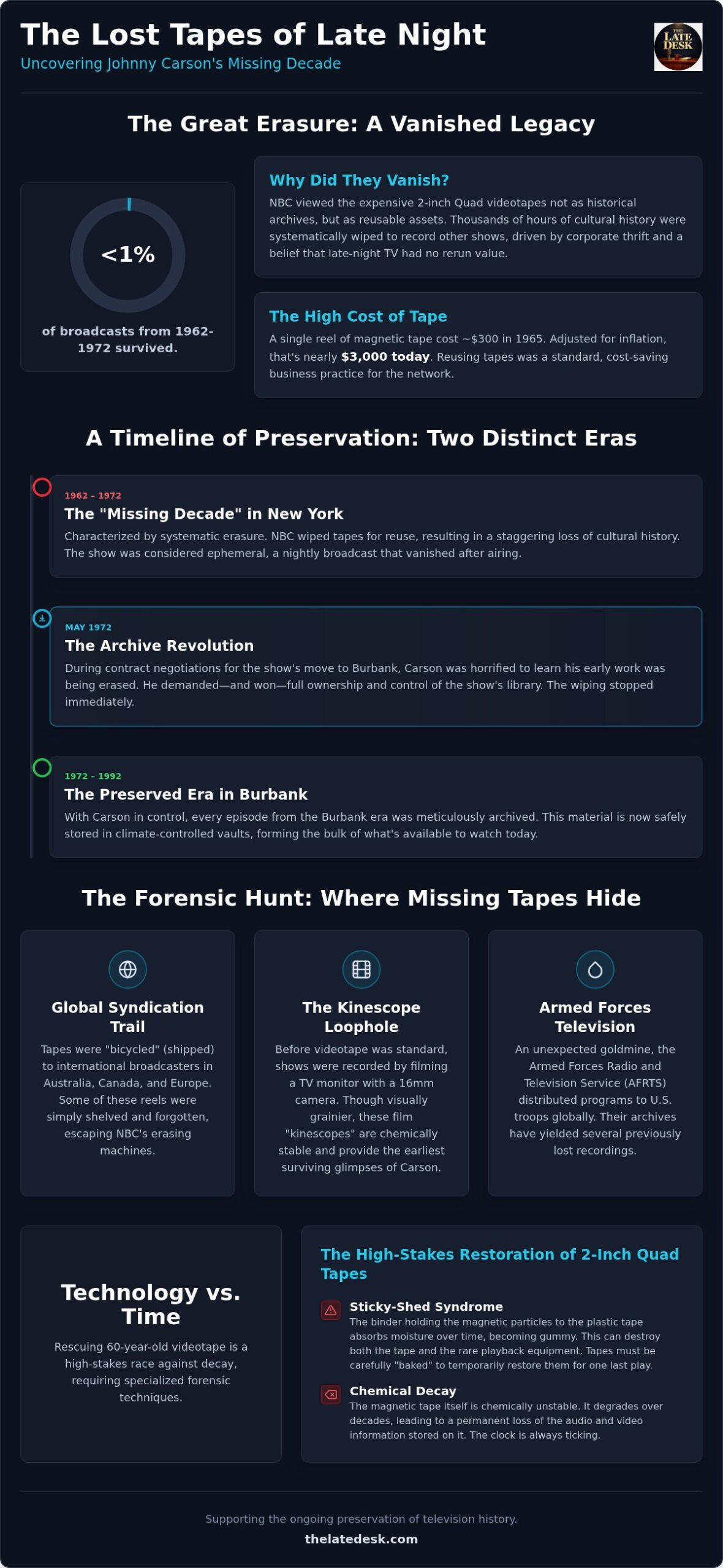
In the dimly lit control rooms of 1960s Rockefeller Center, the future was an afterthought. Producers viewed The Tonight Show as ephemeral, a nightly conversation that vanished into the ether as soon as the final credits rolled. This mindset fueled The Great Erasure of Carson’s early episodes, leaving a cultural void where the first decade of his reign should be. Between 1962 and 1972, thousands of hours of television were recorded, broadcast, and then systematically destroyed. It’s a staggering loss for historians, as less than 1 percent of material from this “missing decade” exists in the official vaults today.
The High Cost of Magnetic Tape
The primary culprit wasn’t a lack of respect for the medium, but the brutal economics of early magnetic tape. In 1965, a single reel of 2-inch Quad videotape cost approximately $300, which is nearly $3,000 when adjusted for today’s inflation. NBC executives didn’t see these reels as archives; they saw them as expensive, reusable assets. To balance the books, technicians would routinely “wipe” the tapes, recording over a historic Carson interview with a daytime game show or a local news segment. This routine erasure was a standard business practice, driven by tax incentives and the belief that late-night television had no “rerun” value. The difficulty of recovering lost johnny carson episodes today stems directly from this era of corporate thrift.
The 1972 Archive Revolution
The tide finally turned during Carson’s high-stakes contract negotiations in the early 1970s. As he prepared to move the production from New York to Burbank in May 1972, Carson demanded something unprecedented: full ownership and control of his show’s library. He had discovered that the network was erasing his early work and was reportedly horrified by the loss. Once he secured the rights, the systematic wiping stopped immediately. This shift created a sharp historical divide. While the Los Angeles era is meticulously preserved in climate-controlled vaults, the New York years remain a fragmented puzzle. The hunt for these lost artifacts is now a race against time, as any surviving tapes from the 1960s continue to deteriorate in private collections. For a comprehensive look at how this pivotal moment reshaped what we know today, the full Tonight Show archives history traces the dramatic rescue of the franchise’s legacy from the wiping era through Carson’s landmark ownership deal.
The Forensic Hunt: Where Missing Tapes Hide in the Modern Age
While NBC’s accountants were busy balancing the books by erasing magnetic tape, Johnny Carson’s image was quietly traveling the globe. The network’s shortsightedness was occasionally thwarted by the very syndication deals that kept the show profitable. Because The Tonight Show was a cultural juggernaut, reels were shipped to international markets that didn’t always share the parent network’s zeal for erasure. Today, the process of recovering lost johnny carson episodes often feels like an international salvage operation, where a dusty warehouse in Melbourne or a forgotten closet in Toronto might hold the only surviving copy of a 1964 broadcast.
The Global Syndication Trail
In the mid-1960s, television stations in Australia, Canada, and parts of Europe relied on a system known as “bicycling.” Instead of receiving a direct feed, these stations would receive physical tape reels via mail, air, or sea. A single 2-inch Quad reel, weighing nearly thirty pounds, would begin its journey in New York, fly across the Atlantic to a London studio, and then be “bicycled” to another broadcaster in Western Europe before finally being retired. Because these tapes were far from the reach of NBC’s erasing machines, some were simply shelved and forgotten rather than being wiped and reused. These international survivors represent some of the most promising leads for modern archivists.
Beyond videotape, the “kinescope loophole” has provided another vital lifeline. Before high-quality tape became the industry standard, networks used kinescopes, which were essentially 16mm film cameras pointed at a high-resolution television monitor. While the visual quality is noticeably grainier than tape, film is chemically stable and doesn’t require the same specialized playback equipment. Many of the earliest surviving glimpses of Carson’s New York years exist only because a producer or a guest requested a kinescope copy for their personal files.
Armed Forces Radio and Television Service (AFRTS)
Perhaps the most unexpected goldmine for television historians is the United States military. The Armed Forces Radio and Television Service (AFRTS) recorded and distributed Carson’s monologues and interviews to boost the morale of troops stationed in remote outposts. Unlike the commercial networks, which viewed the show as a temporary product, the military often maintained these recordings as part of a broader media cache. In a stunning breakthrough for those dedicated to recovering lost johnny carson episodes, several lost episodes discovered at a military facility recently provided scholars with rare footage from the 1963 season.
These military recordings are unique because they were often edited to remove commercial breaks, leaving behind a lean, performance-heavy version of the show. As the Department of Defense continues to declassify and digitize its media archives, more of these “morale boosters” are coming to light. For fans of the golden age, these discoveries are more than just nostalgia; they are a vital reconstruction of a legend. If you’re drawn to the hidden narratives of broadcasting history, our historical television articles offer a deeper look into the moments that shaped the medium.
Technology vs. Time: The High-Stakes Restoration of 2-Inch Quad Tapes
While the discovery of a lost reel brings jubilation, the physical reality inside the canister is often a nightmare of chemical instability. The search for a missing broadcast is only half the battle; the other half is a frantic race against the natural laws of decomposition. For archivists dedicated to recovering lost johnny carson episodes, the primary enemy is not just time, but the very materials used to record history in the 1960s. The 2-inch Quad videotapes of that era were never designed for longevity, and today, many of them are literally falling apart at the molecular level.
The Chemistry of Decay
The most pervasive threat to these archives is a phenomenon known as sticky-shed syndrome. This occurs through a process called binder hydrolysis, where the polyurethane binder that holds the magnetic particles to the plastic tape backing begins to absorb moisture from the air. Over decades, this chemical reaction turns the tape into a gummy, unplayable mess. If a technician attempts to play a compromised tape without intervention, the magnetic coating will simply peel off, clogging the playback heads and destroying the footage forever. To combat this, restoration experts use a high-stakes technique called “baking.” By placing the reels in a precision-controlled incubator for several hours, they drive out the moisture and temporarily stabilize the binder. It is a “one-shot” opportunity; once the tape is baked and played, it may never be viable for another pass.
From Analog to Digital Gold
Once a tape is stabilized, it must be played on massive, obsolete machines that are increasingly difficult to maintain. These 2-inch Quad recorders are mechanical marvels of a bygone era, requiring specialized engineers to keep their spinning heads aligned to within microns. During this transfer, every remaining pixel is captured through high-resolution scanning to ensure that the digital surrogate is as faithful to the original as possible. This process is particularly vital for color recordings, such as the rare 1964 footage. Digital color recovery can now pull vibrant, saturated hues from even the most degraded signals, bringing the “living color” of the NBC peacock era back to life for a modern audience.
Audio restoration is the final, delicate layer of the process. Engineers work to surgically remove the persistent hiss and hum of sixty-year-old mono tracks while preserving the intimate atmosphere of the studio. They aim to capture the subtle nuances of Carson’s delivery and the spontaneous reactions of the live audience without the interference of decades of magnetic “print-through.” For those who wish to explore these digital graveyards further, our guide to online television archives for researchers offers a comprehensive map to the most significant media history collections currently available to the public.
Notable Recoveries: The August 1964 Breakthrough and Beyond
The quest for lost media often begins with a whisper in an obscure corner of the internet. In the case of the most famous survival story in late-night history, the miracle occurred not in a network vault, but through the persistent detective work of online hobbyists. For decades, the August 24, 1964, broadcast was a ghost, until a mislabeled reel surfaced in a private collection following a tip on the Steve Hoffman music forums. The process of recovering lost johnny carson episodes reached a fever pitch as archivists at DC Video realized they were holding a holy grail: the earliest known high-quality color videotape of the show.
The 1964 Color Discovery
Identifying this specific reel was a grueling task that required the instincts of a forensic investigator. Because the tape was a raw recording, it lacked the standard “color bars” or production “slates” that typically identify a broadcast’s date and origin. Restoration experts had to cross-reference guest logs and internal NBC memos to confirm they had found the 1964 broadcast. The result was a revelation. Seeing a young, vibrant Carson in vivid color during his New York prime offered a startling contrast to the grainy kinescopes of the era. It captured a moment in time when Johnny was still the hungry challenger to the late-night throne, long before he became its undisputed king.
The Lucille Ball Legacy
While thousands of hours were lost to the network’s erasers, appearances by certain Hollywood titans often escaped the purge. Guest spots by icons like Lucille Ball were frequently prioritized for preservation by production staff who recognized their immediate historical value. These segments reveal a fascinating chemistry between the King and the Queen of television, capturing unscripted “insider” moments that feel startlingly modern. Understanding the lucille ball television legacy requires seeing her in these candid environments, where the professional respect and playful rivalry between the two stars is on full display.
Even with the meticulous archiving of the Burbank era, mysteries still persist. A 1981 episode recently became the subject of a viral Reddit investigation, proving that even the well-documented years can harbor “lost” moments due to licensing disputes or misfiled masters. However, the true allure remains the “lost” New York monologues. Unlike the polished, highly produced segments from California, the New York footage feels raw and dangerous. Carson was still sharpening his persona, and the atmosphere of the Studio 6B stage was electric with the energy of Manhattan. To stay informed on the latest breakthroughs in recovering lost johnny carson episodes and other media milestones, explore our historical television articles for exclusive archival insights.
Preserving the King of Late Night: How to Support Television Archive Preservation
The survival of Johnny Carson’s legacy is no longer left to the whims of network executives or the chemical decay of magnetic tape. Today, the responsibility rests with a dedicated group of professionals and a global community of “citizen archivists” who refuse to let the past fade into static. While the mission of recovering lost johnny carson episodes remains a high-stakes endeavor, the existing foundation is remarkably robust. The Carson Entertainment Group now manages a staggering archive of over 4,000 hours of footage, acting as a lighthouse for television history and ensuring that the king’s reign is never truly forgotten.
The Modern Carson Archive
The transition from physical reels to cloud-based historical preservation has revolutionized how we interact with the past. The Carson estate has moved beyond the era of fragile 2-inch Quad tapes, meticulously digitizing and licensing footage for a new generation of viewers on digital platforms. This shift allows for a level of accessibility that was unthinkable during the era of corporate wiping. It also helps clarify the reality of what is truly gone versus what is simply waiting to be found. For those interested in separating fact from fiction, our investigation into lost late night tv episodes explores the persistent myths surrounding these missing broadcasts.
The Citizen Archivist
You don’t need a degree in media studies to play a role in this historical rescue mission. Many of the most significant finds have occurred in the wild, tucked away in estate sales, local television station basements, or private collections. If you happen to encounter a heavy, 2-inch wide magnetic tape or a 16mm film reel labeled with a date from the 1960s, you might be holding a piece of the puzzle. Identifying these artifacts is the first step; contacting institutions like the Paley Center for Media or the Library of Congress ensures they receive the professional care they require. Scholars and serious researchers looking to navigate these institutional repositories with precision will find our guide to television history for scholars an invaluable roadmap through the fragmented landscape of media preservation.
The future of this hunt is increasingly digital. Artificial intelligence is now being deployed to “upscale” and enhance recovered footage that was previously deemed too low-quality for broadcast. By sharpening the grain of a 1963 kinescope or stabilizing the flicker of a degraded tape, technology is bridging the gap between the analog past and the high-definition future. We invite you to join the conversation at The Late Desk to help preserve the history of late night television. Every discovery, no matter how small, brings us one step closer to recovering lost johnny carson episodes that were once thought to be gone forever.
The Ongoing Quest for Television’s Holy Grail
The hunt for Carson’s missing New York years is more than a technical challenge; it’s a restoration of our collective memory. We’ve moved from an era of corporate neglect to a sophisticated age of forensic discovery. Whether it’s through the chemical stabilization of 2-inch Quad tapes or the declassification of military archives, the path to recovering lost johnny carson episodes is paved with both science and serendipity. These efforts ensure that the formative brilliance of the 1960s isn’t lost to the static of history forever.
Your role as a fan and researcher is vital in this preservation journey. By understanding the “story behind the story,” we keep the legacy of the golden age alive. To dive deeper into these narratives, Explore the Vaults of Late-Night History at The Late Desk. Our detailed analysis of 30 plus years of television history and expert insights into the golden age of broadcasting provide a comprehensive guide for every media researcher. The next great discovery could be waiting in a dusty attic or a mislabeled reel. Keep searching; the king’s legacy is still being written.
Frequently Asked Questions
How many Johnny Carson episodes are actually lost?
Thousands of broadcasts from the show’s first decade are currently missing from the official record. While the Los Angeles era is well preserved, the vast majority of the New York years were lost due to network wiping. Estimates suggest that out of roughly 2,500 episodes produced between 1962 and 1972, only a tiny fraction exists today. This makes the mission of recovering lost johnny carson episodes a priority for television historians seeking to document the show’s formative period.
Why did NBC wipe the early Tonight Show tapes?
NBC viewed magnetic tape as a reusable business asset rather than a historical record during the 1960s. A single reel of 2-inch Quad tape was a significant expense, often costing the equivalent of thousands of dollars in today’s currency. To save money, the network routinely recorded over old broadcasts with new programming like daytime game shows. Executives at the time simply didn’t anticipate the long-term cultural value or future syndication potential of late-night television.
Where can I watch the recovered 1964 Johnny Carson episode?
The famous August 1964 color episode is managed by the Carson Entertainment Group and has been featured in various retrospective specials. While the full master is kept in archival storage for preservation, significant portions and clips are often available on the official Johnny Carson YouTube channel. This allows fans to witness the high-quality restoration work performed by DC Video, which brought the earliest known color footage of the show back to the public eye.
Did Johnny Carson own the rights to his show?
Johnny Carson secured full ownership and control of his show’s library starting in 1972 during high-stakes contract negotiations. Before this landmark deal, the rights belonged entirely to NBC, which explains why the network was able to erase so much of his early work without his consent. Once Carson gained control, he ensured that every episode from the move to Burbank onward was meticulously archived. This shift in power dynamics fundamentally changed how television history was preserved.
What is the oldest surviving episode of The Tonight Show Starring Johnny Carson?
The oldest surviving material consists of fragmented clips from 1962 and 1963, often found in military archives or guest kinescopes. A reel of 1963 clips discovered at a Department of Defense facility remains one of the earliest significant finds. However, the August 24, 1964, broadcast holds the distinction of being the earliest known full-length color videotape survival. These rare artifacts provide a vital window into the show’s early atmosphere at Rockefeller Center.
Can AI be used to “recreate” lost Johnny Carson episodes?
AI technology is currently used for enhancing and upscaling existing low-quality footage rather than fabricating entirely new episodes from scratch. While generative AI can mimic voices, archivists focus on using these tools to sharpen the grain of 16mm kinescopes or stabilize flickering magnetic signals. This technical assistance is crucial for recovering lost johnny carson episodes that were previously deemed unwatchable, allowing modern audiences to see the Golden Age in unprecedented detail.
What happens if I find an old film reel of The Tonight Show?
If you discover a vintage film reel or magnetic tape, you should contact a professional archival institution like the Paley Center for Media immediately. These organizations are equipped to handle fragile media and can verify the content’s historical significance. It is important to avoid playing the reel on unmaintained home equipment. Old tapes often require chemical stabilization or specialized baking before they can be safely viewed without causing permanent physical damage to the magnetic coating.