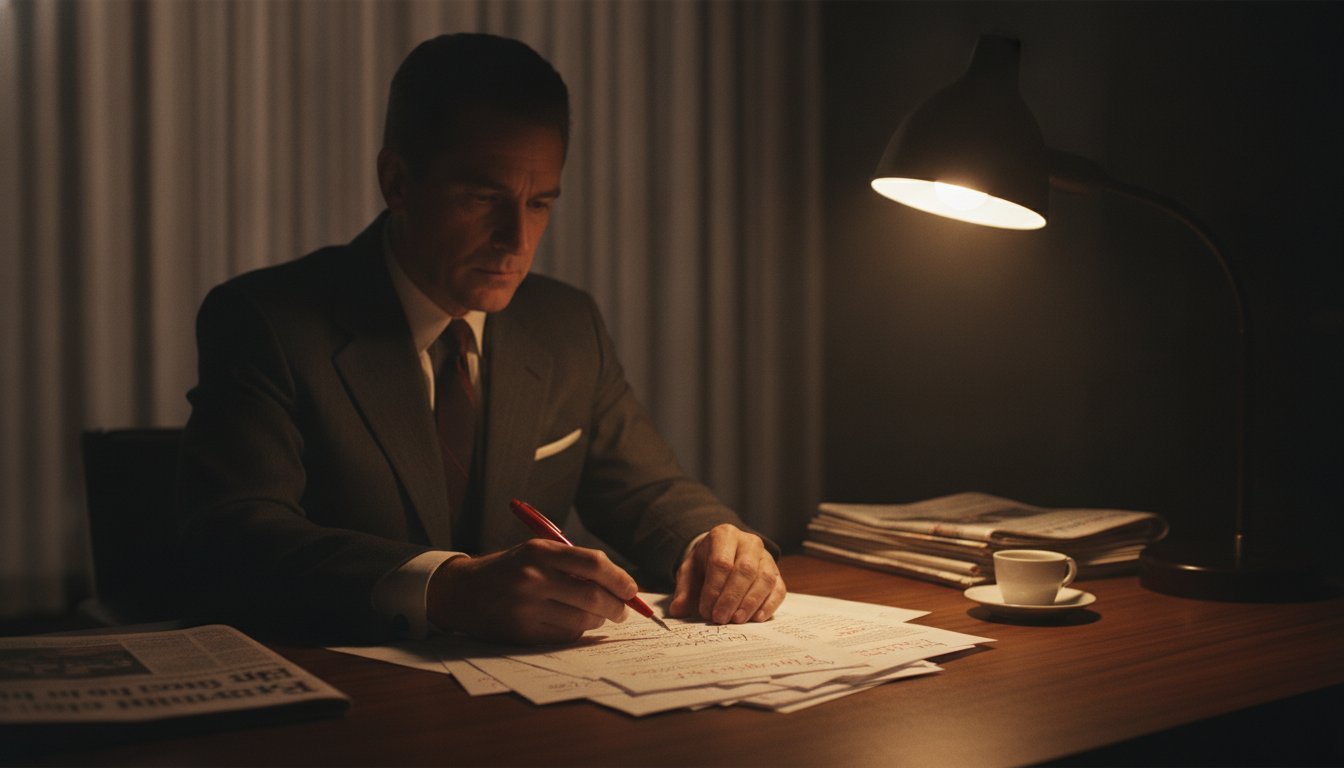
Imagine the quiet tension of the Burbank studio at four in the afternoon. While the band tuned their instruments, one man sat alone with a stack of paper and a sharp red pen, deciding the fate of the evening’s laughter. Most viewers assumed the King of Late Night simply walked out and spoke from the heart, but the reality was a meticulously engineered assembly line. To understand how Johnny Carson prepared his monologue is to understand a thirty year obsession with precision that turned a simple comedy routine into a national institution.
You likely remember the effortless charm and the iconic golf swing, yet the “golden age” of television was built on a foundation of ruthless editorial discipline. This article pulls back the curtain on the rigorous daily routine that fueled ten million nightly viewers. You’ll discover the specific writing secrets Carson used to filter hundreds of jokes, the high stakes pressure his staff faced, and the strategic “safety net” he used to turn a failing joke into a comedic victory. From the first pitch at dawn to the final cue card, this is the secret architecture behind the greatest opening in television history.
Key Takeaways
- Trace the morning ritual of the writing room, where writers scoured daily newspapers to find the topical pegs that defined the national conversation.
- Discover the solitary editorial process and the specific marking system used to understand how Johnny Carson prepared his monologue with surgical precision.
- Explore the “Save File” strategy, a mental library of quips that allowed Carson to transform a failing joke into a masterclass in meta-comedy.
- Analyze the psychological role of the 5:30 PM deadline and why the monologue became a necessary nightly ritual for millions of American households.
- Identify the enduring production blueprint that remains the gold standard for modern late-night hosts navigating the streaming era.
The 5:30 PM Deadline: The Monologue as an American Institution
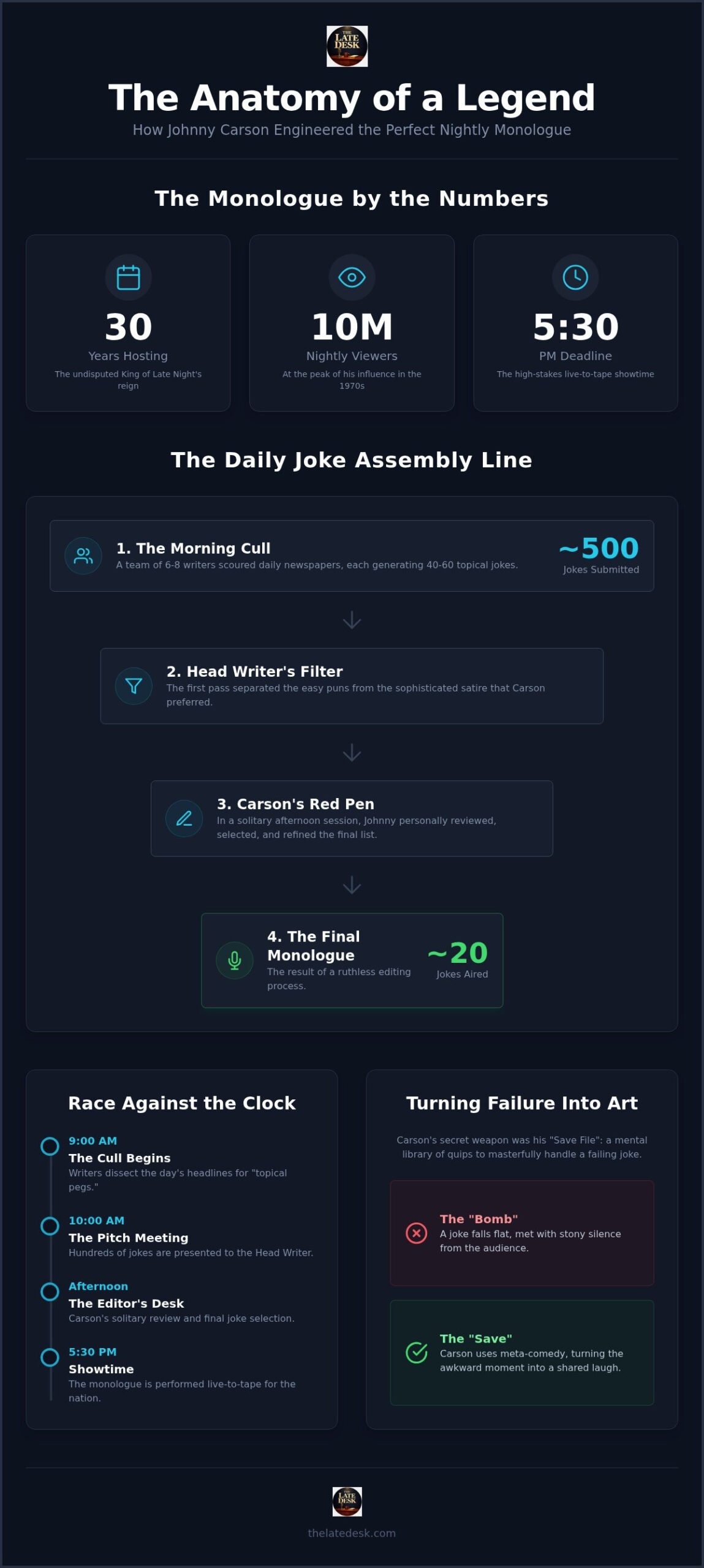
Every weeknight for thirty years, a specific silence fell over millions of American living rooms. It wasn’t just entertainment; it was a collective exhale. At the height of his influence in the 1970s, The Tonight Show Starring Johnny Carson attracted ten million viewers nightly. These viewers didn’t just want to laugh. They needed someone to process the chaos of the day’s headlines into something digestible. The monologue acted as a cultural “state of the union,” a brief window where the host served as the nation’s informal editor-in-chief. Understanding how Johnny Carson prepared his monologue reveals why these few minutes carried such immense psychological weight. He wasn’t just telling jokes; he was setting the tempo for the entire broadcast. Whether the show ran for 90 minutes in the early years or 60 minutes later on, the monologue was the anchor that decided the energy of the evening.
The Weight of the First Ten Minutes
The air in the Burbank studio grew heavy as the clock approached 5:30 PM. For the production crew, this was the most volatile segment of the day. Unlike a pre-taped sketch or a musical performance, the monologue was live-to-tape, meaning any stumble, technical glitch, or stony silence was permanent. The “curtain reveal” became a ritualistic moment in television history, signaling to the audience that no matter how difficult the day had been, the world was still spinning. This era is explored deeply in our analysis of The Tonight Show with Johnny Carson: The 30-Year Reign of Late Night’s King, where the pressure of maintaining this gold standard is laid bare. For Carson, those first ten minutes were a test of his connection with the public, a nightly renewal of a contract built on trust and timing.
The Evolution of the Opening Bit
Carson didn’t invent the late-night opening, but he certainly perfected it. He inherited a format from Steve Allen, who leaned into musical zaniness and piano-based comedy, and Jack Paar, who favored emotional, long-form storytelling that often veered into the personal. Carson recognized that a tired, post-war audience wanted something sharper and more reliable. He transitioned the show into a rapid-fire topical structure that prioritized the “peg,” a specific news item that served as the joke’s foundation. The Carson monologue was a high-wire act that blended the authority of a news broadcast with the rhythmic punch of a vaudeville stage. This shift changed legendary talk show monologues history forever, creating the blueprint that every successor from David Letterman to Jimmy Fallon has attempted to replicate. It was no longer about the host’s mood; it was about the day’s reality, filtered through a lens of sophisticated irony.
The Assembly Line of Wit: Inside the Carson Writing Room
Before the sun had fully warmed the NBC studios in Burbank, the air in the writers’ wing was already thick with coffee and the rustle of newsprint. To understand how Johnny Carson prepared his monologue, one must first look at the “Morning Cull.” Every morning, a team of roughly six to eight writers performed a ritual of deep immersion. They didn’t just read the Los Angeles Times and the New York Times; they dissected them, hunting for the “topical pegs” that would anchor the evening’s humor. By 10:00 AM, the room was a hive of activity as these writers pitched their findings. This ritual was the start of a grueling assembly line designed to produce a surplus of wit, ensuring that only the sharpest observations reached the host’s desk.
The sheer volume required was staggering. Each writer was expected to generate between 40 and 60 jokes daily. In a room of eight writers, this resulted in nearly 500 potential lines for a monologue that rarely exceeded 20 jokes. This mathematical ruthlessness was the secret to the show’s consistency. A Head Writer acted as the first filter, separating the “chaff”—the easy, obvious puns—from the sophisticated satire Carson preferred. It was a high-stakes environment where being “on thin ice” wasn’t a metaphor. If a writer failed to land a joke for two consecutive nights, their position in the hierarchy was immediately questioned. For those interested in the broader history of these production secrets, you can find more deep dives into classic broadcasting archives at The Late Desk.
The Daily Production Timeline
The schedule was a relentless march toward the 5:30 PM taping. From 9:00 AM to 1:00 PM, topicality was the only priority. Writers worked in isolation, hammering out variations on the morning’s news. By 2:00 PM, a collated first draft was delivered to Johnny’s private office. This was the moment the raw material met the master’s eye. Finally, at 4:00 PM, a brief session allowed for final joke sorting, ensuring the flow was rhythmic and the energy was high. This disciplined structure became The Blueprint for Modern Late Night, establishing a workflow that remains largely unchanged in the industry today.
The Diverse Stable of Writers
Carson was deliberate about the composition of his room. He didn’t want a single comedic voice; he wanted a symphony of perspectives. He hired writers with backgrounds ranging from old-school vaudeville to Ivy League satire to ensure a broad comedic range that appealed to both Middle America and the coastal elite. This diversity created a unique set of late night tv power dynamics. While the writers were colleagues, they were also competitors in a “survival of the funniest” contest. Every night was a battle to see whose “voice” would be channeled through Johnny’s iconic delivery, creating a professional hierarchy where status was earned solely through laughter.
The Editor-in-Chief: How Johnny Polished the Daily Draft
While the writers’ room functioned as a high-volume factory, the host’s private office served as the final quality control lab. Behind a closed door, Johnny Carson sat alone with a No. 2 pencil and a “big sheet,” a long, legal-sized document containing the day’s best submissions. This solitary ritual was the most critical phase of how Johnny Carson prepared his monologue. He was not merely a performer reading lines; he was a master editor who understood that the difference between a roar and a groan often lay in a single misplaced syllable. He approached the script with the cold eye of a surgeon, looking for anything that slowed the momentum of the bit.
He employed a sophisticated marking system to architect the set. He labeled jokes by their energy levels and strategic placement, using shorthand to designate the “opener” and the “kicker.” Opener jokes needed to be broad and high-energy to grab the audience immediately. Kickers were the sophisticated punchlines that allowed him to transition smoothly into the next segment or the first commercial break. He was famously ruthless with his pencil. He stripped away every unnecessary word to ensure the setup was as lean as possible. He would often read the jokes aloud to himself, testing the internal rhythm and the specific “beat” of the punchline. If the cadence felt unnatural for his midwestern delivery, the joke was discarded regardless of its merit.
Adapting the News to the ‘Johnny’ Persona
Carson’s genius lay in his ability to act as an “Everyman” filter. He took dry political facts or complex coastal scandals and transformed them into observations that resonated in living rooms from Burbank to Des Moines. He avoided being overly partisan or intellectual, leaning instead into the shared frustrations of the common man. This careful curation of a public identity is a recurring theme in The Lineage of Laughter: A Definitive History of Tonight Show Hosts, illustrating why he remained the most trusted voice in late night. He knew his audience didn’t want a lecture; they wanted a wink and a nod from someone who saw the world as they did.
The Last-Minute Audible
The preparation didn’t end when the pencil was set down. In the high-stakes world of classic broadcasting, news could break at any moment. If a major event occurred between the 4:00 PM rehearsal and the 5:30 PM taping, the script was frequently scrapped or modified. Carson maintained a profound level of trust with his producer, Fred de Cordova. During the final countdown, they would huddle in the wings, whispering adjustments and inserting fresh “pegs” to ensure the monologue felt as immediate as a live news bulletin. This agility allowed him to maintain his status as the definitive nightly chronicler of American life.
Turning Failure into Art: The Preparation for ‘The Bomb’
A joke lands in the Burbank studio and receives nothing but the hollow echo of a cooling ventilation system. For most comedians, this “stony silence” is a nightmare that signals a loss of control. For Johnny Carson, it was a strategic opportunity. A vital component of how Johnny Carson prepared his monologue was the secret realization that perfection is less interesting than a shared struggle. He was the first host to master the “Meta-Monologue,” a technique where the failure of the joke became the new subject of the comedy. By inviting the audience to witness the “bombing” process, he dismantled the fourth wall and turned a potential disaster into a moment of intimate connection.
This wasn’t merely a lucky byproduct of his wit. It was the result of the “Save File,” a mental library of pre-written quips designed specifically for when a topical peg failed to produce a laugh. While competitors might scramble or sweat under the hot lights, Carson remained composed because he had already rehearsed the failure. He spent as much time practicing his non-verbal reactions as he did his punchlines. The “mock-shock” expression and the legendary “slow burn” were carefully calibrated tools. These gestures allowed the audience to laugh at the situation rather than the comedian, building a level of trust that a flawless performance could never achieve. If you want to explore more about the professional hierarchies and production secrets of this era, visit The Late Desk’s historical archives for a deeper look at broadcasting history.
The Psychology of the ‘Save’
There is a profound psychological shift that occurs when a powerful figure admits they have made a mistake. By acknowledging a joke was “bad,” Carson became instantly relatable to the viewer at home. He wasn’t a distant star; he was a working professional having a rough day at the office. Ed McMahon played a crucial role here, using his booming, infectious laugh to signal that the “bomb” was all part of the fun. The iconic golf swing served as a physical punctuation mark for a failed bit, signaling to the room that the tension was released and the show would move forward together.
Rehearsing the Improv
True spontaneity in broadcasting is often a carefully constructed myth. Carson’s ability to handle technical glitches or sudden audience interruptions was rooted in “structured spontaneity.” He and his team anticipated potential disruptions, from a microphone failure to a rowdy guest in the front row. By preparing for these variables, he could pivot without losing the show’s momentum. This preparation ensured that even the most chaotic moments felt like they were part of a larger, controlled narrative. It was this paradoxical blend of rigid structure and elastic reaction that defined the gold standard of late-night television.
The Blueprint for Modern Late Night: Carson’s Lasting Legacy
The era of the No. 2 pencil and the “big sheet” may have passed, but the ghost of Johnny’s discipline still haunts every late-night studio from 30 Rock to Hollywood Boulevard. While the technology has shifted from carbon paper to cloud-based scripts, the fundamental architecture of the late-night opening remains remarkably consistent. Modern hosts like Stephen Colbert, Jimmy Kimmel, and Jimmy Fallon still begin their days with a digital version of the “Morning Cull,” scanning social media and news feeds for the same topical pegs that Carson’s writers once hunted in the LA Times. To study how Johnny Carson prepared his monologue is to study the DNA of the entire genre. The transition from a solitary host with a pencil to a high-speed digital writers’ room has changed the speed of production, but it hasn’t changed the requirement for ruthless editorial precision.
The topical monologue has proven to be the ultimate survivor of the streaming age. In an era where audiences can watch anything at any time, the monologue remains one of the few pieces of content that feels “of the moment.” It provides a nightly anchor in a fragmented media landscape, fulfilling the same psychological need for a shared cultural perspective that Carson established decades ago. This enduring format is why Carson’s approach remains the gold standard in legendary talk show monologues history. He didn’t just host a show; he engineered a delivery system for the American zeitgeist that is still being utilized, refined, and respected by his successors today. That 30-year run came to an emotional close on May 22, 1992, and if you’ve ever wondered when did Johnny Carson leave The Tonight Show and what made his final broadcast so historic, the full story reveals just how profoundly his departure shook the nation.
From Burbank to the Digital Age
The shift from the expansive 90-minute variety shows of the 1960s to today’s 10-minute “viral” monologue segments was actually predicted by Carson’s own editorial style. He was obsessed with a “lean” joke structure, stripping away the narrative fluff that slowed down the pace. This economy of language made his bits perfect for the short-attention-span needs of modern social media snippets. When a viewer watches a punchy 60-second clip of a monologue on their phone today, they’re experiencing the direct evolution of the rhythmic, high-speed editing Carson perfected in his Burbank office. He understood that the audience’s time was a gift, and he refused to waste a single second on a joke that didn’t earn its keep.
Final Verdict on the King’s Craft
The greatest irony of Carson’s career is that his immense labor was designed to be invisible. His effortless charm was not a natural occurrence; it was the curated result of an exhaustive daily assembly line. Preparation was the hidden foundation that allowed him to stand behind the curtain with total confidence, knowing that every “bomb” had a save and every “hit” had a rhythm. For those who wish to understand the broader arc of this medium, you can Explore more behind-the-scenes secrets of the Golden Age of Television at The Late Desk. Johnny Carson remains the definitive architect of late night because he realized that the most spontaneous moments in television are almost always the ones that were the most carefully planned.
Mastering the Invisible Art
The curtain has long since closed on the Burbank era, yet the structural integrity of the late-night monologue remains anchored in the standards set by its greatest architect. We’ve seen that Johnny Carson’s effortless charm was a product of relentless labor, from the mathematical volume of the writers’ room to the solitary precision of his red pencil. By preparing for “the bomb” as thoroughly as the hit, he transformed the unpredictable nature of live television into a nightly masterclass in audience trust. This meticulous study of how Johnny Carson prepared his monologue reminds us that true brilliance in broadcasting is rarely accidental. It’s engineered.
Our archival-quality research into the Tonight Show’s 30-year history provides an in-depth analysis of the “Business of Laughter” and the power dynamics that shaped an entire industry. If you want to peel back the layers of classic television and find the story behind the story, the journey doesn’t have to end here. Discover more hidden stories from Late Night’s Golden Age at The Late Desk. The archives are open, and the next great discovery is waiting just behind the curtain.
Frequently Asked Questions
Did Johnny Carson write his own monologues?
Johnny Carson did not write the raw material alone, but he was the final architect of every script. While a staff of writers provided the “pegs,” Carson spent his afternoons refining the cadence and word choice to fit his specific persona. This meticulous editorial control was the primary reason his delivery felt so personal and effortless to the millions watching at home.
How many writers did Johnny Carson have for The Tonight Show?
The writing staff typically consisted of six to eight individuals at any given time. This was a high-pressure environment where writers were expected to produce dozens of jokes daily just to see a single line make it to the air. The room was a mix of seasoned veterans and fresh talent, ensuring a balance of traditional punchlines and modern observations.
How long did it take to prepare a typical Johnny Carson monologue?
Preparing the monologue was an intensive eight-hour daily ritual. The process began at 9:00 AM with the morning news cull and didn’t conclude until the final rehearsal around 4:00 PM. This timeline was essential for how Johnny Carson prepared his monologue, as it allowed the team to incorporate breaking news that occurred just hours before the 5:30 PM taping.
What did Johnny Carson do if a joke failed during the monologue?
If a joke received “stony silence,” Carson leaned into the failure rather than ignoring it. He maintained a mental library of “save” lines and relied on his mastery of non-verbal comedy, such as the famous “slow burn” toward the camera. These reactions often generated bigger laughs than the original jokes, turning a moment of professional tension into a shared comedic victory.
Did Johnny Carson use a teleprompter or cue cards for his monologue?
Carson relied exclusively on large, hand-lettered cue cards held near the camera lens. This was a central part of how Johnny Carson prepared his monologue for performance, as it allowed him to maintain conversational eye contact. Barney McNulty, the legendary “King of Cue Cards,” ensured the timing of the card-pulling matched Johnny’s rhythmic delivery perfectly, preserving the illusion of a spontaneous chat.
What time did Johnny Carson tape his show in Burbank?
Taping began promptly at 5:30 PM at the NBC studios in Burbank. This schedule allowed the show to be edited and transmitted to the East Coast for its 11:30 PM broadcast slot. Carson usually arrived at the studio by early afternoon to begin the final selection process, ensuring the material was as fresh as possible for the live-to-tape recording.
Why did Johnny Carson always do a golf swing after a joke?
The signature golf swing was a physical punctuation mark that signaled the transition between comedic beats. He used it to move past a joke that failed or to indicate that the monologue was reaching its conclusion. As an avid golfer in his private life, the gesture felt authentic to his persona and became one of the most recognizable visual cues in television history.
How did the shift from New York to LA change Carson’s monologue preparation?
The 1972 move to Burbank shifted the news cycle and the tone of the writing room. In New York, the humor often leaned toward the grit of the city and Broadway culture. In California, the “topical pegs” became more celebrity-focused and relaxed, reflecting the laid-back energy of the West Coast while still maintaining the rigorous editorial standards that defined his career. To understand the full impact of this transition, the story of Johnny Carson’s first show in the LA studio reveals just how high the stakes were on that pivotal opening night in Burbank.