What if the most influential stage in American history wasn’t a Broadway theater, but a mahogany desk tucked inside a windowless studio? Most fans of late-night television recognize the familiar rhythm of the opening jokes and the guest interviews; however, the origins of these rituals often remain buried under decades of broadcast static. You likely feel that modern histories skip the crucial radio years or leave the early rivalries between NBC and CBS in a blur of confusion. This article traces the cinematic journey of the format, providing a deep look into the evolution of the late night monologue and the specific moments that turned a simple conversation into a national ritual.
You’ll gain a clear understanding of the talk show blueprint, moving from the intimate whispers of the radio era to the high-stakes glamour of the television age. We’ll revisit the pivotal contributions of pioneers like Steve Allen and Jack Paar, whose experiments set the stage for the legendary reign of Johnny Carson. By the end of this guide, you’ll see the “National Fireplace” not just as a collection of segments, but as a carefully crafted legacy that continues to shape our digital world today. Let’s step behind the curtain and rediscover the story behind the story.
Key Takeaways
- Discover how the intimate “at home” aesthetic of radio created the invisible stage for the modern talk show host.
- Contrast Steve Allen’s chaotic variety experiments with Jack Paar’s transition into high stakes, personal conversation.
- Trace the evolution of the late night monologue as Johnny Carson refined the segment into a mandatory cultural ritual.
- Explore the modern metamorphosis of the genre, where satire and digital competition shifted the host’s role toward journalism.
The Invisible Stage: How Radio Birthed the Talk Show Blueprint
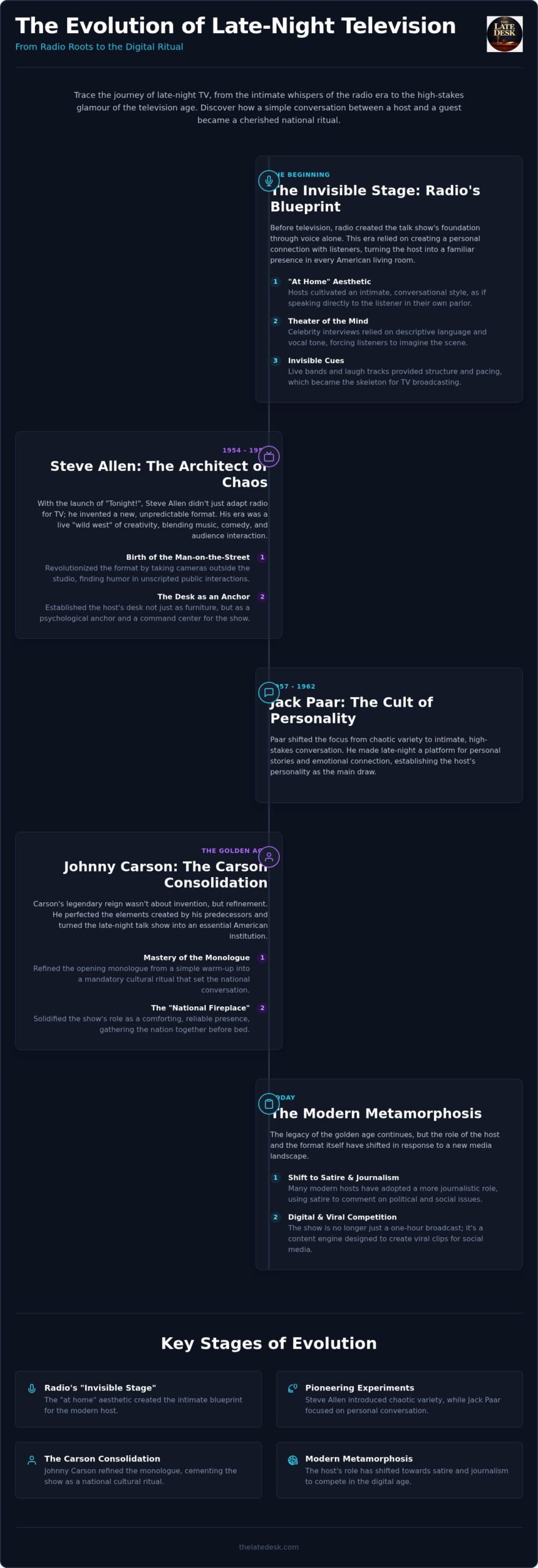
Before the glowing screens of the 1950s, the talk show existed as a spectral presence in the American living room. It was a genre defined not by visual spectacle, but by the magnetic pull of a single voice. This “Invisible Stage” relied on spontaneous conversation and the art of the host’s personality to bridge the distance between the studio and the home. The “At Home” aesthetic was a calculated intimacy; radio hosts spoke as if they were seated in the listener’s own parlor, a technique that stripped away the formality of the theater stage. They utilized invisible cues, such as the rhythmic punctuation of a live band or the communal warmth of a laugh track, which eventually became the structural skeleton of television broadcasting. These elements provided a sense of place and timing, signaling to the audience when to lean in and when to exhale.
The Radio Variety Hour: Intimacy Without Images
Long before the cameras rolled, radio legends like Jack Benny were perfecting the comedic timing that would later define the evolution of the late night monologue. Benny understood that silence was as powerful as a punchline, often letting a long pause do the heavy lifting for a joke. This mastery of pacing became a foundational element in the genre, proving that the host’s reaction was just as vital as the setup itself. Through the “Theater of the Mind,” early celebrity interviews relied on the listener’s imagination to paint the scene, creating a bond that felt more personal than any modern broadcast. These programs often featured sponsor-integrated dialogue, where the host would pivot seamlessly from a joke to a pitch for cigarettes or soap. This created a conversational flow that made the commercial feel like part of the entertainment, a tactic that persists in the live reads of modern broadcasting.
Transitioning the Voice to the Screen
Moving from the microphone to a multi-camera setup presented a daunting technical hurdle for early pioneers. Performers who had spent decades focusing solely on their vocal delivery suddenly had to learn to “speak with their eyes,” projecting charm through a glass lens rather than a steel grill. It was during this transition that the “National Fireplace” concept was truly born. The radio’s ability to gather a family around a central hub was magnified by the visual presence of the host, turning a solitary listening experience into a shared national ritual. For a deeper look at this era, you can explore our history of late night television. The shift from audio to visual media forced a refinement of the evolution of the late night monologue, as hosts realized that a raised eyebrow or a subtle smirk could land a joke better than a loud, theatrical delivery. By the time the first television desks were installed, the blueprint for late night was already written in the airwaves.
Steve Allen and the Invention of Late Night Chaos (1954-1957)
On September 27, 1954, the American night underwent a fundamental transformation. Steve Allen sat down at a piano in New York’s Hudson Theatre and launched “Tonight!”, turning what began as a local experimental broadcast into a national ritual. The early days of late-night television were characterized by a “wild west” energy, a live environment where the technical limitations of the era met the unbridled creativity of the performers. Allen was the perfect captain for this storm. He didn’t just deliver jokes; he conducted an orchestra of chaos, moving from musical interludes to spontaneous audience interactions with the grace of a seasoned jazz musician. This era was the true crucible for the evolution of the late night monologue, as the formal, scripted addresses of the radio era began to dissolve into something more fluid, visual, and unpredictable.
The Birth of the Man-on-the-Street
Allen’s most enduring contribution to the talk show architecture was his decision to treat the streets of Manhattan as a secondary stage. By sending cameras outside the theater doors, he moved the camera’s gaze from the celebrity to the “everyman,” democratizing humor in a way that radio never could. This shift from scripted skits to the comedy of the unexpected interaction was revolutionary. It proved that the funniest moments didn’t come from a writer’s room, but from the raw, unpolished reactions of the public. This structural innovation paved the way for modern staples like Jay Leno’s “Jaywalking” or Jimmy Kimmel’s “Lie Witness News,” establishing a direct line between Allen’s 1950s experiments and the viral segments of the digital age.
The Desk: A Psychological Anchor
Perhaps the most subtle yet profound change Allen introduced was the physical shift from a standing podium to a seated desk. This wasn’t merely a matter of comfort. The desk functioned as a psychological anchor, positioning the host as the “Managing Editor” of the night’s entertainment. In a live broadcast where cameras might fail or guests might freeze, the desk provided a sense of permanence and authority. It transformed the host from a mere master of ceremonies into a figure of trust who navigated the audience through the late-night hours. To understand how this piece of furniture became a symbol of broadcast power, you can read our detailed guide on The Architecture of Authority. If you are a researcher looking for more context on these early broadcast dynamics, our collection of historical television articles provides a definitive archive of the era’s transformation.
Jack Paar and the Cult of Personality (1957-1962)
If Steve Allen was the architect of late-night chaos, Jack Paar was its first true philosopher. When he took the reins of “The Tonight Show” in 1957, he inherited a format built on variety and piano-driven whimsy. However, Paar saw a different potential in the late-night hours. He realized that after the news ended and the house lights dimmed, the American public didn’t just want to be entertained; they wanted to be understood. This realization fueled a significant shift in the evolution of the late night monologue, transforming it from a series of observational quips into a deeply personal address that often felt like a letter read aloud to a friend. He traded the slapstick for a cigarette and a sense of intellectual curiosity, inviting the audience into a world that felt both sophisticated and dangerously real.
Paar’s tenure created the first “Water Cooler Effect” in television history. His unpredictability made the program mandatory viewing, as skipping a single night meant missing a potential cultural earthquake. He didn’t just report on the world; he reacted to it with a raw, often uncomfortable honesty that forced the audience to pay attention. This high-stakes environment turned the talk show into a platform for debate, making the host’s personal opinions as important as the guests he interviewed. It was a period where the “invisible stage” of radio finally found its most human, and most volatile, visual form.
From Variety to Conversation
Paar famously stripped away the heavy reliance on musical acts and slapstick sketches to make room for extended storytelling. He introduced the concept of the “regular” guest, individuals like Elsa Maxwell or Oscar Levant who weren’t necessarily there to promote a project, but were simply fascinating conversationalists. Under his watch, the couch became a site of vulnerability. It was no longer just a place for a guest to sit between songs; it was a stage for revelation, where the host and guest could engage in the “art of the chat” for twenty minutes at a time, establishing the conversational depth we still expect from the genre today.
The Risk of Raw Emotion on Air
Paar’s persona was mercurial and intellectual, a sharp contrast to the polished, detached hosts who would follow him. His unfiltered nature and willingness to share his personal grievances predicted the intimacy of modern live-streamed content and podcasting. This emotional volatility reached a breaking point during his famous 1960 walk-off, an event triggered by network censorship of a joke. This moment remains a definitive case study in late night tv power dynamics, proving that the host’s personality had become more powerful than the network’s own rules. Paar showed that while the audience loved the jokes, they were truly captivated by the man behind them.
The Carson Consolidation: Refining the Late Night Monologue
When Johnny Carson stepped behind the curtain in 1962, he didn’t just inherit a show; he inherited a volatile medium that required a steady, professional hand. While Jack Paar had thrived on emotional unpredictability, Carson brought a Midwestern coolness that stabilized the format. He took the “chaos” of the Allen years and the “conversation” of the Paar era, then distilled them into a rigid, professional blueprint. This period marked a definitive chapter in the evolution of the late night monologue, as Carson standardized the structure that remains the industry law today. The nightly ritual was born: a topical monologue, a desk segment, two guest interviews, and a musical act to close the night. It was a clockwork operation that turned the late-night hours into a dependable sanctuary for millions of viewers.
This standardization wasn’t merely about logistics. It was about creating a sense of permanence in a rapidly changing cultural landscape. By cooling the room down, Carson made the talk show accessible to a broader audience, transforming it from a niche intellectual debate into a “National Fireplace.” He understood that the host’s role was to be a reliable guide through the day’s events, a task he performed with a golf swing and a wink that signaled everything was under control. For a comprehensive look at this thirty year reign, you can explore our feature on the Tonight Show with Johnny Carson.
The Monologue as a Cultural Barometer
Carson’s opening remarks became the ultimate cultural barometer for 1970s and 80s America. The craft of his monologue relied on a precise “set-up” and “swing” at the day’s headlines, a technique that signaled the national mood. If a politician became the target of a Carson joke, it was often a sign that they had lost the room; conversely, his silence could be just as telling. To fully appreciate how the monologue functioned as a political and social weapon during this era, our deep dive into 1970s late night tv culture reveals how Watergate and the move to Burbank transformed Carson’s nightly address into a vital cultural instrument. Perhaps his most brilliant innovation was the “save” joke. When a punchline bombed, Carson would offer a self-deprecating look at the camera or a playful jab at the band. This transparency built an ironclad rapport with the audience, turning a moment of failure into a shared victory of human connection.
The Sidekick, the Band, and the Guest Couch
The “National Fireplace” feel was reinforced by a carefully curated ensemble. Ed McMahon wasn’t just a sidekick; he was a human laugh track and a safety net who provided the necessary warmth to balance Carson’s sharper edges. Alongside Doc Severinsen and the NBC Orchestra, this team created a familiar nightly atmosphere that felt like a family gathering. Carson used this platform to act as the ultimate industry gatekeeper. An invitation to the couch after a set was the definitive career-maker for young comedians, a power dynamic that shaped the comedy world for decades. If you are a media scholar looking to understand these professional hierarchies, our historical television articles provide the definitive context for how these legacies were built.
Beyond the Golden Age: The Talk Show’s Modern Metamorphosis
The retirement of Johnny Carson in 1992 marked the end of the “National Fireplace” era, but it also signaled the start of a far more aggressive chapter in broadcasting history. The 1990s “Late Night Wars” transformed the genre into a landscape of ruthless corporate competition, where the host’s chair became a prize fought over in boardrooms and through tabloid headlines. This period fundamentally altered the evolution of the late night monologue, as the focus shifted from broad, unifying humor to the sharp, distinct voices of David Letterman and Jay Leno. While the structure remained familiar, the stakes had changed. The talk show was no longer just a nightly ritual; it was a high-stakes business where loyalty was secondary to the overnight Nielsen numbers.
The Rise of Satire and Viral Segments
By the early 2000s, a new transformation took hold as the monologue moved away from traditional quips and toward a form of comedic journalism. Figures like Jon Stewart and Stephen Colbert reimagined the opening segment as a “deep dive,” using satire to dismantle the day’s political narratives with surgical precision. This shift from “The Desk” to “The Screen” allowed hosts to incorporate digital media directly into their performances, turning the monologue into an interactive evidence board. These changes reflected the broader cultural impact of late night tv, where the host became a primary source of news for a younger generation. Today, the digital disruption has further fragmented the ritual. The hour-long nightly broadcast has been dismantled into three-minute viral YouTube clips, designed for social media feeds rather than living room sofas. Yet, despite the death of traditional broadcast dominance, the core appeal of the host as a nightly companion remains unshakeable.
Preserving the Narrative at The Late Desk
Studying these shifts is essential for anyone seeking to understand the modern media landscape. The talk show host has transitioned from a master of ceremonies to a modern-day storyteller who helps the public process a chaotic world. At The Late Desk, we believe that the history of these moments provides the necessary context for today’s digital metamorphosis. For those looking to dig deeper into the archives, our guide on online television archives for researchers offers a path to rediscovering the monologues that defined previous generations. The stage may be invisible, and the fireplace may now be a smartphone screen, but the human need for the “story behind the story” is as potent as it was in the days of radio.
Preserving the Legacy of the National Fireplace
While the technology of the broadcast booth has changed, the psychological architecture of the late-night hour remains remarkably consistent. The evolution of the late night monologue shows us that the host is more than a comedian; they’re a nightly companion who helps us navigate the cultural shifts of the era. From the intimate whispers of radio to the biting satire of the digital age, the talk show has survived by balancing the comfort of ritual with the thrill of the unexpected. It’s a legacy built on the invisible cues of the band, the authority of the desk, and the shared laughter of a nation.
For those who wish to go deeper into these broadcast archives, we offer a definitive look at the moments that shaped the medium. Named a top resource for media historians, our collection features over 500 archived articles on classic TV and specialized guides for Tonight Show scholars. We invite you to explore our full archives of late-night history at The Late Desk. The curtains may have closed on the golden age; however, the history of the invisible stage is waiting to be rediscovered by a new generation of fans and researchers.
Frequently Asked Questions
What was the first talk show in television history?
The Joe Franklin Show, which debuted on a local New York station in 1950, is widely recognized as the first true television talk show. While Steve Allen’s “Tonight!” brought the format to a national stage in 1954, Franklin established the foundational host-guest dynamic. He focused on the art of the interview long before it became a network staple, proving that conversation alone could sustain a broadcast.
How did the late-night monologue start?
The monologue began as a visual adaptation of the radio variety hour’s opening remarks. Early hosts used this time to greet the audience and set a casual tone for the evening. The evolution of the late night monologue saw these simple greetings transform into a structured, topical address that allowed the host to interpret the day’s headlines through a lens of sophisticated humor and personal observation.
Why do talk show hosts always sit at a desk?
The desk serves as a psychological anchor and a symbol of broadcast authority. Borrowed from the world of news anchoring, this piece of furniture positions the host as the “Managing Editor” of the night’s entertainment. It provides a sense of permanence in a live studio environment and offers the host a place to manage notes, props, and the rhythm of the guest interviews.
Who is considered the most influential talk show host of all time?
Johnny Carson is almost universally regarded as the most influential figure in the history of the genre. His thirty year tenure at NBC didn’t just define the ratings; it established the professional standard for every host who followed. Carson’s ability to act as a national cultural gatekeeper turned the talk show into a mandatory nightly ritual for millions of American households.
What is the difference between a variety show and a talk show?
A variety show focuses on a broad spectrum of independent acts, such as sketches, acrobats, and musical numbers, often without a central narrative. In contrast, a talk show is built entirely around the personality of the host and the intimacy of conversation. While talk shows often include variety elements, the primary draw is the spontaneous interaction between the host and their guests on the couch.
How has social media changed the evolution of the talk show?
Social media has fragmented the traditional hour-long broadcast into bite-sized, viral segments designed for digital consumption. This shift has significantly impacted the evolution of the late night monologue, as opening segments are now often written to stand alone as shareable YouTube clips. Hosts must now balance the needs of their linear broadcast audience with the demands of a global, digital-first viewership.
Why was Johnny Carson so important to the talk show format?
Carson was essential because he stabilized a medium that was previously defined by emotional volatility and technical chaos. By cooling the room and standardizing the show’s structure, he created a dependable professional blueprint. He turned the “Tonight Show” into the ultimate industry gatekeeper, where a single invitation to the couch could launch a comedian’s career into the stratosphere overnight.
What are the essential elements of a late-night talk show blueprint?
The modern talk show blueprint consists of four mandatory pillars: the topical opening monologue, a desk-based comedy segment, two guest interviews, and a closing musical or comedic performance. This specific sequence was perfected during the golden age of television and remains the industry standard. It creates a predictable rhythm that allows the audience to relax into the program as a familiar nightly ritual.