In the spring of 1974, a rumor rippled through the halls of NBC that the most powerful woman in Hollywood was about to do the unthinkable. On the night of March 22, the iconic curtain didn’t part for Johnny Carson, but for the studio mogul who had already conquered the sitcom world. While many fans today struggle with fragmented clips and conflicting reports about her actual duties, the legacy of a Lucille Ball Tonight Show guest host appearance remains a high-stakes moment in television history. It was a night where the traditional power structures of late-night TV were briefly, and brilliantly, upended.
You likely recognize her as the lovable redhead who couldn’t stay out of trouble, but behind the scenes, she was a calculating executive with enough industry weight to command any room she entered. In this article, you’ll discover the historical significance of her rare stint and gain insights into the complex professional rivalry she shared with Carson himself. We’ll explore how her performance paved a difficult road for the female hosts who followed, revealing the story behind the story that the archives have nearly forgotten.
Key Takeaways
- Explore the rigid gender hierarchy of the 1970s and how stepping behind the desk served as the ultimate test of industry power.
- Step inside the March 1974 broadcast to see how a Lucille Ball Tonight Show guest host stint challenged the traditional late-night format with theatrical flair.
- Compare the contrasting styles of Carson and Ball, examining how her high-energy approach shifted the power dynamics of the studio.
- Trace the direct line from Ball’s hosting success to the rise of later female icons like Joan Rivers.
- Understand how these appearances allowed the public to see the formidable executive behind the beloved “Lucy” character.
The Late-Night Glass Ceiling and Lucille Ball’s 1974 Takeover
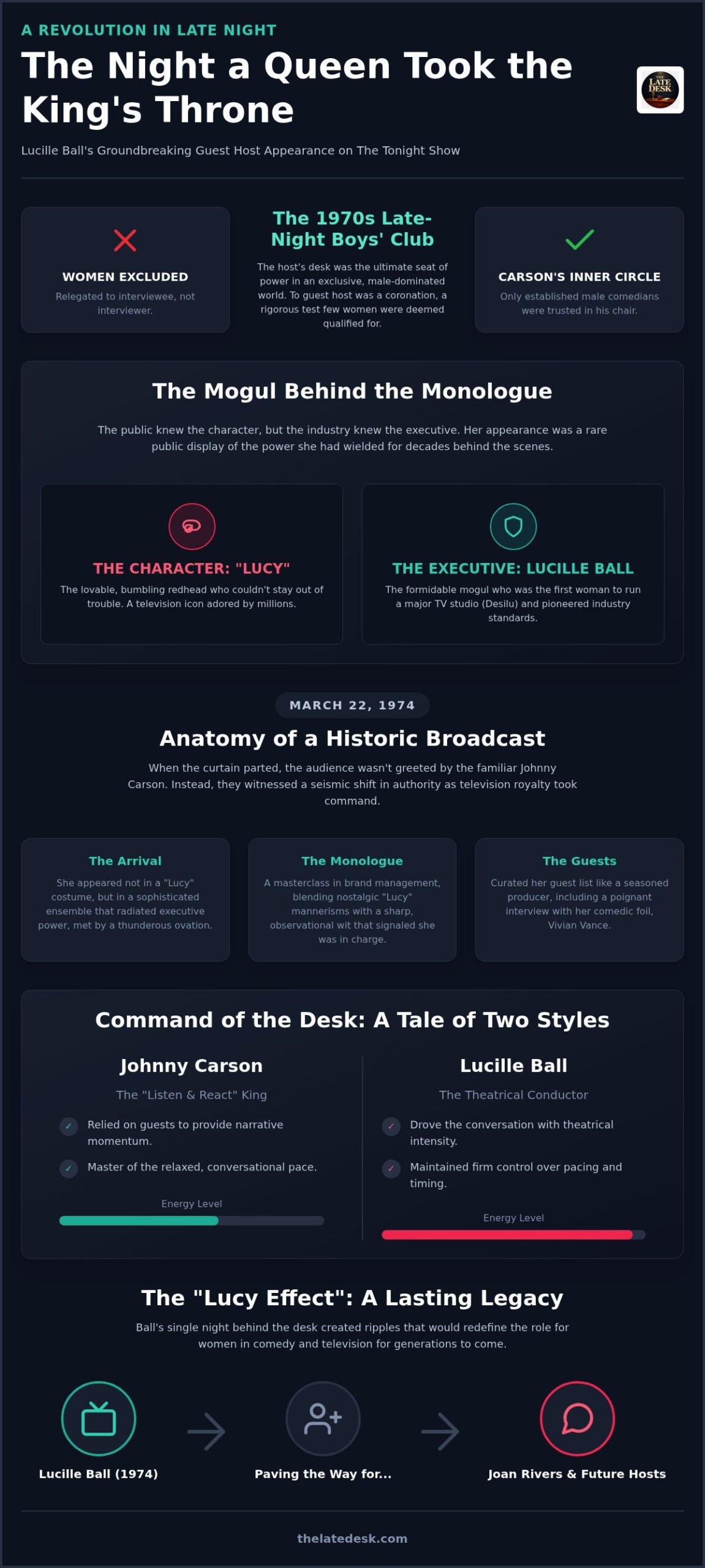
In the early 1970s, the landscape of late-night television functioned as an exclusive, smoke-filled gentlemen’s club. Johnny Carson sat at the center of this universe, his desk serving as the ultimate altar of show business relevance. To be a guest was a career milestone, but to be a guest host was a coronation. This role served as the industry’s most rigorous litmus test, requiring a specific brand of professional gravitas that few women were deemed to possess. While the era is often remembered for Carson’s absolute reign, the broadcast on March 22, 1974, stands as a cultural milestone that challenged the medium’s inherent gender bias. It was a night where the traditional power structures were briefly, and brilliantly, upended.
The Boys’ Club: Late Night Before Joan Rivers
During the mid-70s, the guest host roster was a predictable rotation of established comedians and variety stars. Johnny Carson maintained a strict, almost reverent control over who was allowed to occupy his chair. He sought hosts who possessed a “desk-side manner” that blended sharp wit with the ability to manage the intricate timing of a live-to-tape broadcast. Women were almost entirely excluded from this circle of trust, often relegated to the role of the charming interviewee rather than the one steering the conversation. Lucille Ball was the rare exception who commanded enough respect to bypass these unwritten rules. She didn’t approach the desk as a starlet looking for approval. Instead, she approached it as a peer who had spent decades building the very industry Carson now dominated. Her presence on that March evening created a shift in energy that the Burbank studios hadn’t seen before, proving that the host’s chair didn’t have to be a male-only sanctuary.
Lucille Ball: The Mogul Behind the Monologue
The public often struggled to separate the dizzying antics of “Lucy” from the woman who built a production empire. By the time of her 1974 appearance, she had already cemented a lucille ball television legacy as the first woman to run a major television studio. As the former head of Desilu Productions, she pioneered the three-camera filming technique and the very concept of the television rerun. This business acumen was palpable throughout the Lucille Ball Tonight Show guest host conversation. She understood the mechanics of the medium from the ground up, from camera angles to lighting cues, allowing her to command the stage with a level of authority that was both rare and revolutionary. When she stepped behind that iconic desk, she wasn’t just performing; she was exercising the power she had long wielded behind the scenes. This transition from studio mogul to late-night commander was not a stretch of her abilities, but a public display of her status as the true Queen of Television.
Behind the Curtain: Anatomy of the March 1974 Broadcast
The air in Studio 1G changed the moment the stage manager signaled the start of the March 22, 1974, recording. While the audience expected the familiar comfort of the Tonight Show, they were met with a seismic shift in authority. When the announcer boomed the introduction for the evening’s Lucille Ball Tonight Show guest host appearance, the roar of the crowd wasn’t the standard polite greeting; it was a thunderous acknowledgement of television royalty. Ball stepped out not in the bumbling costume of Lucy Ricardo, but in a sophisticated ensemble that screamed executive power. Her opening monologue was a masterclass in brand management. She leaned into the familiar “Lucy” mannerisms just enough to satisfy the nostalgia of the room, yet she quickly pivoted to a sharp, observational wit that signaled she was the one in charge of the clock.
The Lineup: Guests and Interactions
Ball curated her guest list with the precision of a seasoned producer, ensuring the evening felt like an event rather than just another broadcast. The most poignant moment occurred during her interview with her longtime comedic foil, Vivian Vance. Unlike Johnny Carson’s signature “listen and react” style, which often relied on the guest to provide the narrative momentum, Ball drove the conversation with a rhythmic, almost theatrical intensity. She didn’t just ask questions; she set the stage for her guests to shine while maintaining a firm grip on the segment’s pacing. This pro-active hosting style was rare for the era, showcasing her ability to improvise within a rigid live-to-tape structure. Among the unforgettable talk show guest moments in broadcasting history, her interview with Vance stands as a prime example of how two industry veterans could transform a standard segment into a genuine piece of television art. For more deep dives into these rare moments of broadcasting excellence, you can explore our collection of historical television articles.
The McMahon Factor: Chemistry with the Sidekick
Ed McMahon, the quintessential late-night companion, had to recalibrate his entire professional persona to accommodate a host of Ball’s stature. Typically used to being the boisterous second-fiddle to Carson’s dry, midwestern charm, McMahon became a supportive anchor for Ball’s more high-energy flourishes. The visual contrast was striking. Seeing the red-headed titan of industry flanked by the standard Tonight Show ensemble highlighted just how much she broke the mold of the typical 1970s host. This dynamic remains a fascinating chapter in late night tv sidekick history, proving that the role of the “second banana” was as much about ego management as it was about comedy. McMahon’s deference to Ball throughout the night underscored her status not just as a guest, but as the reigning Queen of the medium.
Lucille Ball vs. Johnny Carson: Comparing Command of the Desk
Johnny Carson’s Tonight Show was built on a foundation of cool, detached professionalism. He was the master of the unspoken reaction, using a raised eyebrow or a silent stare to let the audience in on the joke. When the Lucille Ball Tonight Show guest host experiment took place, this understated energy was replaced by a theatrical whirlwind. Ball brought a high-octane, almost operatic presence to the desk that stood in stark contrast to Carson’s midwestern reserve. This wasn’t merely a change in personality; it was a fundamental power shift. For one night, the desk wasn’t a neutral ground for banter. It was a throne for a woman who had spent her life commanding every frame of film she occupied.
The ratings for her appearance reflected this novelty. While Carson held the loyalty of the late-night “insomniac” crowd, Ball’s presence drew in the massive, multi-generational demographic that typically tuned in for scripted sitcoms. This surge in viewership highlighted the unique gravity she possessed. There was a palpable mutual respect between the two titans, yet a subtle friction existed. Carson was protective of his domain, while Ball was incapable of being anything less than the person in charge. Their relationship was a complex dance of professional admiration and the natural tension that arises when two suns occupy the same system. The deeper bonds and rivalries that shaped this era are explored in detail in our look at the famous talk show host friendships that shaped TV history, revealing how private alliances often defined the public landscape of late night.
The Monologue: Precision vs. Performance
Carson’s monologues were a nightly exercise in topical precision, relying on a rapid-fire delivery of punchlines about current events. Ball took a different path. She turned her monologue into an anecdotal performance, weaving long-form stories that utilized her legendary physical comedy roots. Even while seated, her gestures were expansive and deliberate. She mastered a hook-and-reveal style of storytelling, establishing a mundane premise before pivoting to a chaotic, hilarious conclusion. It was a performance that felt less like a stand-up set and more like a curated one-woman show, proving that her comedic instincts were as sharp in a live talk-show format as they were on a soundstage.
The Interview Style: Control vs. Chaos
The most striking difference lay in how Ball handled her guests. Carson often used silence as a tool, allowing a guest to fill the void or stumble into a laugh. Ball, drawing on her “boss” energy from her days at Desilu, kept her interviews on a much tighter leash. She steered the conversation with a firm hand, ensuring that the comedic beats landed exactly where she wanted them. In the long history of tonight show hosts, few possessed her level of technical control. She famously subverted the “Carson-ism” of the polite, detached listener. Instead, she became an active participant in every guest’s story, often physically leaning into their space to emphasize a point. She didn’t just host the show; she directed it from the chair.
The “Lucy” Effect: Redefining the Guest Host Role
The success of the March 1974 broadcast created a quiet panic within the executive offices of NBC. While the ratings were undeniable, the sheer command Lucille Ball displayed behind the desk introduced a complicating factor into the late night tv power dynamics of the era. Traditionally, a guest host was meant to keep the seat warm, not set the studio on fire. When a Lucille Ball Tonight Show guest host appearance went as smoothly as this one, it sent a clear message to the network that the “Carson formula” wasn’t the only way to win the night. This realization was both a blessing for the business and a subtle threat to the established hierarchy.
Johnny Carson was notoriously protective of his territory. Seeing a peer like Ball navigate the desk with such ease suggested a world where the show could thrive without its primary anchor. This tension is a recurring theme in the history of the program, where the brilliance of a temporary replacement often led to behind-the-scenes friction. For Ball, the goal wasn’t to take the job, but the fact that she *could* have taken it was a point of intense discussion among NBC brass. They found themselves in a paradox, celebrating a ratings win while worrying if the guest was outshining the host.
A Blueprint for Joan Rivers?
It’s impossible to ignore the parallels between Ball’s 1974 stint and the eventual residency of Joan Rivers. Before Rivers became the permanent guest host, Ball had already demonstrated that a female lead could satisfy both the audience’s appetite for comedy and the advertisers’ need for stability. She made the prospect of a woman in the chair a safe bet for the network, even if the industry remained stubbornly slow to change. This path was fraught with difficulty, as seen in the various late night television guest scandals that would later define the era. Ball’s authority provided a shield for those who came after her, proving that the desk was a place for power, regardless of gender.
Legacy of the “Event” Host
In the decades since, we have seen the rise of the “Event Host,” a star whose personal mythology is so vast that they don’t just host the show, they transform it. Lucille Ball was the progenitor of this archetype. Most guest hosts are careerists looking for a break, but Ball was a legend granting the show her presence. She brought a specific gravitas that few others could match, turning a standard Tuesday night into a piece of television history. Her performance established what many insiders call the “Ball Standard” for guest hosting.
The Ball Standard is the rare ability to command a legendary desk with such total authority that the permanent host’s absence feels like a deliberate choice rather than a scheduling necessity. To explore more about these transformative moments in broadcasting, read our historical television articles.
Lucille Ball’s Television Legacy and the Path to Modern Late Night
The 1974 broadcast was more than a mere ratings stunt; it was a bridge between the frantic energy of the sitcom era and the sophisticated authority of Ball’s later years. While the world knew her as the rubber-faced housewife of the 1950s, her time in the host’s chair humanized the woman behind the wig. It allowed the public to see the sharp, calculating mind that had successfully navigated the treacherous waters of studio ownership. By stepping into the Tonight Show arena, she transitioned from a beloved character into an industry elder stateswoman. This evolution proved that her relevance wasn’t tied to a specific character, but to her intrinsic understanding of the medium itself. For those seeking to understand how these moments shaped the landscape we see today, exploring the history of late night television reveals the deep roots of modern broadcasting.
Beyond the Red Hair: The Intellectual Legacy
The Lucille Ball Tonight Show guest host appearance served as a definitive proof of her intellectual depth. In an era where female performers were often expected to remain within the confines of a script, Ball’s quick wit and command of the room were revolutionary. She acted as a guardian of the “Golden Age” standards, maintaining a level of decorum and professional polish that was already beginning to fade in the mid-70s. Her ability to pivot from a self-deprecating joke to a serious industry insight showcased a versatility that few of her contemporaries could match. This performance remains a vital case study for media historians, and her contributions are well-documented in various online television archives for researchers who wish to study the mechanics of 20th-century stardom.
Conclusion: The Night the Desk Belonged to Lucy
The evening of March 22, 1974, remains a singular moment in the annals of broadcasting. It was the night the “Boys’ Club” of Burbank was forced to acknowledge that the most capable host in the building wasn’t on the payroll; she was the guest. Lucille Ball didn’t just fill a seat; she redefined what it meant to hold the attention of a nation from behind a mahogany desk. Her legacy in late-night isn’t just about the laughs she generated, but about the ceiling she cracked with a single, confident monologue. She remains the ultimate guest host because she understood that the chair wasn’t a place to hide, but a platform to rule.
The history of late-night television is filled with these hidden gems and forgotten triumphs. Sign up for our newsletter to uncover more lost late-night history and the stories that define the golden age of the small screen.
Preserving the Legacy of Late-Night Royalty
Lucille Ball’s 1974 broadcast remains a masterclass in professional authority, proving that her influence extended far beyond the sitcom stage. By examining her command of the desk, we see how she successfully navigated the rigid power structures of the era, paving a difficult road for future icons like Joan Rivers. Her stint as a Lucille Ball Tonight Show guest host wasn’t just a ratings win; it was a seismic shift that demonstrated how an “event host” could transform a medium. We’ve explored the anatomy of that night, from her meticulous guest selection to the palpable friction that often arises when two industry titans share a single stage. It’s these hidden layers that define the true history of the small screen.
At The Late Desk, we specialize in providing in-depth historical analysis of 1970s media and exclusive insights into Johnny Carson’s inner circle to ensure these pivotal moments are never forgotten. Our mission is to document the “story behind the story” for those who cherish the craft of broadcasting. Explore the Full Archive of Late Night Legends at The Late Desk. Join us as we continue to peel back the curtain on the stories that defined the golden age of television.
Frequently Asked Questions
Did Lucille Ball ever guest host The Tonight Show Starring Johnny Carson?
Lucille Ball did indeed step behind the iconic desk, most notably during the broadcast on March 22, 1974. While she was a frequent guest throughout the Carson era, this specific night saw her take full command of the program. It was a rare moment in the 1970s where a woman of her industry stature was given the keys to the kingdom. Her appearance as a Lucille Ball Tonight Show guest host remains a significant milestone in the history of late-night television.
When was the exact date Lucille Ball hosted The Tonight Show?
The historical broadcast took place on March 22, 1974. This evening is often cited by historians as a seismic shift in the show’s traditional gender dynamics. While guest hosts were common during Carson’s frequent vacations, the selection of a studio mogul like Ball was an intentional move that signaled a high level of professional respect from the network. It wasn’t just a guest spot; it was a takeover by the reigning Queen of Comedy.
Who were the guests on the night Lucille Ball guest hosted?
The primary guest for this legendary evening was her longtime comedic partner and close friend, Vivian Vance. Their interaction on the Tonight Show stage offered a sophisticated twist on their classic “Lucy and Ethel” chemistry, though the conversation was grounded in their real-world friendship. Ball also interviewed other contemporaries, using her sharp executive instincts to keep the pacing of the interviews tight and theatrical. This lineup transformed the typical talk show format into a curated event.
How many times did Lucille Ball appear on The Tonight Show?
Lucille Ball appeared as a guest on the program dozens of times throughout the 1960s, 70s, and 80s. She was one of Johnny Carson’s most reliable and beloved visitors, often appearing to promote new projects or celebrate industry milestones. However, her stint in the host’s chair was a far more exclusive occurrence. While her guest appearances provided many laughs, her single night as host provided a rare look at her capabilities as a broadcaster.
Why did Johnny Carson choose Lucille Ball as a guest host?
Johnny Carson viewed Lucille Ball as a true peer and a fellow titan of the television industry. He was notoriously selective about who he allowed to sit in his chair, requiring a host who possessed both comedic timing and the ability to manage a live-to-tape production. Ball’s history as the head of Desilu Productions made her an ideal candidate. She understood the mechanics of the medium better than almost anyone else in Hollywood at the time. Much like the famous talk show host friendships that quietly governed who received these coveted opportunities, Carson’s trust in Ball was built on years of mutual professional respect forged well away from the cameras.
Was Lucille Ball’s guest hosting performance well-received by critics?
Critics widely praised her performance for its high energy and professional polish. Many reviewers noted that she brought a “theatrical flair” to the desk that was a refreshing departure from the standard late-night formula. Audiences responded with equal enthusiasm, as the ratings for the March 1974 broadcast were exceptionally strong. Her success proved that the late-night audience was more than ready for a female lead, provided she had the gravitas to command the room.
How did Lucille Ball’s hosting style differ from Johnny Carson’s?
Ball’s style was proactive and theatrical, whereas Carson was known for his “listen and react” approach. While Johnny would often lean back and let the guest drive the comedy, Lucy leaned in and directed the conversation with the authority of a seasoned producer. She utilized her physical comedy roots to punctuate jokes, making the entire broadcast feel like a scripted performance. This active hosting style ensured there was never a dull moment in the ninety-minute slot.
Are there any recordings available of Lucille Ball hosting The Tonight Show?
Full recordings of the 1974 broadcast are considered rare treasures within television archives. While the complete episode isn’t always available on standard streaming platforms, fragmented clips of her monologue and her interview with Vivian Vance frequently surface in retrospectives. These recordings are essential viewing for anyone studying the Lucille Ball Tonight Show guest host legacy. They capture a moment when the most powerful woman in Hollywood briefly claimed the most influential desk in late night.